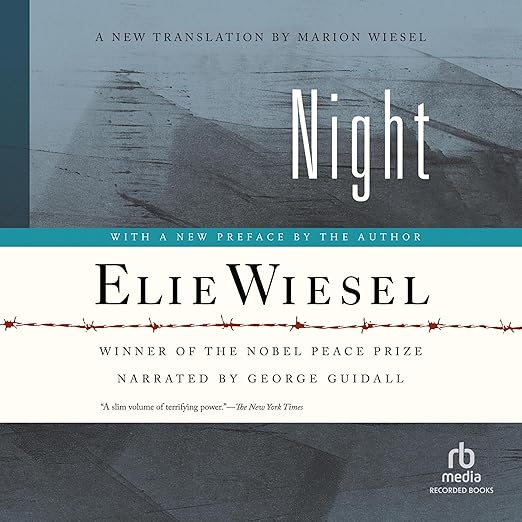
Eliezer is fourteen when the cattle cars leave Sighet, and the townspeople packed into them still refuse to believe the rumors. That refusal drives the opening hour, and it is why Night remains harder to sit through than almost anything else in the literature of witness: you know what waits at the end of the line, and they do not. The audiobook runs four hours and seventeen minutes, short enough for a single afternoon and heavy enough that the afternoon stays with you. George Guidall is the credited reader on this Recorded Books edition from January 2006.
Plain Sentences Carry the Worst Details
What makes the book endure is its refusal to reach for effect. Wiesel writes an account rather than an argument, and the most terrible passages arrive in the plainest sentences available, which is precisely why they land. The description tracks the sequence honestly: rumors dismissed, a town loaded into cars, a reception center, a march toward the crematory, and only then the truth sinking in. Auschwitz and Buchenwald are recounted by someone who was inside them, and the questions the memoir closes on are asked rather than answered. How could a person commit these horrors, and could such evil come again.
The book's own history is nearly as instructive, and the most substantial response on this record supplies it. That five-star from October 2015 reports that the memoir might never have existed had Wiesel not approached the novelist Francois Mauriac, notes that its power was not recognized immediately, and quotes the New York Times on the 2006 edition as a slim volume of terrifying power. A classic that almost went unwritten and then waited years for its readership is a useful thing to know before you start, because it explains the restraint. Nothing in this book was written to be admired.
Guidall Gets Out of the Way
The edition question actually matters here, and this listing answers it. Night exists in more than one English translation, and the text described on this record came from Marion Wiesel, translated out of the original French, presented as the definitive edition. This recording is dated January 2006, the same period as that translation, so a buyer is not getting an older rendering repackaged. For a book this widely assigned, knowing which text you are hearing is not a collector's detail, since the phrasing of individual passages differs between versions and those passages are the ones people quote.
Hearing testimony read aloud also returns it to something like its original form. Survivor accounts began as speech, given to commissions, families, classrooms and courts long before they were typeset, and a listener receives this the way its first audiences did, in sequence, unable to skip ahead. Four hours and seventeen minutes is a short runtime by any measure, and the compression is part of why the book works. Nothing is repeated, nothing is explained twice, and no scene stays longer than it must.
What the recording demands is discipline rather than range. Material at this pitch collapses the moment a reader performs it, because any audible effort to intensify what is already unbearable reads as decoration. The job is to get out of the way, to keep the pace level through the passages a listener will want to flinch from, and to let the sentences carry their own weight. George Guidall carries the full four hours alone, and the standard the text sets is a hard one to meet.
Listening Removes the Reader's Protective Distance
Consider the listening experience itself before you press play. A reader can skim, look away, close a book and come back in a week. A listener moves at the reader's pace through everything, including the passages about the crematory and the transports, and audio removes the small protective distance that eyes on a page provide. A four-star dated 5 December 2025 says simply that it produced sobbing on multiple occasions, and that response comes from someone who read it. Choose your circumstances deliberately, and do not put this on as background to anything.
Written responses here describe the book rather than this production. The October 2015 entry cites a printed edition by publisher and city; the five-star from 1 December 2025 explains that the purchase was a physical copy, bought to keep in a collection after a first encounter in high school. All five responses are engaging with a text they read, which makes the 4.7 across twenty-three ratings a verdict on one of the twentieth century's essential memoirs and not on this recording of it.
Three listing details are worth flagging. The series field places this as book one of the Night Trilogy, and the description never mentions a trilogy or names the volumes that follow, so a buyer has no idea what comes next or whether it is needed. The genre tag reads Military, which is a poor fit for a memoir about a civilian deportation and the destruction of a community. And one entry in this column carries a mid-sentence fragment where its title should be, a scraping glitch rather than anything the reviewer intended.
Wait for the Right State of Mind
Everyone should read or hear this once, which is a sentence I would write about almost no other book. It belongs on any history list, in any classroom old enough for it, and in the hands of readers who have only ever encountered the Holocaust as a number. The five-star from May 2025 makes a point worth repeating for anyone deciding whether they need another camp memoir: this one covers what came before and what came after, not only what happened inside, and it is the arc of dehumanization rather than the atrocity that stays with you.
Timing and state of mind are the real considerations. Listeners in fragile periods, and younger listeners without an adult available to talk afterward, should wait rather than skip, because nothing is gained by hearing this while unable to absorb it. Read the room you are in. Four hours and seventeen minutes is a small obligation to carry against what it asks you to remember, and the brevity is the reason so many people who intend to get to this book eventually do.