
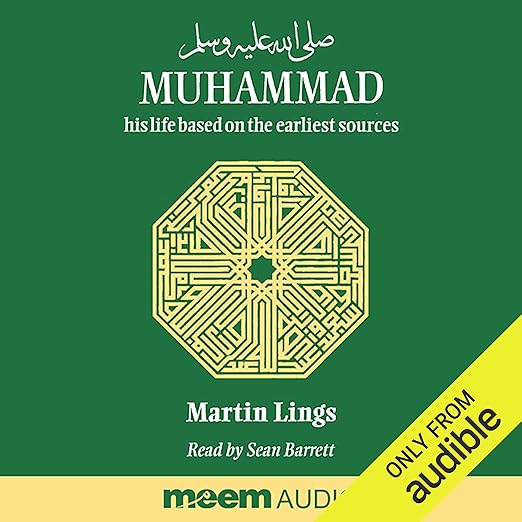
Muhammad by Martin Lings holds a specific and well-earned place in the English-language Islamic biographical tradition. This audiobook brings together an author whose scholarly investment in his subject was lifelong, a narrator of considerable experience, and a text that has remained in continuous circulation for over four decades because it has not been surpassed. Sean Barrett reads what is widely recognized as the best biography of the Prophet in English, selected by Muslim Welfare House London and the Muslim Council of Britain as a worthy introduction to the life of Prophet Muhammad, and the audio version represents, by the synopsis's own account, the first of its kind in this format.
What We Made of It
What Lings accomplished in this biography is a rendering of the Prophet's life that draws from primary Arabic sources, including the earliest Islamic historians and biographical traditions, while remaining genuinely readable for an English-speaking audience with no prior scholarly background. Martin Lings was a scholar who converted to Islam and spent decades studying Sufi tradition, and he brought both intellectual rigor and genuine spiritual investment to the project in ways that are evident on every page. The biography covers Muhammad's early life in Mecca, the years of revelation, the formation of the early Muslim community, the Hijra and the migration to Medina, and the later campaigns and diplomatic efforts that shaped the first Islamic state. Reviewer a_guy_01, identifying as a history enthusiast drawn to influential historical figures, specifically cited how vividly the biography captures the society and culture of seventh-century Arabia. That sociological dimension is one of the book's genuine and sustained strengths: Lings is not simply narrating a sequence of events but reconstructing a world, and the texture of that world comes through in prose that treats its subject with both precision and care.
Reviewer Razeen Ahmad noted chapters that arrived as surprises, content not anticipated going in that proved thrilling to encounter. That response reflects how much ground the biography covers beyond the most familiar episodes in the Prophet's life. The biography's comprehensiveness is one of its primary virtues, and the audio format gives it a different quality of access than the print edition: you cannot skim Lings in audio, which is ultimately to the reader's advantage.
Why Listen to Muhammad
Sean Barrett is one of the most experienced British narrators in the audiobook industry, and his voice brings to this material what the text demands. Lings's prose is formal and elevated in register, drawing on the tradition of classical Arabic biography while operating in English, and Barrett's delivery respects that register without making it feel either stiff or inaccessible. The six-hour-and-three-minute runtime is notable for a biography of this historical and spiritual significance. The relatively compact length makes the audiobook accessible in a way the print edition's density sometimes prevents for busy readers, while the audio format encourages the kind of sustained attention that Lings's writing rewards. For listeners who encountered this biography in print and returned to it multiple times, the audio version opens the text to a different kind of engagement: the cadence and balance of Lings's sentences, and Barrett's interpretive choices within them, produce an experience that complements rather than simply replicates the reading experience.
What Might Not Land
One reviewer, Nazia Mobeen, rated the book at the highest level while noting that the audiobook appears to be missing chapters present in the print version, and that some stories from the text do not appear in the audio adaptation. This is a practical consideration worth noting for listeners who know the book from print and are transitioning to audio format: the adaptation may not be chapter-for-chapter complete, and listeners who have specific sections they wish to revisit should verify whether those passages are included before assuming full equivalence. For listeners coming to Lings's biography for the first time via audio, the experience is substantively intact. The biography's core argument, that Muhammad was a figure who combined prophetic authority with political leadership, personal warmth, and a capacity for suffering and loss that only deepened his humanity, comes through with clarity even if the audio version omits some material from the original text.
The biography's particular accomplishment is that it treats the Prophet's life as a subject worthy of the same rigorous biographical attention that English-language scholarship applies to major political and historical figures, without reducing the spiritual dimensions of that life to their social or political effects. Lings was a scholar who believed deeply in what he was writing about, and that commitment shaped both the research and the prose in ways that distinguish this biography from more detached academic treatments. Whether or not a reader shares that belief, the care it produced in the writing is evident throughout.
The Right Listener for Muhammad
Listeners who want a serious, scholarly, and sympathetically rendered account of the Prophet's life in English will find Lings's biography the appropriate starting point, and Sean Barrett's narration makes the audio version a legitimate alternative to the print edition rather than a lesser substitute. Muslim listeners familiar with the text will find the audio a different and complementary way to engage with a work many consider a foundational reference. Non-Muslim listeners approaching the biography with genuine curiosity about Islamic history and the life of one of the most consequential figures in world religious history will find Lings a fair and serious guide throughout. The six-hour runtime makes this a more accessible commitment than the print edition's density sometimes allows.







