
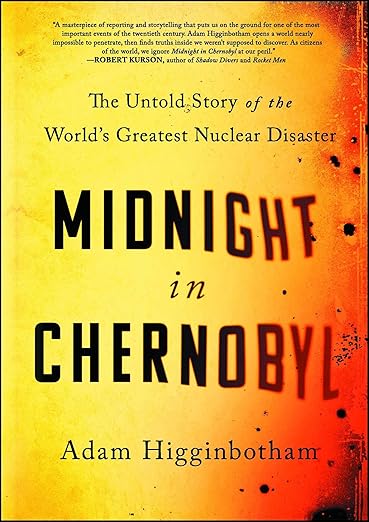
Reactor Number Four exploded early on April 26, 1986, and this audiobook spends nearly fourteen hours on how that came to happen and on how long the truth took to follow. Adam Higginbotham's account is built from hundreds of hours of interviews gathered across more than ten years, plus letters, unpublished memoirs, and documents from archives that were only recently declassified. The description promises a narrative that runs through the people who were there rather than through the physics, and the physics is still in it. Both things are true at once, which is the achievement. Fourteen hours is not a small ask, and the book earns them by refusing to simplify either half.
Propaganda and Myth Outlast the Explosion Itself
Secrecy is the actual subject. The description is explicit that the disaster has spent decades lodged in the collective imagination as shorthand, for radiation sickness, for technology slipping its leash, for ecological fragility, and for what a dishonest state does to the people it governs, while the real sequence of events stayed in dispute the whole time. Propaganda, secrecy, and myth are named as the obstacles the book had to work through. That framing is what separates this from a straightforward disaster narrative: the explosion is chapter one of the problem, and the cover-up is the rest of it. That structure also explains why so much of the book takes place in rooms full of officials rather than in the reactor hall.
Design flaws are what a five-star from April 2, 2019 remembers most clearly, filed from the United Kingdom seven weeks after release and written by somebody whose own career was redirected by the accident more than three decades earlier. That response singles out three things: the flaws built into the reactor, the smaller accidents that preceded this one, and the bureaucratic pressure applied to the people operating it. It also reports that the book added substantially to an existing technical understanding, which is a meaningful compliment from a reader who arrived already knowing the outline. Someone with that background is the hardest audience a popular account can face, which makes the endorsement worth more than its length suggests.
Jacques Roy Is Almost the Only Audio Clue
Physics for the general reader is the compliment a June 18, 2025 five-star pays, describing the ability to make a detailed and complicated analysis of nuclear engineering comprehensible to somebody without the training. That response finished this and immediately read the same author's book about the Challenger disaster, which is the highest practical endorsement a work of narrative nonfiction can collect. Explaining reactor design without either patronizing the listener or losing them entirely is the hardest thing this book attempts, and it is the reason the running time is what it is. Anyone who has bounced off nuclear history before should treat that as the argument for trying this one.
Only two fields on this record describe an audio product at all: the narrator credit naming Jacques Roy, and a running time of thirteen hours and fifty-five minutes, formatted differently from every other duration around it. Everything else belongs to a hardcover. That makes the credit unusually load-bearing, because it is the sole evidence on the page that a recording exists, and because a book this dense with unfamiliar surnames, plant terminology, and institutional acronyms lives or dies on a reader who can carry them without stumbling. The record indicates no abridgement, no full cast, and no supplementary audio, so what is on offer is one reader working straight through.
Hardcover Data Gets Welded Onto This Credit
Five hundred and sixty pages is one of the fields on this listing, sitting beside a thirteen-digit ISBN, an ISBN-10 in the identifier slot where an audio product number belongs, and a publisher name that reads as a marketplace seller rather than as a publishing house. Several of those values are preceded by invisible formatting characters, the kind that get copied when a block of text is lifted wholesale from somewhere else. The conclusion is unavoidable: a print hardcover's data has been welded onto an audio credit, and nobody checked. None of it is dishonest exactly. It is a page that cannot tell a buyer which object it is selling.
Everything was fine, says one of the five texts posted here, dated January 1, 2025. No issues, says another, filed July 12, 2019. Neither says anything further. That leaves three responses of any substance out of five, on a record whose badge reads 4.9 across fifty-seven ratings. That badge is also extraordinarily tight: it requires the whole group's total to sit between 277 and 282, against fifty-seven perfect scores adding to 285, so between three and eight stars have gone missing across the whole group. Near-unanimity is real here, and almost none of it was written down. A pool agreeing this completely is worth noticing on a book this long and this technical, since long nonfiction normally collects at least a few complaints about pace.
More Than a Companion to the HBO Series
Hand it to anybody who came to this story through television and wants the documented version underneath it. A July 11, 2019 five-star describes it as a great companion to the HBO series and as hard to put down, which is the right relationship between the two: one dramatizes, the other establishes. Readers of technical history get the reactor design and the institutional failure in the same volume, and readers who prefer people get the operators, the firefighters, and the officials who had to decide what to say and when. It also serves as a first serious book about the Soviet system for anyone who has met it only through fiction.
Anyone who wants a short introduction should start somewhere else, because fourteen hours is a serious commitment and the early chapters build the Soviet nuclear program before they get anywhere near the control room. The material is grim in specific, physical ways, and the record posts no warning of its own. Listeners expecting thriller pacing should know that the reporting is patient by design and takes its time with committee meetings as well as with catastrophe. Beyond a narrator credit and a running time, everything else on this listing belongs to a hardcover.
- Read by: The credit and the runtime are the only two fields on this page that describe a recording rather than a hardcover.
- At its heart: Nuclear disaster, state secrecy and propaganda, engineering failure, institutional cowardice and individual courage
- Vibe: Controlled, forensic and steadily horrifying
- Short version: The definitive popular account of the disaster, on a record whose metadata belongs to a different edition entirely.
Good to Know
How much technical knowledge does this audiobook assume?
None going in. The description promises a narrative built around the men and women who witnessed the accident, and the reactor physics arrives through them rather than through diagrams. The density of institutional names and plant terminology rewards attention rather than background listening, but no prior physics is assumed anywhere in the copy.
Is fourteen hours of audiobook justified for a single night's events?
The night occupies a fraction of it. Thirteen hours and fifty-five minutes covers the design of the reactor, the accidents that preceded it, the institutional pressures on the operators, the response, and thirty years of contested history afterward. Anyone wanting only the explosion itself will find a great deal of context around it.







