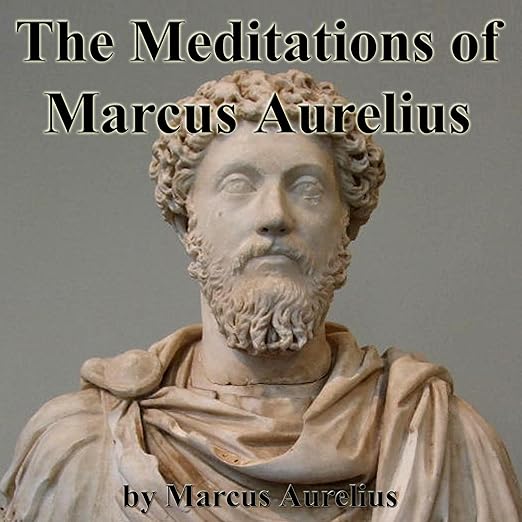
Campaign quarters between 170 and 180 C.E. produced the notes collected here, and the audiobook that carries them runs five hours, with Walter Covell credited as the reader for Jimcin Recordings. The description gives you the emperor generously: ruler from 161 C.E. until his death in 180, born into a family tied by blood and marriage to rulers and bankers, last of the Five Good Emperors, and, in the phrase the copy borrows, history's first ombudsman. What it never gives you is the name of whoever turned the original into the English being read aloud here, and on this particular title that omission is not a detail. It is the whole question.
Jimcin Recordings dates this release to November 14, 2007, and the running time is compact for a work that circulates in many competing English versions. The copy calls these writings confessions, and the word earns its place. Marcus wrote in numbered books, setting down reminders for himself between military obligations, with no audience in mind and no position to defend. Nothing is being argued at anyone. A man is talking himself down from irritation, from grief, from the wish to be admired, and then doing it again a few pages later because the wish came back. The satisfaction of the book and the frustration of it come from the same source.
Translation decisions are the reason two people can finish this work having read very different books, and the five write-ups on the page keep circling that fact from different angles. The most enjoyable of them comes from marcus chatman, writing in March 2016, who arrived at the emperor sideways: the name surfaced while researching a different historical author, and a shared first name did the rest. The write-up opens with a flat declaration of hatred and then turns it inside out, hating the book for how thoroughly it ends up being loved. As a description of the experience that is accurate. Aurelius is not consoling and is not trying to be liked, and the pull of the thing is that he is not performing at all.
Ombudsman Fits Better Than Emperor Does
Duty, virtue, and humility are the three nouns the description reaches for, and they hold up, though they undersell how practical the writing is. What the copy files as confessions works more like maintenance notes for a temperament: a man with absolute power setting down, for nobody's eyes, the arguments he expects to need again tomorrow. Very little of it presumes any grounding in Stoic doctrine, which is why it survives out of context so well. The description helps by presenting the work as a record of what one office holder thought his job required of him, rather than as a school of thought with a syllabus attached.
Ombudsman is the odd word the copy picks for him, and it guides the tone better than emperor does. Wyenotgo, writing in August 2025, is the most useful of them on where the value actually sits: rich material, Books I through VII above all, a single theme worked over from every side, and reasoning cogent enough that some transgressions get forgiven along the way. The same write-up is candid about the cost, naming a rambling repetitiveness in the later chapters and an idea of beauty it judges grossly inadequate. Praise with two named complaints attached is the most useful shape a write-up can take, and it tells a buyer more than the star count above it.
Reviewers Praise Translations They Never Name
Aphorisms travel badly between languages, which is the practical problem this listing hands you. JRDallas, writing in February 2019, states the case about as plainly as it can be stated: the versions are not equivalent, and beginning with the wrong one can cost you the book permanently. Three have been tried so far in that case, starting with a cheap download whose translator was not clearly identified, issued by Prabhat. The objection is aimed at editions being stacked together under a single product entry, and it lands squarely here, because nothing on this page tells you whose English you are about to hear for the length of the file.
Mill turns up in the copy as well, which reports that he set the Meditations beside the Sermon on the Mount in his Utility of Religion, and the same paragraph passes along praise for the work's exquisite accent and its infinite tenderness. Both compliments describe the text in the abstract rather than any particular rendering of it, and a listing that pools renderings cannot make either compliment mean much. christina Kyosti, writing in April 2015, calls this one of the best translations of the book and a good introduction to the Stoics, and even that generous grade never names the translation it is grading.
Covell's Reading Is Only a First Pass
Emperors make unreliable self-help authors, and anyone arriving for a system of rules will find surprisingly few. The rewards here are cumulative rather than quotable: after an hour the repetitions stop feeling like repetitions and start feeling like a person under pressure, which is a different and better experience than reading the famous lines on their own. Listeners who like history in a first-person register, and who are comfortable with a text that has no plot, no scenes, and nobody to talk to, are the right audience.
Stoicism as a school is not taught in these pages, which the German-language write-up filed in August 2025 gets exactly right when it classes the work as personal notes rather than a systematic philosophy. Anyone wanting the movement explained, with dates and successors and a bibliography, should buy a guide instead and come back to the primary source afterward. Anyone wanting the primary source will find the commitment modest and the reward large. If the specific translation matters to you, and on this book it eventually will, treat this file as a first pass and choose your permanent copy with the translator's name in front of you.
The Short Version
- Narrator: A single credited voice carrying a text with no plot, no scenes, and nobody for the reader to play against.
- Subjects: Duty, self-correction, mortality, power exercised under restraint.
- Tone: Plain, private, repetitive by design.
- Bottom line: A short, honest way into the emperor's own reminders, so long as you accept that the page hides which English you are getting.