
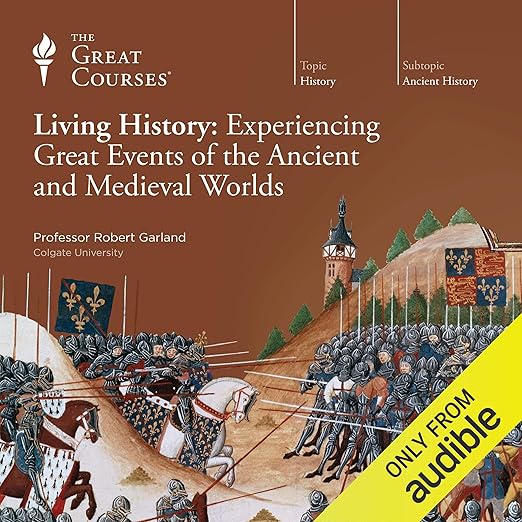
Quick Take
- Narrator: Robert Garland self-narrates, bringing a professor's authority and genuine enthusiasm to the material, though the lecture-hall cadence may not suit all listeners equally.
- Subjects: Ancient and medieval history through individual lives, primary sources as windows into turning points, the heartbeat of history beneath famous events
- Tone: Academic but accessible, immersive in its best moments and survey-like in others
- Bottom line: A genuinely interesting lecture series that succeeds when Garland zooms in on specific individuals but occasionally loses momentum when the survey instinct takes over from the storytelling one.
Living History: Experiencing Great Events of the Ancient and Medieval Worlds is an audiobook that poses a genuinely interesting methodological question: can you make ancient history feel intimate by entering it at the level of individual experience rather than sweeping political arc? Robert Garland, a professor with a career built on making the classical world vivid and accessible, bets his twenty-four lectures on exactly this premise. He calls it experiencing the heartbeat of history, and that phrase is not mere marketing. It is a precise description of what he attempts, and often enough, achieves.
The course spans thousands of years and three continents, from ancient Egypt, Greece, and Rome through medieval Europe and Asia. Each of Garland's twenty-four lectures focuses on a specific turning point: the assassination of Philip II of Macedonia in 336 B.C.E. under circumstances that remain genuinely murky, the Byzantine Empress Theodora persuading Justinian not to abandon Constantinople to an angry mob in 532 C.E., and Pope Urban II's crusade speech in France in 1095 C.E. that inspired thousands of his subjects to march toward Jerusalem. The structure is smart because it resists the urge to narrate large sweeping arcs and instead drops the listener into a specific room, on a specific day, among specific people who do not yet know that what they are doing will matter to historians two thousand years later. The contrast with conventional survey history is both real and intentional.
Rather than merely reviewing the facts of events such as the Battle of Marathon, the arrest and trial of Jesus, and the coronation of Charlemagne, Garland engages with firsthand accounts and authentic primary and secondary sources. From reports by historians such as Herodotus and Livy to official scrolls and administrative records, these eyewitness sources take listeners back through the eyes of people who were actually present. That methodological commitment is the course's strongest selling point.
What Makes Living History Worth Hearing
Garland self-narrates, which is a meaningful choice for a course of this kind. His academic authority is present throughout, and so is the conversational energy of someone who has spent decades teaching these stories to rooms full of students encountering them for the first time. The listener review from a reader named Solstice captures what works best: a sense of experiencing events first-person, of encountering details that even historically literate listeners did not know, including the possibility that Philip II of Macedonia was killed by a personal guard who may also have been his jilted lover. That kind of texture, pulled from firsthand accounts and ancient historians, is where the course earns its premise most fully. Herodotus on the Battle of Marathon filtered through Garland's contextualizing narration lands differently than the same events in a standard textbook treatment. The twelve-hour-and-thirty-nine-minute runtime gives Garland enough space to do this thoroughly across the full geographic and chronological range the course covers.
Things to Know Before Starting Living History
The course has a divided reception that reflects a genuine tension in its methodology. Reviewer Gilbert M. Stack noted that the result is mostly a collection of short biographies of important people from ancient and medieval times, and that while the biographies are interesting, the connective analytical thread is sometimes thin. That is a fair criticism. The course works best as a series of vivid close-up portraits and somewhat less well as a unified argument about how individual moments shape history. Another reviewer flagged a specific factual error in lecture twenty-two regarding the baptism location of Prince Vladimir the Great, placing the event at the wrong site. These limitations are real. Listeners who come expecting a coherent historiographical thesis may find themselves wanting more connective tissue between the twenty-four scenes. Those who come for each individual portrait, taken on its own terms, will find the material consistently engaging across the runtime.
It is worth noting that the course also functions effectively as a supplement to more conventional history audiobooks rather than as a replacement for them. Listeners who have worked through sweeping chronological treatments of ancient Rome or medieval Europe will find Garland's close-up lecture format a valuable corrective to the tendency of survey history to dissolve individuals into forces. The two approaches work together more productively than either works alone, and Garland's format is specifically designed to fill the experiential gap that conventional narrative history leaves open.
The mixed ratings on this audiobook, ranging from one star for the Vladimir factual error to five stars for the sense of first-person historical immersion, reflect how differently listeners weight accuracy versus atmosphere in a lecture format. Garland's course is clearly more interested in making history feel lived than in serving as a reference text, and that priority is evident in how each lecture is constructed. Listeners who share that interest will find the course rewarding across its full runtime. Those who want the lecture to also function as a reliable fact source should supplement it with additional reading.
Who Robert Garland Is Writing For
History enthusiasts who already have a solid grounding in the ancient and medieval periods will get the most from this audiobook. The individual lecture format rewards listeners who can place each event in its broader context without needing Garland to provide it explicitly. Listeners seeking an introductory survey may find the close-up approach disorienting without that pre-existing framework. Anyone who has enjoyed Garland's other Great Courses work on ancient Greece and Rome will recognize his teaching style here and find it fully consistent with their prior experience. Skip it if you need scholarly apparatus, precise citation chains, or a unified historiographical argument. Return to it if you want to spend twelve hours with a professor who loves this material and has the specific anecdotes to prove it.
Good to Know
Is this audiobook structured as a lecture series or as a continuous historical narrative?
The format is twenty-four discrete lectures, each centered on a specific historical event or turning point. They are thematically linked by Garland's emphasis on individual experience and primary sources but do not form a continuous narrative. Each lecture stands independently, which suits selective or repeat listening across the twelve-plus-hour runtime.
Does the Living History audiobook cover events beyond ancient Greece and Rome?
Yes. While ancient Greece and Rome feature prominently, the course spans from ancient Egypt through the medieval period, including Byzantine history, the Crusades, and events in medieval Europe and Asia. The geographic and chronological range is genuinely broad, which is one of the course's primary ambitions.
Does Robert Garland's self-narration work well for this kind of history audiobook?
For listeners who respond to the lecture format, Garland's self-narration is an asset. His enthusiasm for the material comes through clearly and his academic cadence gives the content appropriate weight. Listeners who prefer professional voice actors may find the delivery more classroom than studio, which is worth knowing before committing to twelve-plus hours of listening.







