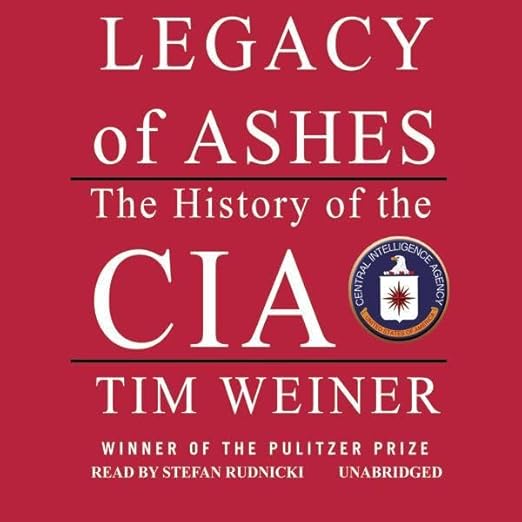
Legacy of Ashes arrived in 2007 already carrying serious institutional weight: a National Book Award winner in nonfiction, written by a Pulitzer Prize-winning New York Times reporter who built the whole account from more than fifty thousand declassified documents. That pedigree matters going into this audiobook, because the claims inside it are large. The synopsis calls this the book the CIA does not want you to read, and says Tim Weiner relied on primary sources only: no anonymous tips, no blind quotations. Blackstone Audio released the twenty-one-hour-and-thirty-seven-minute edition the same year the book itself came out. The synopsis is blunt about its own thesis, stating plainly that the CIA has never deserved the confidence the American public has placed in it, and framing sixty years of institutional secrecy as the reason that argument has taken this long to reach general readers.
First, the Big Picture
The book's argument, as the synopsis lays it out, is that the CIA spent sixty years managing its own myth while burying its failures in classified archives, and that Weiner's job here is to unbury them using the agency's own paper trail rather than outside speculation. Stefan Rudnicki narrates the full twenty-one hours and thirty-seven minutes. This one is filed under both history and political and social science, which fits a text that reads as much like an argument about institutional behavior as a chronological account. One reviewer, going deep on the book's scope, refers to the agency throughout with the shorthand USCIA and calls the writing on the 1950s section, including the incompetence and inadequate briefings under Allen Dulles heading into the Eisenhower administration, particularly fascinating despite how damning it is. The page currently lists only two star ratings behind its 4.5 average, and simple math on two whole-star votes only reaches that average if the two scores add up to nine out of a possible ten, meaning one of the two listeners gave four stars rather than five. That is a strange gap to sit next to five separate written reviews, since a rating count of two would normally suggest far less engagement than five detailed responses imply. One reviewer calls the book encyclopedic, citing over one hundred fifty pages of reference material backing five hundred plus pages of narrative text.
Why Listen to Legacy of Ashes
Several of the five reviews single out the same thing: Weiner's willingness to name names and cite sources rather than hide behind institutional euphemism. One reviewer, a longtime New York Times reporter covering the same intelligence beat, calls the book both illuminating and frustrating, and credits Weiner with drawing on direct interviews alongside the archival material, though that reviewer also flags that Weiner is uniquely positioned to have gotten this kind of access in the first place. That same reviewer, posting under the name Ted Grimsrud, notes that Weiner lays his materials out openly rather than shaping them to fit a predetermined narrative, which is precisely the kind of restraint a book making claims this serious needs to earn trust. Another reviewer, writing from the United Kingdom, describes the level of detail as deepened by personal reflection and operational experience, and says the book pushed them toward Weiner's follow-up, The Mission, next. A third reviewer frames the book as essential reading for anyone interested in 20th century politics after WWII, calling it a must read outright. Taken together, the five reviews describe a book that rewards readers who want the paper trail laid out plainly rather than a breezy narrative gloss on decades of intelligence failures.
A Few Reservations
One reviewer, describing the book as a fair and well-written assessment of CIA history, also points out a specific gap: the account covers the agency's history broadly but does not address waterboarding directly, and that reviewer hopes for a reissue that updates the record. That is worth flagging for anyone expecting a comprehensive accounting through the more recent war-on-terror era specifically, since the book's original 2007 publication predates a full reckoning with that period. The density that reviewers praise also means this is not a light listen: one review describes over one hundred fifty pages of references behind five hundred plus pages of main text, and at twenty-one hours and thirty-seven minutes, the audiobook asks for real time investment. A shorter review from Australia calls it simply a great read that arrived in perfect condition, phrasing that reads more like feedback on a physical shipment than a response to the narration itself, and it is a useful reminder that not every rating on this page reflects a considered response to what Rudnicki actually reads aloud. The rating picture is also worth a second look before you weigh it heavily: only two ratings sit behind the 4.5 average shown on the page, well below the five written reviews actually visible, so treat the star average as a smaller sample than it might first appear.
Should You Listen to Legacy of Ashes?
Readers who want an intelligence history built from documents rather than anecdotes are the clear audience, willing to sit with sixty years of institutional failure laid out in sequence rather than a single dramatic episode. Readers of Weiner's later work, or anyone planning to continue on to The Mission afterward, will find this a natural starting point given how directly one reviewer connects the two. It also rewards listeners specifically interested in the Eisenhower-era CIA and the Dulles years, which multiple reviews single out as some of the most damning material in the book. Skip it if you specifically want the agency's post-2001 record, including its use of torture, since at least one reviewer notes that ground is not well covered here. Five hundred dense pages of sourcing across twenty-one hours reward patience more than casual listening, so budget accordingly before starting.
A Few Questions About Legacy of Ashes
How is the Legacy of Ashes audiobook different from a typical CIA history?
The synopsis says the account draws on more than fifty thousand documents, mostly from the CIA's own archives, with no anonymous sources or blind quotations. Reviewers back that up, describing the book as heavily referenced and citing named sources throughout rather than relying on the kind of unnamed intelligence contacts that usually fill this genre.
Is the Legacy of Ashes audiobook worth it if I plan to read Tim Weiner's follow-up, The Mission?
Based on one reviewer's experience, yes. That reviewer specifically says the depth of detail here pushed them toward reading The Mission next. Legacy of Ashes covers the CIA's institutional history broadly, so listeners planning to continue with Weiner's later book get useful grounding before moving on to it.