
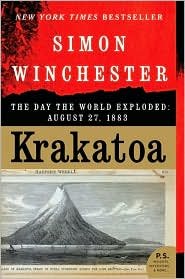
Volcanoes demand patience from their historians. The 1883 eruption of Krakatoa lasted hours; its consequences reshaped the world for years. Simon Winchester understands this scale intuitively, and his decision to narrate his own audiobook version of Krakatoa turns out to be exactly right for a story that requires both scientific authority and human connection to land properly. I came to this one after a conversation about the history of global telecommunications, of all things, and found myself absorbing the full twelve hours over a long weekend, genuinely unable to skip ahead even through the geological preamble Winchester devotes to explaining how the Sunda Strait came to exist.
Winchester is, by background and temperament, a storyteller who treats science as narrative. His framing of Krakatoa isn't just about the eruption itself but about everything converging to make that particular moment catastrophic: the tectonic setting, the colonial context, the nascent global telegraph network that allowed news of the disaster to circle the earth in hours for the first time in human history. That contextual reach is what separates the book from a simple disaster account, and Winchester's narration makes the connective tissue between disciplines feel natural rather than forced.
What We Made of It
Winchester narrating his own work is a choice that pays dividends with this material. His voice carries the cadence of someone who has read widely and traveled to the places he describes, which is exactly the case. He spent time in the region researching the book, and that physical familiarity surfaces in the way he describes the Sunda Strait's geography, the Indonesian political environment, and the behavior of the local population in the months before and after the eruption. You hear a man describing somewhere he actually knows, not a writer working from secondary sources alone.
The self-narration has one cost: Winchester is not a trained audio performer, and the reading is occasionally more steady than dynamic. Emotional peaks don't always register in his voice the way they might from a professional narrator. But for nonfiction this dense with scientific and historical content, steadiness is actually an asset. You're not listening for drama; you're listening for comprehension. Winchester's clear, measured delivery gives the listener space to absorb the geology, the meteorology, and the political history without getting lost.
Why Listen to Krakatoa
The scope of what Winchester covers in twelve hours is legitimately impressive. He begins with the geological formation of the Sunda Strait region, explaining the tectonic plate dynamics that make the area perpetually volcanic. He then moves through the colonial history of the Dutch East Indies, the social conditions of the region's population, and the specific circumstances that made the 1883 eruption so catastrophic rather than merely significant. The blast itself, when it comes, has been prepared for so thoroughly that the listener understands exactly why it destroyed what it destroyed and killed the people it killed.
Equally important is what Winchester does after the eruption. The tsunamis that followed the main event killed far more people than the explosion itself, and his account of the coastal communities on Java and Sumatra who were simply erased is harrowing in its precision. He then follows the aftermath: the dust cloud that circled the planet and produced vivid sunsets for over a year, the barometric pressure wave recorded at weather stations around the world, and the political and social consequences for the Dutch colonial administration. One reviewer noted this is 'a thorough account of one of the greatest disasters in history based on written accounts by survivors and ship crews,' and that sourcing is evident throughout.
What Might Not Land
Winchester is an essayist at heart, and the audiobook reflects that. He follows digressions that interest him even when they slow the main narrative. The extended section on the development of plate tectonics as a scientific theory is intellectually fascinating but will test listeners who came primarily for the disaster story. Similarly, his treatment of the Islamic political movements that emerged in the region following the eruption, which he argues were partly inflamed by the psychological impact of the disaster on the local population, is a provocative thesis that he supports more through assertion than through deep evidentiary argument. It's worth noting as a claim that historians have debated.
The incompleteness of some of Winchester's own underlying historical sources is also worth flagging directly. Winchester is working with 1883-era records, ship's logs, telegraph dispatches, and survivor accounts that are necessarily partial and sometimes contradictory. He is scrupulous about acknowledging uncertainty where it exists, which is good scholarship but occasionally makes the narrative feel provisional in ways that can frustrate listeners expecting clear answers about casualty counts and precise sequences of events.
None of this diminishes the book's achievement. Winchester produced a work that takes a geological event and makes it comprehensible as a human catastrophe with global consequences, and the audiobook format suits the material because you can absorb the scientific passages at whatever pace you need by rewinding, which several listeners report doing.
Should You Listen to Krakatoa?
This audiobook suits listeners with an appetite for narrative nonfiction that doesn't shy away from science. If you've appreciated Winchester's other work, particularly The Professor and the Madman or The Map That Changed the World, you'll find the same methodical depth and discursive range here. History readers interested in the 19th-century colonial Pacific, the geology of volcanic systems, or the early history of global communications will get particular value. Skip it if you want a straight disaster narrative with the science minimal and the human drama primary; that's not what Winchester is building here.
At a Glance
- Narrator: Simon Winchester narrates his own work with steady authority and geographic familiarity; not a performance narrator, but exactly right for dense scientific-historical material.
- Subjects: Geological catastrophe and human consequence, colonialism and disaster, the birth of global information networks
- Tone: Measured and expansive, with genuine weight when the eruption finally arrives
- Bottom line: A rigorous, wide-ranging audiobook that treats a volcanic disaster as the lens through which to read an entire era of human history.
Is this audiobook too technical for a general history listener?
Winchester pitches the science at an educated general audience rather than specialists. The geology and meteorology sections are thorough but explained in plain language. Some patience is required for the plate tectonics passages, but they're accessible rather than forbidding.
Does Simon Winchester's self-narration work for the audiobook?
It works well for this material. His steady, authoritative delivery suits the scientific and historical content, and his familiarity with the region he describes comes through clearly. He's not a trained audio performer, so don't expect dramatic vocal range, but the clarity and intelligence of the reading are real assets.
How does this audiobook compare to Winchester's other titles?
Krakatoa shares the same wide-lens approach as his other narrative nonfiction, using a single event to illuminate larger historical and scientific forces. Listeners who enjoyed The Professor and the Madman or The Map That Changed the World will recognize the structure and appreciate the depth.
Does the audiobook cover the aftermath as well as the eruption itself?
Extensively. Winchester spends significant time on the tsunamis that followed, the atmospheric effects recorded around the world for over a year, and the political and religious consequences in the Dutch colonial territories. The eruption is the centerpiece, but the aftermath gets equal serious treatment.






