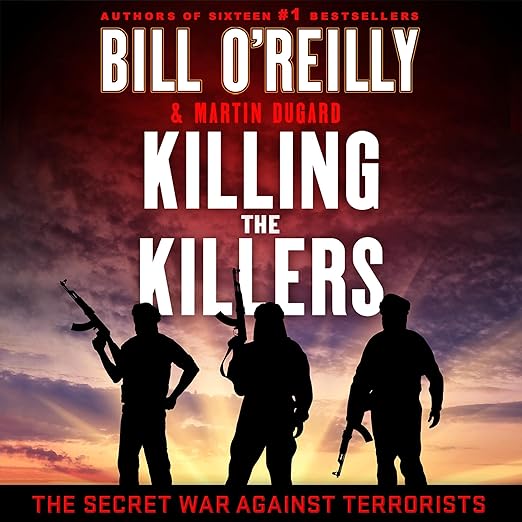
The opening line of Killing the Killers, as one listener quoted it: 'The man with thirty minutes to live slept.' That sentence lands differently in audio than on a page. Robert Petkoff delivers it with the flat calm of a documentary voice-over, and then the clock starts. I was three minutes into this audiobook when I realized the craft operating here isn't just in the research or the pacing of the narrative. It's in the compression. Bill O'Reilly and Martin Dugard have spent more than a decade refining a formula for popular history that uses the present tense, the ticking clock, and the close third person to turn archival material into something that plays like a thriller. The eleventh installment in the Killing series demonstrates that the formula still works.
This is a book about the global war on terror, spanning from the September 11 attacks through operations in Afghanistan, Iraq, Yemen, Syria, Libya, and beyond. O'Reilly and Dugard cover the hunt for Osama bin Laden, the rise and territorial peak of ISIS, the targeting of Abu Bakr al-Baghdadi, and the ongoing campaign against the Iranian Revolutionary Guard's most dangerous figures. The scope is ambitious, and the book does not pretend to be neutral.
A Closer Look at Killing the Killers
What makes this installment distinctive within the series is its attention to operational detail. Where earlier Killing books reconstructed events from decades or centuries past, this one operates closer to living memory, drawing on sources and accounts that are still politically contested. O'Reilly and Dugard navigate that proximity with varying success. The book is at its strongest when it reconstructs specific targeting operations with the precision and scene-setting energy the series does well: the compound in Abbottabad, the desert compound in Barisha where al-Baghdadi died, the Baghdad airport strike that killed Qasem Soleimani. Those sequences are vivid and tautly assembled.
The ideological framework is visible throughout. The authors are not attempting to write a balanced policy analysis; they're writing advocacy history with strong convictions about American purpose in the war on terror. Readers who approach the text with that understanding in mind will find it a coherent and energetic account. Readers expecting geopolitical nuance will find the narrative occasionally oversimplified in ways that serve pace over complexity.
Robert Petkoff is the right choice for this material. He has narrated several books in the Killing series and brings a steadiness to the voice that keeps the more theatrical moments from tipping into melodrama. His delivery of the operational sequences, where the text shifts into near-present tense to reconstruct a raid or a targeted strike, is measured and authoritative without feeling detached. Petkoff knows when to let the facts carry the drama without pushing his interpretation on top of them. For a nine-plus-hour listen on dense geopolitical and military material, that restraint is a genuine asset.
The audio format works particularly well for this book because the structure is designed for linear listening. Each chapter builds from the previous one, and the narrative jumps between theaters of operation in a way that rewards consecutive engagement rather than chapter-picking. A listener who tries to use this as a reference text, jumping to the chapter on Yemen or the chapter on ISIS's origins, will miss the connective tissue that gives the book its momentum. Listened to continuously, the book accumulates force.
For listeners coming to the Killing series for the first time via this volume, context will be useful. O'Reilly and Dugard assume familiarity with some of the earlier geopolitical history covered in Killing the Rising Sun and Killing the SS, and new readers may occasionally want background they don't have. But the book is largely self-contained enough to work as an entry point.
Things to Know Before Starting Killing the Killers
The political perspective is consistent and declared rather than hidden, but listeners should bring their own critical faculties to the material. The treatment of the Iranian nuclear question, for instance, is argued from a particular policy position. Similarly, the book's handling of the George W. Bush and Barack Obama administrations reflects O'Reilly's longstanding stances on both. This is not a problem unique to this book; it's a feature of the Killing series generally. The strength of these books lies in narrative reconstruction, not in balanced policy analysis.
Listeners interested in a deeper historical account of the war on terror's origins, or in the strategic debates within the intelligence community, would supplement this audiobook with works like Lawrence Wright's The Looming Tower. O'Reilly and Dugard provide the operational drama; other writers provide the institutional and analytical depth. The two modes complement each other.
The book's treatment of intelligence failures and the institutional learning that followed the September 11 attacks is one of its more substantive contributions. O'Reilly and Dugard cover not just the operational victories but the organizational failures that preceded them. The post-September 11 restructuring of American intelligence, the creation of the National Counterterrorism Center, the debates over interrogation practices, these appear not as policy debates but as operational context that shaped what was and was not possible on the ground. That integration of institutional history into the operational narrative is where the book exceeds what a purely cinematic treatment would achieve.
Who Bill O'Reilly Is Writing For
Existing fans of the Killing series will find this a strong entry that delivers exactly what the series promises. Listeners interested in modern military history, counterterrorism operations, or the mechanics of targeted killing campaigns will get substantial material here. Those who want ideologically balanced geopolitical analysis, or who are particularly sensitive to O'Reilly's political perspective, will find the book's framing a consistent presence that colors the entire narrative. For the former group, this audiobook is compelling in all the right ways.
Common Questions
Do you need to have read the earlier Killing books before listening to this audiobook?
No. While the series has a consistent style and the authors assume some general familiarity with twentieth-century history, this audiobook is largely self-contained. First-time listeners to the series can follow the narrative without having read earlier installments, though context from Killing Kennedy or Killing the SS may occasionally enrich the reading.
How does Robert Petkoff's narration handle the shifts between historical reconstruction and direct reporting in this audiobook?
Petkoff navigates the series' trademark tense-shifting well, moving between past-tense historical narration and present-tense operational sequences without losing the listener. His steady, authoritative tone keeps the more cinematic moments from veering into sensationalism.
How does this audiobook compare to other popular history treatments of the same events?
The Killing series prioritizes narrative velocity and operational detail over institutional analysis. For the same period treated with more investigative depth, Lawrence Wright's The Looming Tower covers al-Qaeda's origins thoroughly. The two approaches complement rather than compete with each other.