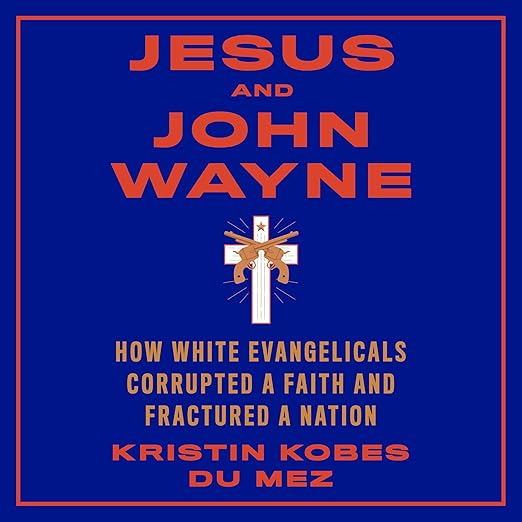
- Voice: Suzie Althens handles a Kalorama production that never lets up on names, dates and organizations, so the twelve hours ask above all for clarity.
- Big ideas: militarized Christian masculinity, evangelical popular culture, Christian nationalism
- Atmosphere: Dense, accumulative, uncomfortable by design
- Worth it?: A carefully sourced cultural history whose scholarship is considerably cooler than the sales copy wrapped around it.
Some books arrive with their reception already attached, and this is one of them. Jesus and John Wayne is a serious work of religious history wearing a provocateur's jacket, and the jacket does it no favors. Kristin Kobes Du Mez argues across twelve hours that American evangelicals spent seventy-five years replacing the Jesus of the Gospels with an idol of rugged masculinity and Christian nationalism. Suzie Althens reads the Kalorama audiobook, twelve hours and three minutes of it, which is the version most people will actually finish. My verdict up front: the scholarship is more patient than the product page suggests, and the product page is what everyone reacts to.
Oliver North to Duck Dynasty, Seventy-Five Years
Seventy-five years is the span, and popular culture is the evidence base. Du Mez builds the argument out of what evangelicals actually consumed rather than out of what their theologians wrote: the celebrities, the paperbacks, the political heroes. The publisher's summary lists the figures who recur, among them Oliver North, Ronald Reagan, Mel Gibson and the Duck Dynasty clan, with John Wayne himself at the center as the icon of a vanished era when men supposedly said what they meant and did what needed doing. Whether you find that reading persuasive depends largely on whether you accept popular culture as evidence of belief. Du Mez plainly does, and builds accordingly.
Twelve Hours of Examples Is Itself the Argument
Scholarly credit is what the most substantial response leads with. That entry calls the book a 'compelling and meticulously researched examination' of how masculinity, faith and politics intertwine in American evangelicalism, and credits Du Mez with tracing the evolution of a militant Christian masculinity that reshaped conservative politics and culture. That reader's emphasis on tracing is the right one. The book's strength is chronological rather than polemical. It shows a sequence of decisions and products accumulating into a worldview, which is harder to wave away than an accusation delivered all at once.
Method matters more than usual here, because admirers and critics are often reacting to the same feature. Assembling a thesis from the heroes, celebrities and consumer culture of a movement produces enormous cumulative force while leaving an obvious opening, since any single item can be dismissed as unrepresentative. The answer, in this book, is volume. Twelve hours of examples is itself an argument about pattern rather than exception, and a listener who wants to evaluate that fairly has to stay with it long enough for the pattern to become visible.
Insider Testimony Calls the Treatment Dispassionate
Insider testimony is the most useful thing in the response pool. A five-star reader who describes having navigated a significant portion of the evangelical landscape across most of their adult life praises the treatment as scholarly and exhaustive, then anticipates the obvious objection, granting that many will read the work as a hit job while insisting its analysis is 'fair, dispassionate, and objective in perspective.' They go further and state that it is by no means an anti-Christian book. Coming from someone inside the tradition under examination, that carries more weight than agreement from a reader who arrived already convinced.
Linear Audio Beats Skipping Ahead in Print
Twelve hours and three minutes of dense proper nouns makes a real demand on a listener. Names, organizations, publications and decades arrive in a steady stream, with no index to consult mid-chapter. That makes clarity the primary requirement of this production, and it makes the linear sweep of audio an advantage rather than a compromise. Reading the book in print invites skipping ahead to the sections about figures you already hold opinions about. Hearing it end to end pushes you through the connective tissue, which is where the actual argument lives.
Publication timing deserves keeping in view. The book landed in 2020, which means its account stops at a specific political moment and cannot address anything that followed. That does not date the historical chapters, which cover the decades before, though it does mean the closing argument now reads as a document of its own year rather than as current commentary. Anyone coming to it fresh should treat the final stretch as history too.
Audio Removes the Option to Skim the Worst
Difficulty is the honest warning, and one four-star reader put it in their heading: important book, difficult to read. Their account of that difficulty is emotional rather than intellectual. They describe finding it horrifying to learn how entrenched the movement is, and how deeply steeped in patriarchy, the submission of women, profit, and hostility toward outsiders defined by skin color, sexuality or immigration status. That reader arrived on a recommendation from a newsletter, trying to make sense of current American politics, and got more than they bargained for. Audio removes the option of skimming the worst pages, which makes this harder rather than easier.
Product copy is its own obstacle. The page copy characterizes a sitting president in openly contemptuous terms and frames the book as an explanation of why evangelicals backed him, which is advocacy writing rather than description. The chapters themselves are considerably cooler. A listener who reads that page and concludes the book is a partisan tract is judging a marketing department, and a listener who buys it expecting a partisan tract may be startled by how much of the runtime sits in the mid-twentieth century.
Smaller record oddities are worth flagging as well. The byline on this listing renders the author's name with a lowercase particle while the description uses the capitalized form, so a search on one spelling can miss the other. And one attached response is written entirely in German and filed from that market, which means a prospective buyer scanning reactions will hit a wall partway down the page. Neither affects the book. Both affect how easily you can assess it from the listing.
Twelve Hours to Make One Historical Case
Historians of American religion, and anyone following the literature on Christian nationalism, are the core audience. The response filed in December places the book squarely in that conversation, calling it a striking contribution to a growing body of work and singling out its historical perspective as particularly compelling. Beyond specialists, the natural audience is anyone who has watched American evangelicalism from outside and wanted an account of how it arrived here that runs on evidence rather than on incredulity. Twelve hours is a fair price for that, and the chronological build makes the case far better than a summary of its conclusions ever could.
Devout evangelical listeners who want their tradition described from the inside on its own terms should know what they are buying. This is a critique, however carefully sourced, and its conclusions about the movement's direction are not neutral. Anyone looking for theology will also come away short, since doctrine barely features and the argument concerns culture rather than belief. And listeners who want a balanced survey giving equal weight to the movement's defenders have the wrong title. Du Mez has a case to make and twelve hours in which to make it.
Frequently Asked Questions
Is the Jesus and John Wayne audiobook hostile to Christianity itself?
The target is a cultural formation rather than a faith. Du Mez writes as a historian of American evangelicalism examining how a particular model of masculinity took hold inside it, and the critique is internal and historical rather than an argument against belief. Whether that distinction holds for you is a personal judgment.
How current is the Jesus and John Wayne audiobook?
The edition dates from 2020, and nothing after that year appears in it. The historical spine covering the previous seventy-five years is unaffected by age, but the closing chapters address a political moment that has since moved on. Read the last stretch as a snapshot rather than as commentary on the present.
Do you need to know evangelical culture to follow the argument?
No. Du Mez introduces the figures and institutions as they arrive, and the recurring names from the publisher's own summary are mainstream enough that most American listeners will recognize them. A listener with no background will simply meet more new material, which the chronological structure handles well.