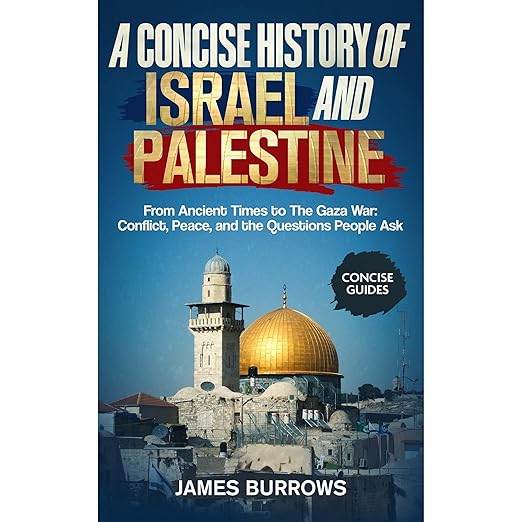
A map of the Middle East sat on my desk for most of last year, referencing it every time a headline required context. James Burrows's audiobook, Israel and Palestine: A Concise History, is the kind of thing I wished I had started with. This audiobook spans thousands of years from ancient kingdoms to the Trump administration's peace proposal, and it does so in four hours and thirty-eight minutes of narration by Virtual Voice. The scope is ambitious. The approach is deliberately accessible. The result is a foundation-building listen for anyone who has spent years consuming current events about this region without a reliable historical frame.
Twentieth Century Gets the Most Detail
Burrows's organizing principle is stated plainly: to understand today's Middle East, you must understand the story of this land and the people who have never stopped believing in it. The book follows a chronological structure, moving from the biblical kingdoms and empires of antiquity through the rise of the three Abrahamic faiths in the Holy Land, the Ottoman period, the British Mandate, the Arab revolts, and partition. The twentieth century receives the most detailed treatment: the 1948 war, the Suez Crisis, the Six-Day War, Yom Kippur, the peace accords, the intifadas, and the rise of Hamas are all covered with enough specificity to be genuinely useful for a listener building from scratch.
One reviewer, described as a kindergarten teacher, praised the book for going into the most detail about the last century, which is exactly what most current-events readers need. Another noted that it distills thousands of years of history into a format that is easy to follow without oversimplifying. That is a difficult balance to strike in any format, and Burrows largely achieves it by maintaining narrative momentum rather than pausing for extensive analysis at each turn.
Burrows Frames the Question as History, Not Polemic
The book also covers the Trump-era peace plan, which gives it a more current endpoint than many historical overviews of the conflict, and it raises the question of why peace remains so difficult through a historical lens rather than a polemical one. That restraint in framing is one of the book's more notable qualities.
Virtual Voice Narration Suits Factual, Chronological History
At under five hours, this audiobook asks for a relatively modest time commitment given the scope of what it covers. That is both a strength and a constraint. The compression means Burrows cannot spend extensive time on any single period, and listeners who want deep analysis of specific events, say, the internal dynamics of the Oslo Accords or the humanitarian dimensions of the Gaza blockade, will need additional sources. But as an orientation listen, four and a half hours is exactly right. It provides enough structure that the listener can approach longer, more specialized works with a reliable conceptual map.
The Virtual Voice narration handles this kind of factual, chronologically organized material adequately. Geopolitical history does not require the emotional register or character differentiation that tests AI narration most severely. The delivery is consistent and clear, which is what the material primarily requires. Listeners particularly sensitive to AI-generated voice patterns will notice, but the information is accurately and accessibly conveyed.
The book's position in the Concise Guides series signals its intended function: a structured, readable overview rather than a scholarly treatment. Within that scope, Burrows delivers what is promised. The writing is balanced in the sense of presenting both Israeli and Palestinian perspectives on contested events without resolving them into a single authoritative account.
Costs of Calling This History Concise
The word concise carries real weight here, and it has costs. The religious dimensions of the conflict receive introductory rather than substantive treatment. The internal political debates within both Israeli and Palestinian societies are touched on but not developed. The humanitarian situation in Gaza and the West Bank receives acknowledgment but not the depth that four-plus decades of documented human experience warrant.
Burrows's claim to balanced analysis is generally supported by the text, but balance in contested historical territory is itself a contested concept. Readers coming to this audiobook from strong prior commitments on either side of the debate may find moments where the framing feels incomplete or tilted. That is not a criticism unique to this book; it attaches to any overview of material this politically charged.
The book was written at a specific historical moment, and the conflict has continued to evolve since its publication. Listeners should treat the coverage of recent events, particularly anything postdating the book's composition, as a starting point for further research rather than a comprehensive account.
Students and General Readers Building a Foundation
This audiobook is well matched for students and general readers who want a historical foundation for understanding current events in the region. It is particularly useful for anyone who has been following news coverage without a solid grasp of how the conflict's present conditions emerged from specific historical decisions and events.
Listeners who already have significant background in Middle Eastern history or who want analytical depth beyond the survey level will find the treatment too introductory to add much to what they already know. And those seeking a specific political argument about responsibility, solutions, or moral priority will find Burrows's evenhandedness frustrating. The book is designed to inform rather than persuade, and that is the appropriate function for an introduction of this kind.
Quick Take
- Performance: Virtual Voice handles this chronological factual survey adequately; the straightforward delivery suits the material's encyclopedic rather than dramatic register.
- What it covers: Faith, identity, and politics over thousands of years; the making of an enduring conflict
- Feel: Measured and informational, pitched at the curious generalist rather than the specialist
- Our call: A useful orientation audiobook for anyone wanting historical context before engaging with deeper or more specialized sources on this conflict.
Before You Listen
Is this audiobook genuinely balanced in its treatment of Israeli and Palestinian perspectives?
Burrows makes an evident effort to present multiple perspectives without resolving contested events into a single authoritative account. Listeners with strong prior commitments may find individual moments where the framing feels incomplete, but the overall approach is oriented toward context-building rather than advocacy.
What prior knowledge does a listener need before this audiobook?
None is required. The book is designed as a foundation-building resource for listeners approaching the topic without established historical context. It introduces key figures, events, and turning points rather than assuming familiarity with them.