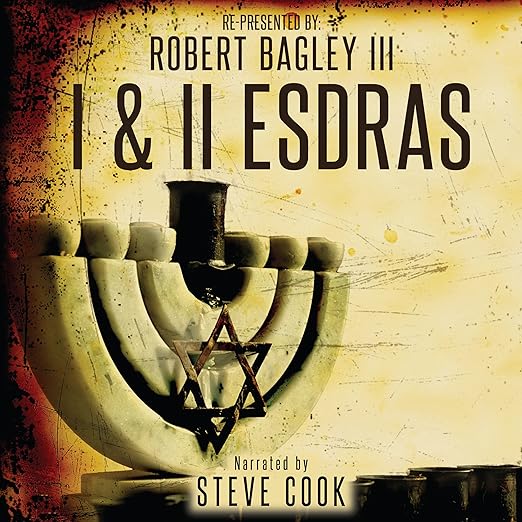
A background in literary studies tends to make you attentive to the way genre shapes reception, and the Apocrypha presents a particularly interesting challenge: these are texts that have existed in a contested relationship with canonical scripture for centuries, and approaching them through an audiobook format reframes that contest in a useful way. I and II Esdras, narrated by Steve Cook with Robert Bagley III as author-compiler, enters audio as something between sacred literature and historical document, and Cook's narration handles that double register with care. This audiobook is a short but substantively rich listen for anyone curious about the margins of the Hebrew biblical tradition.
Two Apocryphal Books Just Outside the Canon
The Books of I and II Esdras occupy a specific and unusual position in biblical literature. Drawing on supplemental material from II Chronicles and Nehemiah, these books revise and expand the canonical Book of Ezra, and their relationship to the Roman Catholic canon adds another layer of interpretive complexity: this is not included in the Catholic Bible, which means its authority and authenticity have been subjects of debate across centuries of theological scholarship. Bagley's framing of the text positions it as Apocryphal scripture with genuine historical and theological significance rather than as marginal curiosity.
I Esdras contains the famous debate before the King of Persia, in which three young men argue over what is the strongest thing in the world. The exchange is memorable and has a literary quality that distinguishes it from straightforward historical chronicle. II Esdras is theologically denser: Ezra's conversations with angels sent to address his questions about theology include a remarkable account of the loss of Hebrew Scriptures during the Babylonian exile and their miraculous restoration through Ezra's perfect recitation. Whether approached as theology, as literary artifact, or as historical document, these texts repay attention.
Steve Cook's Composure Across a Compact Runtime
Steve Cook's narration brings a quality of gravity appropriate to the material without tipping into the kind of sonorous over-performance that sometimes accompanies religious texts in audio format. The background music noted by one reviewer as something they would prefer to remove is present in the production, and listeners who prefer unaccompanied narration for scriptural material should know it is a feature of this recording. Cook's voice handles both the more dramatic passages, the king's debate, the angelic dialogues, the scenes of prophetic dictation, and the more genealogical and procedural sections with consistent composure.
Reviewer Amazon Customer wrote that the text 'describes our days perfectly,' which is the kind of observation that says more about the reader's interpretive frame than about the text itself but also speaks to the enduring relevance that readers find in apocalyptic and prophetic literature. Second Esdras in particular has the quality of genuine visionary writing, and the account of Ezra dictating seventy secret books, to be read only by the wise, has a literary and theological charge that audio brings out well, since the image of oral transmission suits the listening experience.
At three hours and forty-four minutes, this is a comparatively compact audiobook relative to the interpretive territory it covers. The length is appropriate for what Bagley has assembled: a focused encounter with two specific Apocryphal texts rather than a comprehensive study of Apocryphal literature as a whole. Listeners wanting scholarly commentary will need supplementary resources, but as a direct audio encounter with the texts themselves, the runtime is right.
Accuracy Concerns Aside, the King's Debate Still Shines
One reviewer specifically criticized the production's accuracy to certain verses, which is a concern worth noting for listeners who come to the text with their own prior familiarity with Esdras. Bagley makes interpretive and textual choices in his presentation, and listeners with strong prior knowledge of the Greek or Latin versions may encounter moments where his reading diverges from their expectations. The musical background accompaniment is also not universally welcomed, as one reviewer indicated.
For listeners entirely new to the Apocrypha, some context about the broader textual tradition would be useful before starting. Knowing that Esdras is the Greek form of Ezra, and understanding the basic relationship of these texts to the canonical books of Chronicles, Nehemiah, and Ezra, will make the material more accessible from the first chapter.
The king's debate in I Esdras deserves specific attention as a piece of writing that has survived across centuries not merely as historical document but as something with genuine literary staying power. The three young men who compete to answer 'what is the strongest thing in the world?' give answers that are each satisfying on their own terms before the eventual winner delivers a conclusion that reframes the entire competition. Hearing that sequence aloud, as Steve Cook delivers it, gives the exchange a dramatic quality that silent reading sometimes misses. The debate structure is one of the oldest in literary history, and encountering it in audio makes the antiquity feel less like distance and more like familiarity.
II Esdras' account of the prophetic dictation, Ezra reciting from memory the entirety of Hebrew Scripture after the Babylonian destruction, is one of the more audacious claims in the Apocryphal tradition, and Bagley presents it without apology. Whether approached as historical record, theological claim, or literary invention, the image has a grandeur that merits the text's inclusion in the broader scriptural conversation. Cook's narration of these passages maintains the appropriate register: neither incredulous nor credulous, but attentive to the weight of what is being claimed.
Second Temple Scholars Over Casual Devotional Listeners
Listeners with an existing interest in biblical Apocrypha, Second Temple Judaism, or the history of the biblical canon will find this audiobook a valuable and concentrated encounter with two texts that are often discussed but rarely heard directly. Students of religious history, those exploring the breadth of the scriptural tradition beyond the Protestant or Catholic canon, and listeners drawn to the prophetic and wisdom literature of the ancient Near East are all well-positioned to engage with this material. Those expecting conventional devotional audio or mainstream Christian content should note the Apocryphal status of these texts and the specific debates around their authority.
- Voice: Steve Cook delivers with appropriate gravity, handling both the dramatic debate sequences and the denser theological passages with steady composure, though background music accompanies the recording.
- Big ideas: Apocryphal scripture and canonical authority, prophetic vision and divine dictation, wisdom and the Babylonian exile.
- Atmosphere: Contemplative and historically weighted, with moments of surprising narrative vitality.
- Worth it?: A short, concentrated audiobook encounter with two rarely-heard Apocryphal texts, suited for listeners already oriented toward biblical history and scripture outside the mainstream canon.
Good to Know
What prior knowledge do I need before listening to this audiobook?
Basic familiarity with the Old Testament, specifically the books of Chronicles, Nehemiah, and Ezra, will make the material more accessible. Understanding that Esdras is the Greek form of Ezra, and that these books are not included in the Roman Catholic Bible, provides useful context for the interpretive stakes.
Does this audiobook include scholarly commentary or just the texts themselves?
It presents the texts with framing rather than detailed academic commentary. Listeners seeking in-depth scholarly analysis of the Apocrypha will need supplementary resources, but for a direct encounter with I and II Esdras in audio form, the production is focused and complete.
Is there background music in this audiobook recording?
Yes. One reviewer specifically mentioned preferring to listen without the background dramatic music that accompanies the narration. Listeners who prefer unaccompanied scriptural readings should factor this into their decision.
How does this audiobook fit within the broader landscape of Apocryphal literature available for listening?
I and II Esdras are among the less commonly encountered Apocryphal texts in audio format, which gives this recording a specific value for listeners who want to move beyond the more frequently recorded books of the Apocrypha. The texts themselves are rich: I Esdras contains the well-known king's debate, while II Esdras is one of the more elaborate prophetic and visionary texts in the tradition.