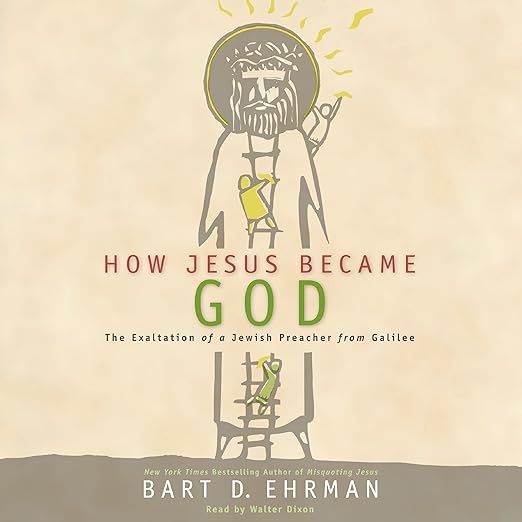
I finished How Jesus Became God during a long train ride through rural France, watching the landscape flatten out while Bart Ehrman dismantled nineteen centuries of theological certainty with the quiet confidence of someone who has tenure and nothing left to prove. That combination of physical movement and intellectual destabilization was oddly fitting. This book is, in the truest sense, a journey through ideas that most of us assume were always fixed.
Ehrman spent eight years on this project, and that labor is legible throughout. The book does not feel like a lecture repurposed for publication. It feels like a sustained argument built from the ground up, with each chapter earning its position in the sequence. For audio, that density requires a narrator who can hold the architecture visible while reading linearly, and Walter Dixon does that job with considerable competence.
What Bart D. Ehrman Delivers
What Ehrman does here that most popular theology books avoid is to situate the question of Jesus's divinity inside the actual thought-world of the ancient Mediterranean. He begins not with the New Testament but with how divinity itself worked in Greco-Roman and Jewish cultures before Christianity existed. The concept of a spectrum between human and divine, of figures who moved between those realms, was entirely normal in that world. This background is not a detour; it is the necessary frame that makes everything that follows legible.
The argument then moves through the post-resurrection visions, through Paul's high Christology in letters written decades before the Gospels, and through the progressive elevation of Jesus's divine status across the Gospel accounts themselves, from Mark to John. Ehrman shows that this was not a sudden invention but a gradual, contested development across communities that disagreed sharply with one another. A reviewer with a background in early Christianity noted that the book covers broad aspects with authority and without bias, which is an accurate description of Ehrman's method.
What Bart D. Ehrman Gets Right
The audiobook format actually helps with one of Ehrman's central rhetorical strategies: he repeats key points at chapter transitions in a way that works beautifully when you are listening rather than reading. What might feel slightly redundant on the page serves as genuine reinforcement when you have been walking or driving between sessions. Dixon's pacing supports this rhythm well.
The section on the earliest post-resurrection visions is particularly strong in audio. Ehrman's argument that those experiences were genuine, in the psychological sense, for the disciples who had them, without necessarily being literal, is delivered with a careful precision that rewards close listening. He is not dismissive of the experiences; he is trying to explain what they might have meant to people who lived before modern categories of hallucination or grief vision existed.
Where Bart D. Ehrman Loses Some Ground
Ehrman's critics within biblical scholarship, and there are many, argue that he sometimes presents contested positions as settled conclusions. Listeners should be aware that this is an argument, not an encyclopedia entry. The material is well-supported by primary sources, but it is not the only reading of the evidence. The book is most valuable when treated as one rigorous voice in an ongoing conversation rather than as the final word.
The final third, dealing with the Council of Nicaea and the consolidation of Trinitarian doctrine, is denser than the opening sections. If your interest is primarily in the historical Jesus rather than the political machinations of the fourth-century church, you may find your attention wandering in those chapters. Dixon's narration remains consistent throughout, but the material becomes more technical.
Who Should Pick Up How Jesus Became God
This audiobook is well suited for listeners who approach religious history with genuine curiosity rather than a predetermined conclusion to defend. Secular readers interested in the mechanics of how religious belief evolves will find it exceptionally well organized. Christians who are intellectually confident in their faith and willing to engage with challenges to traditional doctrine will find Ehrman a respectful if unsparing interlocutor. Listeners who want their existing beliefs confirmed rather than examined should probably start elsewhere.
At a Glance
- Voice: Walter Dixon delivers Ehrman's dense scholarly argument with steady clarity; his measured pacing suits the material but lacks the heat the subject sometimes demands.
- Big ideas: Historical Christology, early church evolution, the gap between the human Jesus and later doctrine
- Atmosphere: Methodical and intellectually absorbing, built for curious skeptics and open-minded believers alike
- Worth it?: If you have ever wondered how a first-century Jewish prophet became the second person of the Trinity, Ehrman gives you the most rigorous accessible answer available in audio.