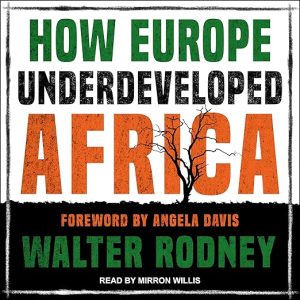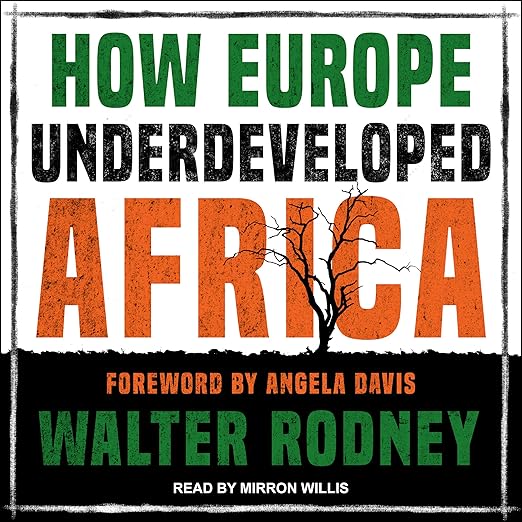
How Europe Underdeveloped Africa is a thirteen-hour audiobook edition of Walter Rodney's work of political economy, framed by the synopsis as an argument that the gap between the West and the rest of the world came from exploitation rather than accident, with an introduction from Angela Davis.
Rodney Traces Extraction Across Four Continents
Rodney, a Guyanese intellectual who led anticolonial movements across North America, South America, Africa, and the Caribbean before his assassination at thirty-eight in 1980, wrote this as his central argument: that European colonialism did not simply neglect Africa but actively extracted from it in ways that produced what the synopsis calls the great divergence between the West and the rest. Mirron Willis carries the sole narrator credit across all thirteen hours and twenty-one minutes, the kind of single-voice commitment a dense work of political economy needs to stay coherent from argument to argument.
Reviewer S J Daniels calls it, in their own words, a good communist's survey of colonial oppression and its consequences, framing Rodney's proposed path forward around rebuilding what the review calls natural, native-centered economies. That is one reader's ideological read on the book rather than a neutral summary, and it is worth knowing upfront that Rodney's argument is explicitly political rather than a detached academic overview.
Rodney's deportation from Jamaica, per the synopsis, helped trigger that country's significant 1968 riots, and he founded the Working People's Alliance in Guyana not long before his assassination. Tantor Audio's production, running thirteen-plus hours, gives the argument room to build case by case across regions rather than compressing decades of colonial history into a short summary.
Geographic reach matters here too: the synopsis is careful to specify movements across North America, South America, the African continent, and the Caribbean, describing Rodney as a lightning rod for working class Black Power wherever he went. That breadth is part of why the book reads less like a single-region history and more like an argument meant to apply across the whole of the colonized world.
Angela Davis's Introduction Updates an Old Argument
Dusable calls it a book with great knowledge about African history, and Obi's short review simply calls it excellent and highly recommended. Mikal A.'s review, though brief, echoes the same word other reviewers reach for: informative. Together, the reviews describe a book that delivers real substance even when individual reviews stay short.
The synopsis notes Rodney's scholarship influenced decades of activism and academic work after his death, and that he was organizing on the ground in multiple countries while developing the ideas this book lays out. For listeners interested in twentieth-century anticolonial movements specifically, that biography adds real weight to the argument itself, since this is a book written by someone who was living the consequences of the systems he was analyzing.
Angela Davis's introduction, described in the synopsis as powerful, situates the book for a contemporary audience rather than leaving it as a strictly historical document. That framing matters for listeners encountering Rodney's work for the first time, since it connects his decades-old argument directly to ongoing conversations about global inequality today, a link the synopsis draws explicitly.
Willis Reads Cleanly Despite the Text's Typos
The rating counter here shows just one rating attached to a four point seven average, even though five separate readers left full written reviews underneath it. The counter and the review column are clearly tracking two different totals, which is worth knowing if you are weighing the aggregate score.
One reviewer's complaint deserves a careful read: they describe an incredible number of grammar and spelling mistakes, as if the text had been scanned and reprinted without proper editing, citing lime appearing where time belongs. That specific complaint reads as a text or print edition issue rather than anything about Mirron Willis's audio reading, since a scanning error would not affect what a narrator says aloud, but it is worth knowing that some edition of this book has had real editorial quality problems.
At thirteen hours and twenty-one minutes, this is a substantial commitment for a work of political economy, and listeners should expect dense, argument-driven prose throughout rather than a narrative pace. This is not a book built for background listening; it rewards close attention chapter by chapter.
S J Daniels's review is dated to a specific day, and reads more like a set of personal study notes than a typical reader reaction, going deep into Rodney's argument about rebuilding what that review calls natural economies tailored to native populations rather than colonial extraction. Listeners expecting a lighter, more conversational review column should know several of the visible responses here read closer to academic engagement than casual reaction.
Anticolonial Theory Readers Get the Deepest Payoff
Readers of political economy, African history, and anticolonial theory, along with anyone working through Angela Davis's broader reading list, will find this a substantial, well-regarded entry point into Rodney's thinking.
History-minded listeners specifically interested in the 1968 Rodney riots in Jamaica, or the broader wave of Caribbean and African anticolonial organizing Rodney was part of, get added context here too, since the synopsis situates the book directly within that biography.
Look elsewhere if you want a neutral, on-the-fence historical survey, since Rodney's argument is explicitly a political one and reviewer S J Daniels describes it in explicitly ideological terms. For listeners open to that framing, thirteen-plus hours of a single steady narrator makes the case an easier one to follow start to finish.
Key Details
- Narrator: One steady voice, Mirron Willis, holds the whole thirteen-plus-hour argument together.
- Subjects: Colonial exploitation, anticolonial theory, African economic history
- Tone: Serious and argumentative, dense but purposeful
- Bottom line: A substantial listen for readers of political and African history, best approached knowing its argument is openly political.