What Tools a Historian Uses for the Supernatural
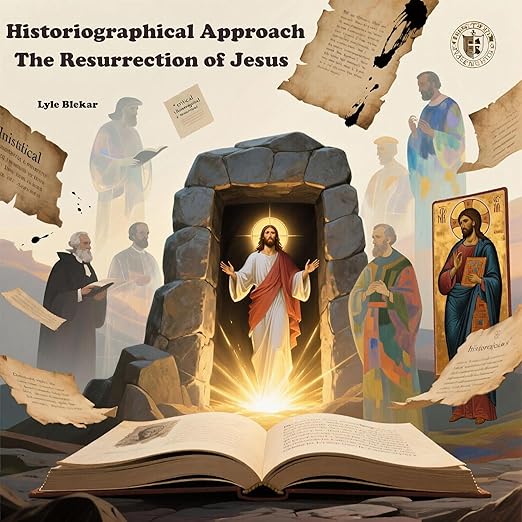
The strongest case for resurrection historiography here has nothing to do with faith and everything to do with method. Before any argument about what actually happened outside a tomb roughly two thousand years ago, the book insists on settling a prior question: what tools should a historian even use when the claim under examination is supernatural? That question drives the first portion of this twenty-hour, thirty-two-minute audiobook, credited to author and narrator Lyle Blekar, and it's a more interesting starting point than most popular treatments of the resurrection debate bother with.
From there, the project narrows into a close reading of the earliest and most reliable sources, an assessment of what scholars across the belief spectrum generally accept as historical bedrock, and a systematic evaluation of naturalistic alternatives to the resurrection claim. The approach is methodical rather than rhetorical, more interested in building a chain of evidence than in landing rhetorical punches, which will read as either admirably rigorous or slow going depending entirely on how invested you already are in the underlying question.
Historians working on ancient claims generally lean on a handful of established criteria: multiple independent attestation, the criterion of embarrassment, for material that would have been awkward for its original authors to invent, and coherence with the broader historical context. This audiobook's real project is applying that same toolkit, developed largely for evaluating ordinary historical claims, to an extraordinary one, and asking whether the standard rules should bend, break, or hold firm when the claim under examination is a resurrection rather than a battle or a treaty.
Blekar's Measured Register for a Three-Part Argument
Blekar narrates his own material in a measured, lecture-style register, closer to an extended seminar than a dramatic reading, and that fits content built around sustained argument rather than storytelling. Listeners who enjoy long-form theological or historical argument delivered without embellishment will likely find the pacing appropriate, since the book never rushes toward a conclusion it hasn't earned step by step.
The genuine value here is in the historiographical framework itself, the explicit attention to how historians handle miracle claims as a category, which is a more sophisticated starting point than simply asserting the resurrection happened or didn't. For listeners who've engaged with the broader historical Jesus conversation, whether through scholars defending the resurrection's historicity or skeptics like Bart Ehrman arguing against it, this audiobook offers a structured way to weigh the methodological questions underneath the debate rather than just the conclusions.
The book's overall structure moves in three broad stages across its twenty-plus hours: establishing historiographical method, applying that method to the earliest source material, and finally weighing the resurrection claim against naturalistic alternatives point by point. Listeners who prefer knowing the shape of an argument before committing to it will find that three-part structure easy to track, even across a runtime long enough that returning after a break requires some reorientation. Chapter breaks are clearly signposted in the narration itself, which helps considerably given how much cross-referencing a project built around cumulative historical argument tends to require.
An Unnamed He Echoing Michael Licona's Work
A note on the source material is worth flagging directly. The synopsis text supplied with this edition reads oddly in places, referring to an unnamed 'he' who 'identifies a crucial yet often overlooked issue' without ever naming who that is, and describing a project that closely resembles established academic work on resurrection historiography associated elsewhere with the scholar Michael Licona. This particular edition credits Lyle Blekar as both author and narrator. Listeners who want a specific, verified scholarly pedigree before committing twenty-plus hours should confirm authorship and edition details before purchasing, since the available description doesn't fully resolve the question.
Independent, self-published, or small-press audiobook editions of academic-adjacent religious scholarship carry these kinds of metadata inconsistencies more often than titles from major publishers, where editorial review typically catches a stray unnamed pronoun or an unresolved third-person reference before release. That doesn't resolve the specific question of authorship here, but it does offer some useful context for how a synopsis this polished in its actual argument could still contain such a basic descriptive gap, and it's a pattern worth watching for across similar independently produced audiobooks in the same crowded apologetics category.
No listener reviews or ratings are attached to this title yet, so the usual social proof isn't available here, and at over twenty hours, this is a serious time commitment for a niche academic subject. This isn't a casual listen or a general-audience introduction to the historical Jesus debate. It assumes real interest in historiographical method going in, and listeners hoping for a faith-building devotional experience rather than an argument-driven historical case may find the register drier than expected.
Wright, Habermas, Craig, and Ehrman Readers Welcome
This audiobook is built for a specific, engaged audience: listeners already interested in Christian apologetics, historical Jesus scholarship, or the specific methodological question of how historians should treat miracle claims. If you've read N.T. Wright, Gary Habermas, or William Lane Craig on the historicity side, or Ehrman on the skeptical side, this audiobook will feel like a natural continuation of that conversation rather than an introduction to it.
Casual listeners looking for an accessible overview of Easter-story history, or anyone hoping for narrative storytelling rather than sustained argument, should look elsewhere first. Listeners building out a broader library on this subject might pair this audiobook with more mainstream entries in the historicity debate to get a sense of how this more specialized, methodology-first approach compares to arguments pitched at a wider readership. On its own, though, it works best as a deep cut for listeners who already know the broad contours of the debate and want to go one level deeper into the historian's toolkit itself.
Common Questions
Is the synopsis for this audiobook accurate?
Partially. The supplied description reads oddly, referencing an unnamed 'he' and closely resembling academic work elsewhere associated with scholar Michael Licona, while this edition credits Lyle Blekar as author and narrator. Listeners should confirm authorship before purchasing.
Do I need a background in theology to follow this audiobook?
Some familiarity with the historical Jesus debate helps considerably. The book assumes real interest in historiographical method rather than offering a beginner's introduction to the subject.
How long is the Historiographical Approach audiobook?
It runs twenty hours and thirty-two minutes, a substantial commitment for what is essentially an academic argument delivered in lecture-style narration.
Does this audiobook argue for a specific position on the resurrection?
Yes, it builds a historically argued case in favor of the resurrection's historicity, working through source reliability and alternative explanations methodically rather than simply asserting a conclusion.