Before You Press Play
- At its heart: Irish famine emigration, Irish-American political and cultural impact, immigration and identity in 19th-century America
- Vibe: Narrative-driven and celebratory, with genuine historical weight
- Short version: O'Dowd's audiobook makes a compelling case for the famine generation's outsized role in shaping modern America, combining journalist's momentum with personal investment in the subject.
Coffin Ships That Reshaped American Institutions
Picture the docks of New York harbor in 1847: hollow-eyed men and women stepping off coffin ships from famine-ravaged Ireland, carrying nothing but disease, desperation, and the surnames that would later appear on the rolls of Congress, the rosters of Union Army regiments, and the credits of Nobel Prize-winning plays. That is the starting scene Niall O'Dowd builds toward in From Tragedy to Triumph, an audiobook that reframes the Irish famine emigration not as a story of victimhood, but as one of the most consequential population movements in American history.
O'Dowd, founder of the Irish Voice newspaper and one of the architects of the Northern Ireland peace process, brings a journalist's instinct for narrative and an immigrant's personal investment to the material. The book is neither academic history nor simple hagiography. It sits in the tradition of popular history that follows specific individuals as a means of mapping broader structural change, tracing how the famine generation's children and grandchildren entered and reshaped nearly every institution that defines modern America.
Ford's Galway Roots, JFK's Wexford Roots
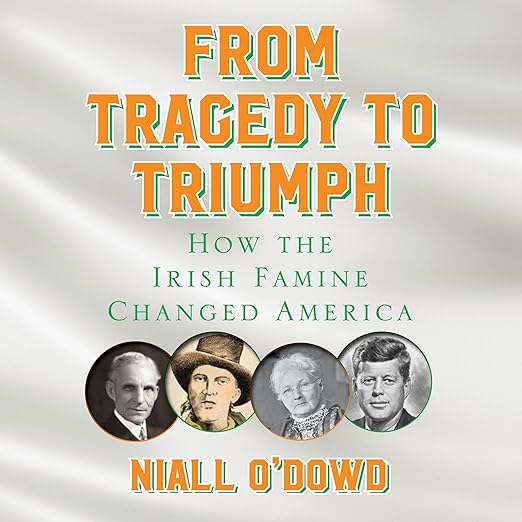
The book's central argument is genuinely underexamined in mainstream history: that without the Irish famine exodus, the United States would look materially different across politics, labor, religion, law enforcement, and literature. O'Dowd builds that case through a roster of figures who will be familiar to many American listeners in isolation but rarely seen as part of a connected demographic story. Henry Ford's Galway ancestry. JFK's Wexford roots. Mother Jones's organizing in the coal fields. Billy the Kid's Irish parentage. Eugene O'Neill's immigrant family background and its direct pressure on the American theatrical tradition.
The connective tissue between these figures is what makes the book valuable. O'Dowd is not simply collecting famous Irish-Americans; he is arguing that the specific circumstances of their parents' and grandparents' arrival, the brutality of the coffin ships, the discrimination they faced from established Protestant America, and the specific political and social infrastructure that existed in the mid-nineteenth century produced a generation with both grievance and organizing capacity in unusual combination.
The historical argument around the Civil War section is particularly strong. O'Dowd makes a case that Irish immigrant soldiers fighting for the Union were not simply patriots of convenience but participants in a calculated exchange: military service as a pathway to civic belonging for a community that had been told it did not belong. That framing gives the battlefield chapters a weight beyond military history.
Narrator and Runtime Both Still Unconfirmed
The book's narrator information is not confirmed in current metadata, and listeners should verify the narration credits before purchasing if that is a factor in their decision. The audiobook's duration is also listed as not yet confirmed, which suggests this review is written before full production details are publicly available.
O'Dowd is a passionate advocate for his subject, and some academic historians may find the popular history framing too triumphalist at points. The title itself signals a certain arc. The book is most interested in achievement rather than assimilation's costs: the ways in which Irish-American identity was shaped partly by anti-Irish discrimination and partly by Irish community discrimination against Black Americans and other immigrant groups is present but not foregrounded. Listeners who want a critical history of Irish-American identity rather than a celebratory one should supplement with other works.
The Catholic Church Built by Immigrants
That caveat aside, the storytelling instincts are strong. O'Dowd knows how to move between the macro and the human scale without losing either, and the historical research grounding the most specific claims is solid.
O'Dowd's treatment of the Catholic Church's role in Irish-American community formation deserves special attention as a chapter that general American history tends to skip over. He argues that the Catholic Church in America was effectively built by Irish immigrants and their children, and that the institutional culture it developed, its organizational discipline, its relationship to political machines, its role as a social safety net for immigrant communities, directly shaped American urban Catholic life for a century. That is an argument with real historical substance that extends well beyond the Irish-American story to the broader history of American religious institutions.
The narrative around Henry Ford is one of the book's most interesting and morally complex sections, given Ford's later and well-documented antisemitism. O'Dowd handles this with care rather than ignoring it, acknowledging that the same generation whose origins were in famine-driven displacement produced both remarkable reform figures and figures whose complicated legacies require honest reckoning. That willingness to hold complexity alongside celebration gives the book more integrity than a purely triumphalist account would have.
Accessible Prose for Irish-American History Fans
This audiobook suits listeners with an interest in Irish-American history, immigration history, or the deep roots of American political and labor institutions. It works for listeners who enjoy popular history organized around compelling individuals rather than structural analysis alone. O'Dowd's journalistic background means the prose is accessible and the pacing is engaging.
Academic historians or listeners looking for a critical examination of Irish-American complicity in American racial hierarchies will find the book's scope limited. But as an introduction to a genuinely underexamined dimension of American history, told by an author with both expertise and personal connection to the material, From Tragedy to Triumph offers a perspective that most mainstream American history does not fully include, and it does so with the momentum of journalism and the weight of lived connection to the material.