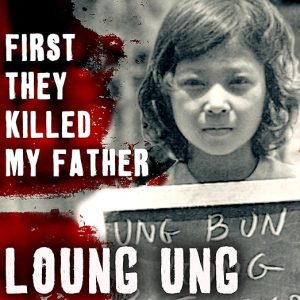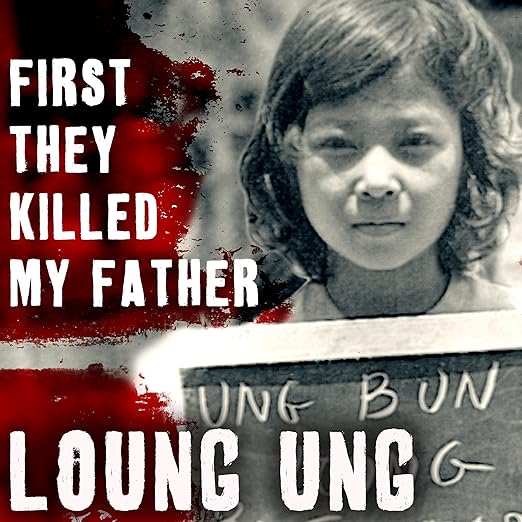
Can a five-year-old comprehend what it means to lose everything? Loung Ung was that age when Pol Pot's Khmer Rouge army entered Phnom Penh in April 1975 and shattered a life her family had believed was secure. Her father was a high-ranking government official. Her family had a driver, an apartment, food. Within days, they were refugees. Within months, they were separated, scattered to labor camps, orphanages, and survival by concealment. First They Killed My Father, narrated by Tavia Gilbert, is Loung Ung's memoir of that period, told through the lens of the child she was. The audiobook format is particularly powerful here: a child's voice reconstructing atrocity has a quality of disorientation that Gilbert's narration captures with care.
Ung was trained as a child soldier in a work camp for orphans. She was nine years old at the time. Her siblings were sent to labor camps. The Khmer Rouge was not destroyed until the Vietnamese invasion of 1979, and the family's survival and partial reunion came at the end of four years of sustained horror. This is the first book in the A Daughter of Cambodia series, and it reads as a primary document as much as a memoir: specific, sensory, and stripped of retrospective wisdom in ways that keep it close to the child's experience rather than the adult writer's interpretation.
Where This One Lands
The book's most significant formal decision is its choice of perspective. Ung writes from inside the child's consciousness, giving the reader access to a five-then-nine-then-eleven-year-old's understanding of the regime that has consumed her world. That means the political and historical context that surrounds the Khmer Rouge's rise and practices is present only insofar as a child could grasp it, which is to say, partially and sideways. The reader understands more than Loung does, and that gap between what the child narrates and what the reader comprehends is where much of the book's moral weight lives.
One reviewer writes that it's 'important that you understand how it happened, and more importantly, how it could easily happen to you and yours,' and that's a claim the book makes implicitly throughout. The Ung family's vulnerability did not come from political naivety or lack of resources. It came from the total collapse of the institutional structures that had made their middle-class existence possible. That lesson, that security is contextual rather than earned, is embedded in the child's confusion rather than stated by the adult writer. The restraint is its own form of power.
Tavia Gilbert brings to this audiobook the same attentiveness she applies to Amy Harmon's historical fiction, but the register is entirely different. Where Harmon's prose is literary and composed, Ung's is spare and immediate. Gilbert adapts accordingly. Her narration of the child Loung is not performed innocence; it's genuine simplicity, the voice of someone reporting what she sees without fully understanding it. That calibration is difficult to achieve and essential to the audiobook's emotional effect. Overdramatizing any moment would break the spell of witnessing that Ung creates.
The audio format has a particular value for memoir of this kind. Reading silence is different from hearing it. The pauses in Gilbert's narration around the moments of greatest loss, the deaths, the separations, the training to become something no child should be, register in listening as they cannot in print. Several reviewers describe the book as one that makes you 'cry and smile at times,' and that emotional range is supported by Gilbert's refusal to settle into a single emotional key. She follows Ung's actual register, which moves between grief and the small survivals that grief cannot extinguish.
For listeners who have visited Cambodia or have existing knowledge of the Khmer Rouge period, the book provides a civilian's-eye view that complements the historical accounts. One reviewer with substantial Cambodia experience notes it as 'a very good first book to introduce the Pol Pot era.' For listeners with no prior knowledge, it functions as the most visceral possible introduction: not history from above, but history from the ground, as experienced by a child who did not choose to be its witness.
What to Watch For in First They Killed My Father
The book is a memoir, not a historical analysis. Listeners who want geopolitical context, the Chinese backing of the Khmer Rouge, the US bombing campaign that preceded the regime's rise, the Vietnamese-backed overthrow, will need to supplement this account with other sources. David Chandler's academic histories or the documentary record provides that context; Ung provides the lived experience. The two are complementary but distinct, and this audiobook should be understood as personal testimony rather than comprehensive history.
The content is genuinely difficult. Child soldiers, mass death, torture, and the dissolution of family are not handled euphemistically. Listeners who need emotional preparation before encountering this material should know what they are entering. The book has a shape that moves toward survival and partial reunion, and the 'harrowing yet hopeful' descriptor in the subtitle is accurate, but the harrowing comes first and in full.
Who Should Listen to First They Killed My Father
Listeners interested in Cambodian history, survivor testimony, or the literature of genocide and survival should prioritize this audiobook. Gilbert's narration makes the audio format a genuine enhancement rather than a neutral alternative to print, and the child's-eye-view structure works powerfully when heard rather than read. Those who need geopolitical framing alongside personal testimony should supplement with historical accounts. Emotionally, this is not easy listening; it is necessary listening for anyone who wants to understand what the Khmer Rouge meant for the people who lived through it.
In Brief
- Voice: Tavia Gilbert's narration of child Loung's perspective is calibrated with remarkable restraint, refusing to overdramatize moments where simplicity carries more weight.
- Big ideas: Survival under genocide, the child's experience of political violence, family dissolution and partial reunion
- Atmosphere: Spare, harrowing, with hard-won moments of resilience
- Worth it?: A survivor memoir told through a child's eyes with unflinching honesty, and one of the most powerful audiobooks in the literature of the Khmer Rouge period.
How does Tavia Gilbert's narration handle the emotional weight of this memoir audiobook?
Gilbert narrates with deliberate restraint, which serves the book's child-perspective structure. She doesn't perform grief or dramatize horror; she delivers Loung's witness as the child reported it, which is both more accurate and more powerful. Her pacing around the moments of greatest loss, quiet rather than emphatic, is the audiobook's most important interpretive choice.
Does this audiobook cover Loung Ung's entire life, or just the Khmer Rouge period?
The narrative covers the period from 1975, when the Khmer Rouge took Phnom Penh, through the Vietnamese liberation in 1979 and the immediate aftermath. It is the first book in the A Daughter of Cambodia series; Ung's subsequent life and her work as a UNICEF spokesperson are covered in later volumes.