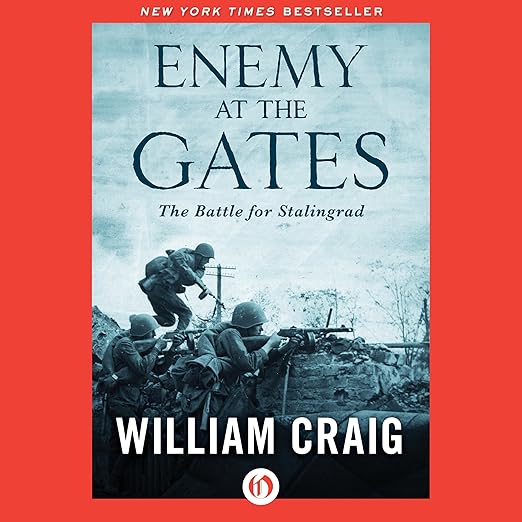
- Narrator: David Baker's reading draws a direct compliment in the review column, with one listener calling it a match for the prose.
- Subjects: Siege warfare, Eastern Front history, individual survivor accounts
- Tone: Grim and meticulously researched
- Bottom line: A dense, well-researched account of Stalingrad that rewards patient listeners more interested in the full campaign than the sniper duel the film made famous.
Dust rose over the Russian steppe in August 1942, as Hitler's 6th Army pushed toward Stalingrad certain they would be home for the holidays instead. This audiobook of William Craig's history spends thirteen hours and twenty six minutes proving how wrong that certainty turned out to be.
Is Enemy at the Gates Worth Your Time?
One review opens by comparing the book directly to its own film adaptation, the 2001 movie starring Joseph Fiennes and Jude Law, and makes a point worth repeating: the famous sniper duel that anchors the film is, in Craig's telling, "a tiny story" inside a far larger and more comprehensive account of the battle. Craig spent five years researching this book, traveling to three continents to interview survivors and review documents, and that research shows in the scope rather than in any single dramatic set piece. The 6th Army marched toward Stalingrad and the oil fields of Azerbaijan beyond it with total confidence, an elite unit that had not suffered a single defeat in three years of war, its target already softened by Luftwaffe bombing before ground troops arrived.
That overconfidence is one of the through-lines Craig keeps returning to: an army so certain of its own superiority that basic contingencies went unplanned, expecting to occupy the city rather than lay siege to it for months against an enemy already dismissed as beaten. Watching that certainty erode chapter by chapter, long before the disastrous winter that finished the job, is where the book's tension actually lives, well before any single sniper enters the story.
Five months, one week, and three days: that is how long the siege that followed lasted; nearly two million people died; and the German 6th Army, the same force that marched in so confidently that August, was entirely destroyed by its end. Many historians consider it the turning point of the war in Europe, the moment Hitler's momentum broke and the Soviet Army's eventual victory became foreseeable rather than hoped for.
Considered by many historians to be the turning point of the war in Europe, the battle's outcome did more than stop one army; the synopsis frames it as foreshadowing both Hitler's eventual downfall and the rise of a new communist superpower under Stalin's Soviet Union, stakes that reached well past the city limits of Stalingrad itself and into the shape of the rest of the twentieth century.
The Best Parts of Enemy at the Gates
Praise for the narration comes directly from a 2025 review, favorable and specific: "the narration is excellent and matches the prose perfectly," a listener writes, adding that the personal accounts woven through the book make the conflict feel "atmospheric" rather than abstract, with "the calm before the attack in the city" landing as something tangible rather than a history-book abstraction. That combination, a well-matched reading and a book built from hundreds of individual interviews, is what elevates this above a standard campaign history.
Interview-driven, the approach is the book's real distinguishing feature. Rather than staying at the level of generals and strategy, Craig moves between common soldiers, civilians, and top commanders on both sides, and the personal detail that results is what most reviews single out, whether they are praising the emotional weight or, in one case, worrying beforehand that it might clutter the narrative and finding instead that it clarifies it. That same review calls the story "riveting" once the initial hesitation faded, a word that captures what the interview-driven approach is built to produce: immersion in events eight decades gone rather than distance from them.
Before You Commit to Enemy at the Gates
A 2004 review, one of the oldest on file, raises a specific and fair scholarly quibble: Craig's habit of adding the aristocratic "von" particle to names inconsistently, a small detail, but the kind that a reader steeped in German history will notice and that speaks to broader, if minor, imprecisions elsewhere in the book. That same review still calls the material "excellent" and credits Craig with having personally collected much of it through his own interviews, so the criticism sits alongside real admiration rather than replacing it.
Separately worth noting: the book's 4.5 rating is drawn from just three whole-star votes, and no combination of three whole stars can actually average out to 4.5 under any standard rounding, so the badge at the top of the listing cannot be a literal summary of that small a sample. It is a reminder that a star average on a lightly rated title says less than the written reviews sitting underneath it.
Should You Listen to Enemy at the Gates?
Make time for this if you want the definitive, ground-level account of Stalingrad rather than the condensed, sniper-focused version the film made famous; one reader specifically credits it with delivering a "good general understanding" of events by moving between common soldiers, civilians, and generals on both the German and Soviet sides, including the accompanying Italian and Romanian forces often left out of shorter accounts.
That same 2021 review makes the case for the book's balance directly, noting that Hitler's and Stalin's own decisions are given real weight alongside the ground-level accounts, rather than letting the leadership disappear behind the soldiers' stories or the reverse happening instead. That dual focus, command decisions and individual survival held in the same frame, is part of what makes the book function as a complete history rather than an oral history collection with a light narrative thread stitched through it.
Steer clear if you are looking for a tight, plot-driven read closer to the film's scope, or if five months of siege warfare recounted in granular detail sounds like more than you want from a single listen. Whatever your entry point, thirteen and a half hours is a serious commitment, but it is the kind that rewards patience with a fuller picture than almost any other format offers.
The synopsis frames the book itself as a classic of the genre, first published decades before this audio edition, and the review column bears that reputation out: responses here span more than two decades, from 2004 through 2025, a rare spread for any book still finding new listeners rather than fading into a single era's readership.