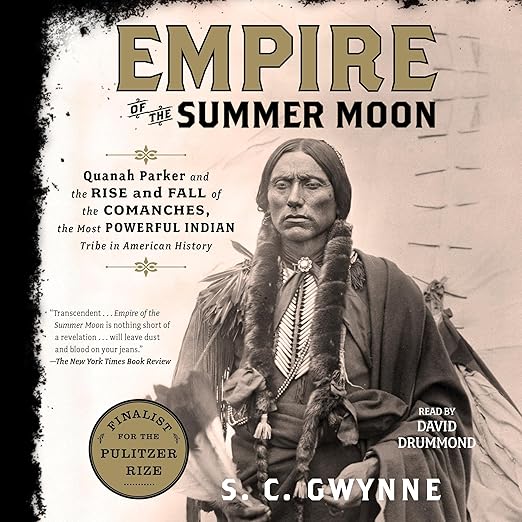
Quick Take
- Voice: David Drummond brings measured historical authority to 15 hours of Comanche history, pacing shifts between action and analysis with real skill.
- Big ideas: Comanche military power and decline, westward expansion mythology versus reality, Cynthia Ann Parker and Quanah
- Atmosphere: Immersive and unflinching, narrative history at its most substantive
- Worth it?: One of the most compellingly narrated American history audiobooks of recent decades, essential for Great Plains history and required listening if you think the story of the West is settled.
The Texas plains in the mid-nineteenth century were not a frontier in the romantic sense. They were a war zone: contested, violent, and far more complex than either the settlers moving west or the federal government managing them understood. S.C. Gwynne opens Empire of the Summer Moon in the specific texture of that complexity, and the audiobook, narrated by David Drummond, drops you into Comancheria with the disorienting immediacy of a dispatch from a war correspondent. Within the first chapter, the history you were taught, if you were taught it at all, reveals itself as a significant simplification of what actually happened in those four decades of conflict.
Comanche Power and the Parker Family's Story
The book carries two parallel narratives, and Gwynne integrates them with genuine structural skill. The first is the rise and fall of the Comanche as a military power, the story of how a relatively small tribe of hunter-warriors stopped the northward expansion of colonial Spain from Mexico, repelled French expansion from Louisiana, and then held the American frontier at the eastern edge of the Edwards Plateau for decades longer than either army or settler population could understand. The second is the specific human story of Cynthia Ann Parker, captured as a child in 1836 and raised as Comanche, and her son Quanah, who became the last great chief of the Comanche Nation.
Gwynne is a journalist by training, and it shows in the best possible way. He writes history the way the best narrative journalists write feature stories: with scene-setting, with character interiority where the historical record permits it, and with the kind of physical specificity that puts you on horseback in the grasslands rather than in a university seminar. The description of Comanche horsemanship, boys riding bareback by age six, warriors considered the most skilled horsemen who ever rode, is not just impressive. It explains why the American military struggled against them for so long.
This is a New York Times bestseller that was a finalist for the Pulitzer Prize and the National Book Critics Circle Award. Those recognitions reflect the quality of the writing rather than the cultural moment of its publication. Reviewers have praised it as 'the most interesting and comprehensive account of life in central prairies of United States from the late 17th until late 19th centuries,' which, based on what I listened to across 15 hours, is not an overstatement.
Drummond's Pacing Shifts Between Battle and Analysis
David Drummond's narration is the right choice for this material. He reads with the measured authority of a historian who takes his subject seriously, without ever sliding into the monotone that can make long history audiobooks feel like lectures. At 15 hours and 9 minutes, this is a substantial listening commitment, and Drummond earns the time. He differentiates the pacing between action sequences and historical analysis, giving the battles a slightly heightened tempo and the contextual sections a more deliberate rhythm that allows complex material to register properly.
The audiobook format serves historical narrative exceptionally well when the narrator is this skilled, because it enforces the linear reading of a story that rewards linear reading. Gwynne builds toward the story of Quanah Parker, the mixed-blood son of Cynthia Ann who became chief by force of personality and political intelligence rather than lineage alone, and the weight of that buildup pays off fully only if you have followed the entire arc of Comanche history that precedes it. An audiobook ensures you do.
Gwynne pushes back explicitly against the romantic mythology of westward expansion and against the dehumanization of Comanche violence that earlier histories often relied on as justification. He is writing history that holds complexity without collapsing it into morality plays. The audiobook gives that complexity the space it needs to develop, and Drummond's voice sustains it across the full 15 hours without the listener feeling the weight of the commitment.
Unflinching Violence and a Settler-Filtered Record
The violence in this audiobook is not gratuitous, but it is unflinching. Comanche raids and the retaliatory actions of frontier militias are described with enough physical specificity that listeners who are sensitive to detailed historical violence should prepare themselves. This is Gwynne's commitment to making the actual stakes of this conflict legible rather than abstract. But the choice is deliberate and serves the historical argument, so it is worth knowing in advance rather than encountering unprepared.
Some historians have noted that Gwynne's treatment of Native perspectives, while more sympathetic than most popular histories of the period, still operates primarily from the documentary record generated by white settlers and government officials. The Comanche voices in the book are largely filtered through that record, and listeners who come with a background in Native American history may find the epistemological constraints worth noting, even as they appreciate what Gwynne accomplishes within them.
Fits Alongside Grann, Larson, and Hampton Sides
History listeners who want American history told with journalistic immediacy and genuine analytical depth will find this audiobook essential. Anyone with ties to Texas, Oklahoma, or the broader Great Plains region will find Gwynne's account of the period illuminating in ways that formal education rarely provides. Listeners who have enjoyed narrative history by writers like David Grann, Erik Larson, or Hampton Sides will find Gwynne's approach closely aligned with that tradition.
Listeners who prefer history that centers Native perspectives rather than settler accounts, or who want a more academic treatment with full scholarly apparatus, should supplement this audiobook with additional reading. Empire of the Summer Moon is narrative history at a high level, but it is narrative history, with the genre's specific strengths and specific limitations both on full display.
Before You Listen
How does David Drummond's narration handle the 15-hour runtime of this audiobook?
Drummond differentiates his pacing between action sequences and analytical sections, which prevents the audiobook from becoming monotone. He reads with the measured authority the material requires, making the historical investment feel worthwhile throughout all 15 hours.
Is this audiobook appropriate for listeners who are sensitive to historical violence?
The raids and retaliatory violence are described with physical specificity rather than abstraction. Gwynne believes the reality of the conflict must be legible to be understood. Sensitive listeners should be prepared, but the graphic elements serve the historical argument rather than functioning as spectacle.
What makes the story of Quanah Parker the emotional center of this audiobook?
Quanah was the son of a captured white woman and a Comanche chief, raised fully within Comanche culture, and became the last and arguably greatest chief of the Comanche Nation. His story requires the entire arc of Comanche rise and fall as its context, and the audiobook's structure earns the weight of those final chapters.