At a Glance
- Narration: Derek Perkins carries sixteen hours and five emperors alone, and not one reviewer on this listing names the reading.
- Themes: The first five Caesars from Augustus to Nero, a republic gone wrong, source criticism, decline as narrative shape.
- Mood: Florid and lurid, quietly skeptical of its own sources.
- Verdict: A popular Roman history close to its best, though sixteen hours of ornate prose and unreachable notes ask something real of a listener.
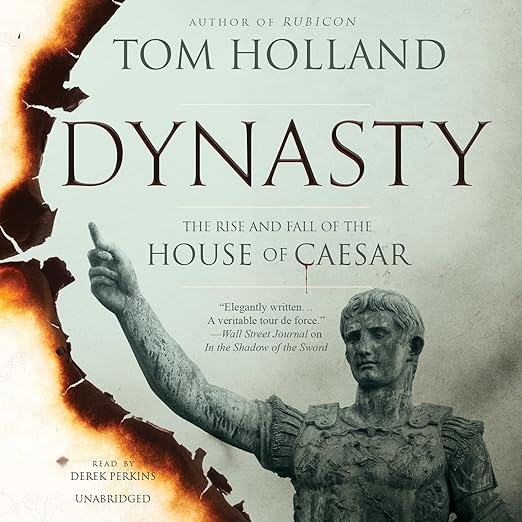
Sixteen hours of Julio-Claudian rule, five emperors running from Augustus to Nero, and a column of five reviewers who between them mention the recording exactly zero times. Dynasty is the sequel to Rubicon, opening at the murder of Julius Caesar, and this audiobook edition came from Blackstone Audio in October 2015. What the column does supply is unusually specific about the writing, and it repays close reading before you commit the better part of two working days. Five reviewers with strong opinions about prose and none about performance is a particular kind of column, and it shapes what can honestly be said here.
Perkins Narrates, but the Reviews Discuss Holland
Derek Perkins holds the reading and goes unnamed by anybody who wrote here. The closest the column comes is one sentence from T.R.: he narrates the reigns of Augustus, Tiberius, Caligula, Claudius and Nero. That is Holland doing the narrating, the author's own marshalling of the material, not the voice arriving in your ears. On an audio listing the word slides between two meanings, and everyone on this page has used the other one. Anybody scanning for a verdict on the performance will find a sentence that looks like one and is not.
Intrigue, Murder, and a Sequel Standing Alone
Augustus to Nero is the span, and the publisher's summary is refreshingly candid about where the appeal lies: intrigue, murder, naked ambition and treachery, greed, gluttony, lust, incest, pageantry, decadence. Michael Kohlhaas's four-star response makes the same point more drily, observing that the Julio-Claudian era stays ever-popular partly because a republic going wrong is a fascinating study and partly, in that reviewer's words, because of the good sexy bits. Two very different registers, both accurate, and the book apparently manages to hold them together.
Rubicon is the question anybody new to Holland will ask first, and the answer from this column is reassuring. Robert Hayes calls Dynasty a great sequel in much the same vein as its predecessor, though considerably longer and carrying more of the juicy material. Nothing in the description or the responses suggests the earlier book is a prerequisite. The copy says only that this one opens where that one ended, which is a chronological handoff rather than a dependency. Come to it cold and you lose some resonance; you do not lose the plot.
Kohlhaas Shelves Dynasty Beside Tacitus and Graves
Michael Kohlhaas's response is the most valuable thing on the page because it situates the book against a shelf, and names the shelf: Suetonius and Tacitus at one end, modern works by Alan Massie and Robert Graves at the other, with a dozen books on similar subjects already owned. A reviewer who has read the competition and still lands on four stars is telling you something that no enthusiastic newcomer possibly can. Four stars from somebody with a dozen rival volumes on the shelf is a firmer recommendation than five from somebody with none.
Robert W. Piedrahita's entry gets specific in a way that indicates close attention: Tiberius portrayed somewhat sympathetically in the early years, and Caligula removing the mask Octavian had placed over the power he had accumulated, revealing to the Romans what they had become. Whether or not you accept that reading, it is evidence the book makes arguments rather than merely relaying anecdotes, which is the line separating popular history from very old gossip, and it is the distinction that justifies the runtime.
T.R.'s four-star response holds the single most important sentence for anybody choosing the audio edition: the author has a terrific command of English and a florid manner of writing, which means it is not a quick read but certainly an entertaining one. Florid prose across sixteen hours is a real consideration. A sentence you can reread on a page has to land the first time when somebody else is delivering it at their own pace. That is not a reason to avoid the recording, but it is a reason to give it your attention rather than half of it.
One Vote Can't Produce a 4.4 Average
One rating, according to the counter, sitting behind a displayed 4.4. Five reviewers have left prose beneath that count, and 4.4 is not a figure any single whole-star vote can produce. The two numbers on this page are straightforwardly incompatible, and no reading of them recovers a usable average. Take the five write-ups as the evidence instead, note that their grades run five, four, five, five and four, and let the badge go.
Nero closes the book, and decline is the structure rather than merely the subject. T.R. describes the reigns as presented in a steady and sometimes astonishing fall from Tiberius onward, which is a shape rather than a chronology and worth knowing before you start. Sixteen hours of descent carries a different emotional weight from sixteen hours of survey, and anyone who prefers history level and unshaped may find this arc more novelistic than expected.
Suetonius, Tacitus and the rest raise the one genuine format problem. Robert Hayes praises the author for not always taking the primary sources at their word and cites the notes as proof, in the phrase as many of the notes attest. T.R. makes a parallel point about original sources each having their own reasons. Skepticism of that kind lives in the apparatus, and apparatus is precisely what an audio edition cannot let you flip to, check, or read at your own speed.
Newcomers Can Start Here Despite the Florid Style
Blackstone Audio published this in October 2015 and the earliest response on the page is dated February 2016, so unlike a good many older listings this column at least postdates the recording it sits under. Every entry still addresses the writing rather than the reading, and the vocabulary throughout is read, written, referenced, researched. The book got reviewed. The edition stays an open question, which is the honest summary of what this page is able to tell you.
Nobody should arrive expecting a tight single-volume narrative with a firm chronological spine, because the responses describe something richer and less orderly: a dot-connecting examination of the Julio-Claudian emperors, in PC's phrase, delivered without the tedium of an overly academic treatise. Newcomers to Roman history will do perfectly well starting here, provided they accept a florid style, sixteen hours of it, and a set of notes they will never once be able to consult.
Good to Know
Do I need Rubicon before starting the Dynasty audiobook?
Nothing here says so. The description states that this volume opens where Rubicon ended, at the murder of Julius Caesar, which is a chronological handoff rather than a dependency. One reviewer who read both calls it a great sequel in the same vein, so prior reading enriches it without being required.
How well do the source notes work in the audiobook?
Badly, by their nature. Two separate reviewers lean on the notes as evidence that the author interrogates Suetonius, Tacitus and the other ancient writers rather than accepting them. That apparatus is what a listener cannot flip to or scan, so the skepticism arrives as assertion rather than as something you can check.
Why does this listing show one rating and five responses?
Because the counter and the column contradict each other. A displayed 4.4 cannot be generated by a single whole-star vote under any convention, and five signed write-ups sit visible underneath that count of one. No usable average can be recovered, so the individual responses are the only evidence worth weighing.
How demanding is Tom Holland's prose to follow by ear?
More demanding than average. One four-star reviewer credits a terrific command of English alongside a florid manner of writing, adding that it makes for entertainment rather than speed. Over sixteen hours that ornamentation compounds, and a listener cannot slow down over a clause the way a reader can.