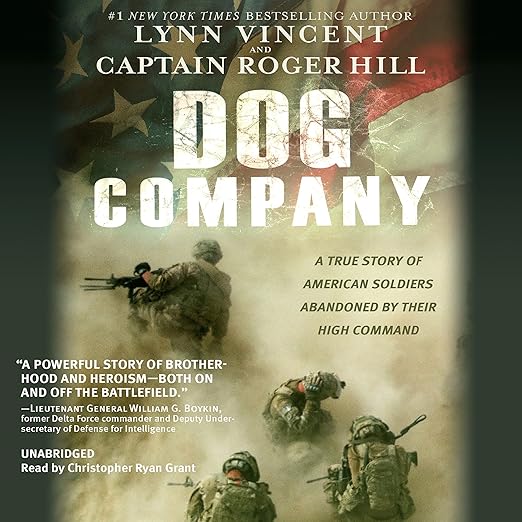
I started listening to Dog Company on a long drive back from a weekend away, somewhere past the point where the radio signal cuts out and the highway empties. That felt right, actually. Lynn Vincent's account of Captain Roger Hill and the 1-506th in Afghanistan's Wardak province is the kind of book that demands a quiet, uninterrupted stretch of road. By the time I pulled into my driveway, I was still sitting in the car, unwilling to stop the final hour.
Vincent, who co-wrote American Sniper with Chris Kyle, brings the same documentary precision here. Dog Company is built from interviews, records, and firsthand accounts, and the result reads less like a memoir and more like a prosecution file, one that builds its case methodically against a system that abandoned the men it sent to fight.
A Closer Look at Dog Company
What makes this book more than a standard war narrative is its structural argument. Vincent is not simply recounting what happened in Wardak in 2008. She is making a case: that the lawyered-up Pentagon war ethic of that era created an impossible bind for combat commanders, requiring soldiers to meet battlefield violence with courtroom-grade caution while the enemy faced no such constraint. Captain Hill's story is the proof of concept.
Hill is not presented as perfect. Vincent shows the pressure, the exhaustion, and the moment where he crossed a line with detained enemy fighters, a decision made in a fog of grief after two of his men died. But the book situates that decision inside a system that had already failed him repeatedly, from a battalion commander who threatened to relieve him constantly to a chain of command that vanished when he needed support most. The result is a portrait of institutional dysfunction that several reviewers compared to Breaker Morant, and the parallel is apt: a soldier tried for the crimes his commanders tacitly permitted.
What Makes Dog Company Worth Hearing
Christopher Ryan Grant's narration is a strong match for the material. He reads with a kind of measured gravity that avoids melodrama. There is no performative outrage, no swelling into moments that the text has already made emotional enough on its own. Grant lets the facts carry the weight, which is exactly what this kind of journalism-as-audiobook needs. At nearly fifteen hours, the pacing never drags.
The audio format also suits the sprawling cast of soldiers, officers, and bureaucrats. Grant keeps the voices distinct without resorting to caricature, which matters when you are tracking the moral positioning of a dozen different people across a 14-hour runtime. One reviewer noted that the book's structure jumps around in a way that occasionally made it hard to follow in print. I found the audio actually smoothed this out considerably, with Grant's transitions helping to orient the listener between timelines.
Things to Know Before Starting Dog Company
The foreword by Sean Hannity will immediately signal to some listeners where this book's political sympathies lie. That framing is worth holding at arm's length. The underlying story is genuinely important and does not require ideological endorsement to land. Vincent's reporting is solid, and the institutional critique she builds applies across administrations and political camps. Readers who come in expecting pure hero-worship will find something more complicated: a man who made a catastrophic choice under catastrophic pressure, and a system that put him there and then turned on him.
The section covering the counterintelligence operation, where Hill and his team identified enemy infiltrators on their own base in Wardak, is particularly vivid. So is the account of the battalion commander whose relationship with Hill is one of the book's most quietly devastating throughlines. These are the sections that linger.
Who Lynn Vincent Is Writing For
This one is well suited to listeners with an interest in military history, counterinsurgency doctrine, or the ethics of combat command. It works alongside books like Red Platoon by Clinton Romesha or The Outpost by Jake Tapper, which cover similar terrain in eastern Afghanistan during the same era. Readers who need narrative closure or moral simplicity should know upfront that Dog Company offers neither. The ending is not triumphant. It is honest about what happened to Hill and what it cost him, and that honesty is the book's greatest strength.