Before You Press Play
- Performance: Zeihan narrates his own work with the cadence of a practiced lecturer, which works in his favor given how argument-driven the material is.
- What it covers: American isolationism, the collapse of postwar global order, demographic and geographic determinism
- Feel: Intellectually bracing, occasionally alarming, consistently confident to the point of provoking disagreement
- Our call: Whether you find Zeihan's geopolitical framework revelatory or reductive, this audiobook will sharpen your thinking about global order and who benefits from American withdrawal.
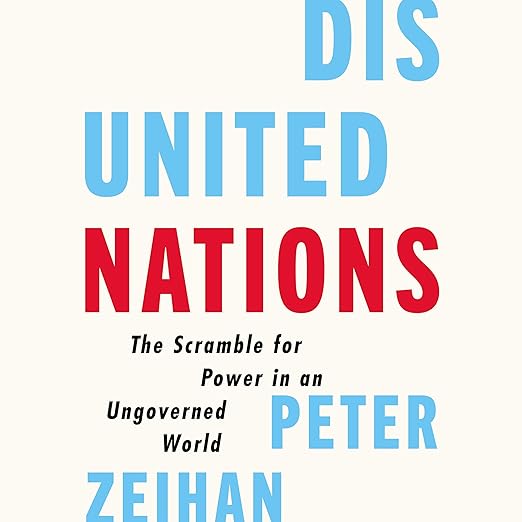
I finished Disunited Nations during a week when the headlines seemed to be running a competition to see which one could be most unsettling. That probably colored my experience of it, because Zeihan's argument, which is essentially that the postwar liberal international order was always an anomaly underwritten by American military and economic power and is now coming apart as that underwriting disappears, does not read as alarmist speculation when the morning news keeps providing illustrations. It reads as diagnosis.
Published in 2020, the book has aged in ways Zeihan could reasonably claim as vindication: the supply chain fractures he predicted, the weakening of multilateral institutions, the return of great-power competition. That does not mean his framework is correct in every particular, and the book's confident sweep across country after country invites the pushback that it simplifies as much as it illuminates. But the experience of listening to it is genuinely engaging, which is not something that can be said of most 16-hour geopolitical arguments.
First, the Big Picture
Zeihan's central counterintuitive claims are the most interesting parts of the book. His argument that Germany is declining as Europe's dominant power and that France is positioned to replace it runs against the conventional wisdom that has persisted since German reunification. His insistence that China's demographic collapse makes it a greater short-term geopolitical risk than North Korea was provocative in 2020 and has only become more credible since. His reframing of Saudi Arabia rather than Iran as the Middle East's most dangerous actor remains contested but is argued with enough specificity to merit serious engagement. One reviewer called the book shockingly revelatory even for a regular reader of serious international affairs publications, and I think that reflects how effectively Zeihan packages genuinely heterodox positions in accessible language.
Zeihan narrating his own work is the right choice here. His prose is already conversational, and his delivery carries the authority of someone who has spent decades briefing corporate and government clients. He knows how to pace an argument for listening rather than reading, which is not a skill all academic authors possess. The 16 hours feel appropriate to the scope of material covered rather than padded: there are chapters on Brazil, Turkey, Japan, and Saudi Arabia that are as fully developed as the better-known China and Europe material. A reviewer described the book as reading like a Tom Clancy novel for coming geopolitical disruptions, which overstates the narrative quality but captures the quality of sustained attention Zeihan commands.
Weak Spots in Disunited Nations
The book's confidence is also its principal limitation. Zeihan writes in declarative sentences about inherently uncertain futures, and listeners who are trained to notice epistemic hedging will occasionally find the certainty jarring. His framework, grounded in geography, demography, and what he calls the deep structural forces of international relations, tends to minimize the role of individual leadership decisions and political contingency. Those who find geographic and demographic determinism reductive will have specific objections to raise throughout. One reviewer, describing themselves as an idealist and a liberal, noted that they agreed with Zeihan's analysis while finding it deeply uncomfortable, which I think is the appropriate response: this is a book designed to disturb settled assumptions, not to comfort them.
The book was published before Russia's 2022 invasion of Ukraine, which Zeihan has addressed in subsequent work. Some of the Russia-specific material reads slightly differently in light of subsequent events, and listeners may want to check Zeihan's more recent publications for updated framing on that particular thread.
Is This One for You?
This is genuinely useful listening for anyone in business, policy, or international relations who wants a sweeping framework for thinking about where power is moving in the next two decades, even if their ultimate conclusion is that Zeihan overstates his case. Regular readers of serious international affairs publications will find it accessible without feeling dumbed-down. Listeners who prefer empirically modest geopolitical analysis, with more emphasis on uncertainty and less on structural inevitability, may find a complementary volume in something like Robert Kagan's work. Do not begin here if you expect to be reassured about the state of the world.
Common Questions
Does this audiobook hold up given it was published in 2020?
Largely yes, with some notable gaps. Zeihan's predictions about supply chain fragility, the weakening of multilateral institutions, and China's demographic vulnerabilities have tracked reasonably well. The Russia-Ukraine material would be framed differently today. His subsequent books update the framework.
How does this compare to Zeihan's other books like The Accidental Superpower or The End of the World Is Just the Beginning?
Disunited Nations functions as both a standalone argument and a mid-series development of ideas Zeihan introduced earlier. Listeners new to his work can start here without confusion, but those who want the foundational framework may prefer beginning with The Accidental Superpower.