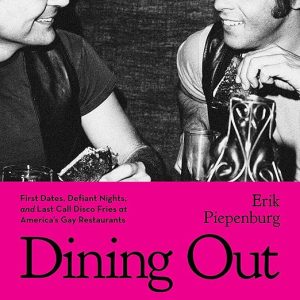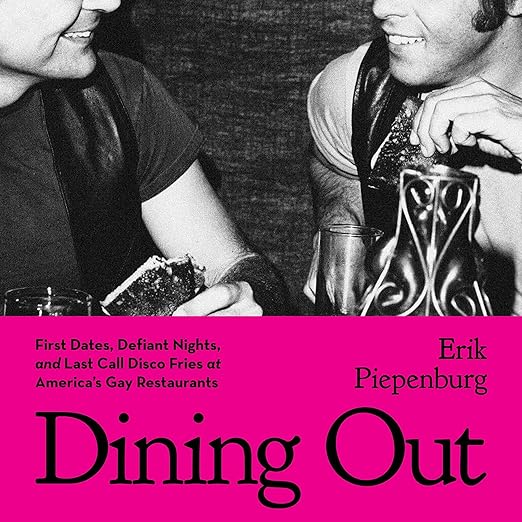
Gay bars have their historians. Gay restaurants, the diners and cafeterias and coffee shops where the same community ate rather than drank, have had almost none, and this audiobook sets out to fill that gap. Erik Piepenburg, a New York Times journalist, reads his own eight hours and fifty-seven minutes of reporting for Grand Central Publishing, moving from the cruisy urban cafeterias of the 1920s to the mom-and-pop diners that fed the Stonewall generation to the intersectional rooms of the early twenty-first century. It is a history built table by table, and the organizing idea holds up.
Filed Under History, Missing the Word Food
Three names carry most of the description, and between them they mark out the range: Hamburger Mary's, Florent, and a suburban Denny's queered by the kids who claimed it. A chain diner out in the suburbs sits beside a single-name institution, which is the whole argument in miniature. Piepenburg builds from archival material, original reporting, interviews and first-person accounts, so the book keeps switching register between documented history and somebody talking. Eight hours and fifty-seven minutes gives that alternation room to work without the thing collapsing into a directory of addresses.
Categories on this record work against it. The page files the book under history and LGBTQ+ and stops; the single tag repeats LGBTQ+. Nothing anywhere on the record says food, restaurants, dining or hospitality, on a book about what happened inside restaurants and whose title announces exactly that. A buyer browsing queer history will land here. A buyer browsing food writing, which is the other half of the natural audience and quite possibly the larger half, has no route to this page at all.
Piepenburg's Voice Carries the Connective Tissue
A reported book read by its reporter creates one problem and solves another. The problem: these pages are full of other people talking, owners and cooks and regulars whose speech was collected in interviews, and a journalist reading aloud has to hand those quotations over without impersonating anybody. The thing it solves is bigger. Connective tissue, the archival digging and the judgment calls about what a given room meant, belongs to one person, and close to nine hours in that person's voice suits material whose through-line is a point of view rather than a plot.
Geography is this book's quiet achievement, and a five-star filed on June 11, 2025 puts a finger on it. That entry singles out the Napalese Lounge in Green Bay, Wisconsin, and thanks the author for telling those particular life stories. Green Bay is not where queer history usually gets set. A book able to move between the famous rooms and a Wisconsin bar without treating one as the real subject and the other as a footnote is doing something the genre mostly does not, and that response is the most specific praise in the column.
Method matters here too, and a five-star filed on July 13, 2025 identifies it precisely: the journalistic style shows through, and the book covers not just the buildings and the locations but the people who owned and worked in them. That entry recommends the book to any historian working on the period from the 1960s forward, which is a fair description of what the reporting supports. Oral history is the backbone. The restaurants are the filing system, and the interviews are the reason to stay for nine hours.
Proper Nouns Will Blur in Ten Minutes
Four stars filed on August 18, 2025 is the lowest grade a buyer can actually read, and it contains no complaint. It calls Piepenburg's point of view strong throughout, describing him as a vegetarian gay man of a certain age, says the book stays relatable regardless, and singles out the sections on restaurants feeding people living with AIDS as powerful and poignant. Nothing visible on this page explains why anybody graded the book below five stars. Whatever produced the 4.4 badge is not present in the responses on display.
Practical caution for the audio: this is a book made of proper nouns. Restaurant names, cities, owners, decades, and a great many rooms that no longer exist. In print you can turn back four pages to work out which diner is which; in a linear file you cannot, and the density peaks exactly where the book is best, in the passages that stack several establishments in one stretch. Nobody needs to take notes, but the names will blur if you listen in ten-minute pieces.
The description is print copy from beginning to end. It addresses readers, promises joy and sex and sorrow and activism and nostalgia, and never once acknowledges that this edition is something you listen to. No word about the reading, no word about how the interview material is handled. That is ordinary for a nonfiction listing and it still leaves the audio buyer with less information than the print buyer gets, on the one decision that separates the two products.
More Food Culture Than LGBTQ History Alone
Queer readers of a certain vintage are the obvious first audience, and a five-star filed on July 2, 2025 makes the case for the second: it treats the book as a contribution to food culture and American storytelling rather than to LGBTQ+ history alone, praising the research and the way the book handles refuge, resistance and joy around tables and counters. Food writers, restaurant people and social historians will all find their own book in here. So will anybody who has ever had a regular booth somewhere.
Recipes, chef profiles and anything resembling a restaurant guide are all absent, so anybody shopping for those should look elsewhere: the cooking is beside the point and the best rooms in the book have closed. Readers who want a tight thesis will also chafe: the structure is a survey, and surveys accumulate rather than argue. Nine hours of that is a commitment. Come for the interviews and the AIDS-era chapters, which are where the reporting earns its length, and accept that the rest is a tour.
Frequently Asked Questions
Does Erik Piepenburg read the Dining Out audiobook himself?
Yes. The byline and the narrator credit carry the same name, which on a reported book means the interviews, the archival material and the first-person judgments all reach the listener through the person who assembled them. The runtime is eight hours and fifty-seven minutes, published by Grand Central Publishing in June 2025.
Is this about gay bars or about restaurants?
Restaurants, deliberately. Bars have been written about extensively and the book positions itself against that, covering cafeterias, diners, coffee shops and unconventional eateries from the 1920s onward. Bars do appear, since some of the rooms were both, but the argument is about the places where the community ate and lingered rather than drank.
How much US history knowledge does the audiobook assume?
Very little. Stonewall gets named, the AIDS years are covered at length, and the description sets the period range from the 1920s to the early twenty-first century. A five-star filed on January 24, 2026 sums up the entry level neatly, calling it an interesting book with great LGBT history of dining and leaving it at that.
Does the book cover restaurants that are still open?
Both, though the balance tips backward. The description runs from the cruisy cafeterias of the 1920s through the diners that fed the Stonewall generation to the intersectional rooms of the early twenty-first century, and frames the whole thing as rise, impact and legacies. Expect more closures than openings, since disappearance is part of the argument rather than a coda to it.