
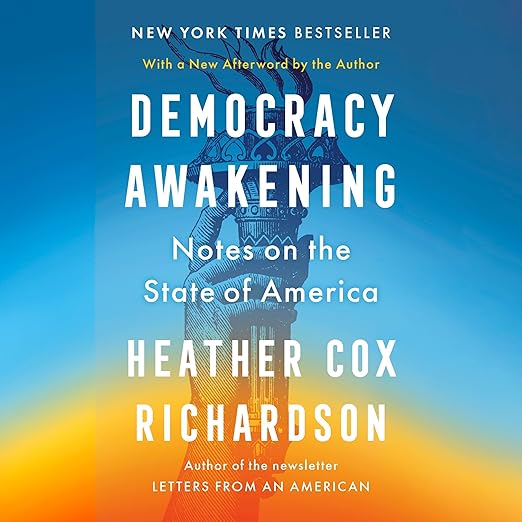
Historians rarely get to test their own thesis against the news cycle, and this audiobook was written by one who does exactly that every night. Heather Cox Richardson reads all eight hours and fifty-one minutes herself, which for a book about how political language gets weaponized is not a small decision: you hear the sentences delivered by the person who chose them. Penguin Audio released it in September 2023. The argument runs from the founding generation through the abolitionists, through Nixon, and out the far side at January 6, and the through-line is that modern conservatism has fed on a disaffected population by rewriting history in public to consolidate power.
Daily Posts from 2019, Compressed into a Spine
Heather Cox Richardson's public work began, as the October 2023 entry recounts in unusual detail, in September 2019, when reports broke about tying American aid to Ukraine to a promised investigation of a political rival, and a then little-known professor of history at Boston College started posting daily summaries of the unfolding constitutional crisis. Concise, well written, well grounded in history: that entry's account of how those posts spread among worried readers is the best short explanation of why this book exists at all. Democracy Awakening is that daily practice compressed and given a spine, and knowing the origin explains both its strengths and its seams.
Authoritarian experiment is the phrase the description attaches to the Trump years, and the method is to refuse to treat it as unprecedented. She traces the roots back to the earliest days of the republic instead, which is the move separating this from the shelf of political books published on the same schedule. The cost is that anyone wanting a blow-by-blow account of recent events will spend a great deal of the running time in the nineteenth century. The benefit is that by the time she arrives at the present, the pattern has been established three times over and no longer needs asserting.
Richardson's Same Voice, Reading Instead of Read
Language is the real subject, and the November 2023 entry identifies it precisely: how weaponizing words led the country to the gateway of authoritarianism. That entry then does something genuinely useful by tracing the argument's starting point back to the 1930s, when members of the Republican Party sought common cause with Southern Democrats because both detested Roosevelt's New Deal and believed government should be handed to business to pull the country out of the Depression, and took up the word conservatism to name that opposition. Whether or not you accept the framing, watching a single word get repurposed across ninety years is the most rigorous work in the book.
Newsletter readers should understand the relationship between the two formats before buying. Letters from an American is daily, reactive, and short. This is its opposite: a sustained argument that assumes you will stay in one place for nearly nine hours. The overlap in material is real, but the shape is entirely different, and the audio edition benefits from that compression, because the same accessible voice the description credits for drawing millions to the newsletter is here doing the reading rather than being read. A call to action is how the copy closes, and the final stretch does turn toward what participation is supposed to look like.
Five Five-Star Entries, a Rating Count of Three
American political history published at this speed always risks dating quickly, and this record carries a specific version of that problem. The description advertises a new afterword by the author, which is the sort of thing publishers add to a later paperback, while the audio release on this page is dated September 2023, matching the book's first appearance. Whether that afterword sits inside this recording is genuinely unclear from the record as it stands. The January 2026 entry supplies a second gap: its heading gives the full name as Democracy Awakening: Notes on the State of America, while the title on this page stops after two words. A missing subtitle is a small thing until you are hunting for the right edition.
Marketplace arithmetic on this page does not add up, and it is worth understanding before reading anything into the score. Five separate entries sit on display, every one of them at five stars, while the rating count above them reads three. Two of those entries were posted from outside the United States, including one from Germany in October 2025 calling it a balanced and very insightful book on the past and present of the American experiment. Ratings and written reviews are clearly being counted in different pools here. Treat the 4.7 as a figure attached to a very small sample rather than as a verdict from a crowd.
Consolidation for Newsletter Readers, Discovery for Others
If you already follow the daily newsletter, the honest question is whether you need this too, and the December 2025 entry answers it about as well as anything could: essential reading for anyone interested in United States history and politics, very accessible, from an academic historian with a large social media presence worth following. That entry is describing a reader who arrived at the book through the platform rather than the other way around. The book stands perfectly well on its own, but it will feel like consolidation rather than discovery if you have been reading along nightly.
Start here if you want the long view rather than the news summary, and pass on it if you came for reporting on any particular administration, because reporting is not the point and the older material is where the actual work has been done. Listeners who disagree with the politics will find the framing openly partisan and should know that going in; this is a historian arguing a case, not surveying a field. Nearly nine hours read by the author is a good format for an argument of this kind, since emphasis is part of the evidence. Vigilance is the word the closing section lands on, and the recording earns the right to use it.
Before You Press Play
- Narrator: Heather Cox Richardson reads her own book, which for an argument about how political language gets repurposed puts the emphasis exactly where the author intended it.
- Subjects: American democracy under strain, the history of modern conservatism, weaponized language and false history.
- Tone: Measured and urgent at the same time, closer to a lecture than a polemic.
- Bottom line: The long historical view repays patience, but look elsewhere if you want reporting on current events.







