Key Details
- Voice: Grover Gardner is credited for close to eighteen hours of clause-heavy argument, a job that asks for architecture rather than characterization.
- Big ideas: Credit before coinage, debtors and creditors, the moral vocabulary of owing, insurrection and forgiveness.
- Atmosphere: Patient, combative, digressive in the way good anthropology is.
- Worth it?: A major argument worth the eighteen hours, on a listing that has lost its own subtitle and shows a star average its vote count cannot produce.
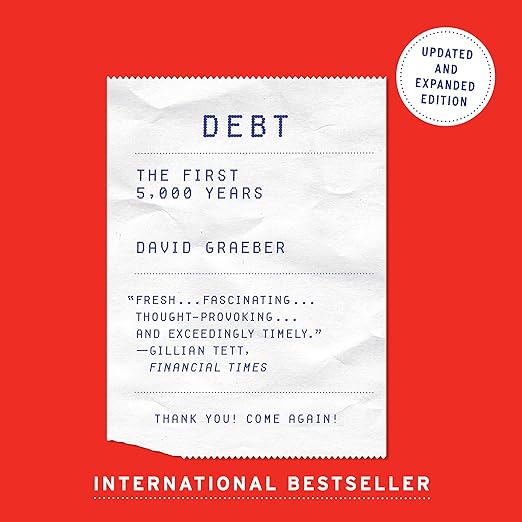
Anthropology is an odd place to go looking for a book about money, which is roughly the point David Graeber was making. This audiobook runs seventeen hours and forty-eight minutes in Grover Gardner's hands, and the argument inside it is one of the genuinely load-bearing nonfiction arguments of the last twenty years: that credit came first, coins came later, and almost everything we assume about the moral weight of owing somebody is an inheritance from a set of very old and very specific quarrels. It is also, on this particular listing, a book whose own name has gone missing.
Missing Subtitle, the First Five Thousand Years
Titles matter for finding things, and this one has been amputated. The field reads Debt, then a hyphen, then Updated and Expanded. The subtitle that made the book famous does not appear anywhere on the record; a reader named Jonny V supplies it in passing, calling the work Debt: the First 5,000 Years, which is the phrase almost everybody actually searches for. Anyone hunting the title they heard on a podcast will scroll past this entry without recognizing it. The Updated and Expanded label creates a second gap: nothing here states what was added, or how far the revision reaches, or when the original came out. For a work of argument that has been in circulation long enough to acquire critics, that omission is not cosmetic; a buyer deserves to know whether the seventeen hours include a response to those critics or simply a new preface.
Graeber's case is easier to summarize than to absorb. For more than five thousand years, since the first agrarian empires, people ran elaborate credit systems long before anyone minted a coin, and it is in that period that societies first split cleanly into debtors and creditors. From there the argument moves outward: quarrels over debt and debt forgiveness sitting at the center of political fights from Italy to China, and enough insurrections to fill a shelf. Then the piece of it that tends to stay with listeners, which is that guilt, sin, and redemption are words borrowed from accounting, and that we are still arguing in that borrowed vocabulary without noticing.
Gardner Holds Long Sentences With No Characters
Seventeen hours and forty-eight minutes is a serious sitting, and the reading job here is unusual. No characters, no accents, no dialogue to differentiate. What the book demands instead is a voice that can hold a long subordinate clause upright and land the end of a paragraph on the word that was doing the work, through digressions into agrarian empires, the language of ancient law and religion, and political quarrels that run from Italy to China and back again. Grover Gardner takes that credit. The record supplies nothing beyond the name, so I will describe the requirement and let the sample answer the rest. What I will say is that this is the kind of book where a reader's failure would be obvious within ten minutes, and where success is close to invisible, which is why nonfiction narration so rarely gets talked about at all.
Responses on this page span three countries and nearly a decade. Imperial Topaz, in 2017, manages to call it a long slow read and a page-turner in the same paragraph, which is exactly right about this book. Jonny V spent months on it, cross-referencing other economics works, and then rated the hardcover's physical build quality. A reader posting from France in 2019 describes it as unsettling and says the reread will have to come before any further comment. From Japan, in January 2026, two words: very interesting. Nobody in that column mentions a recording. What they do establish, collectively, is that the book survives slow reading, translation across markets, and being taken apart against other economics texts, which is more than most nonfiction of this size can claim.
Occupy Wall Street Already Reads Like History
Nick's four-star entry from 2022 raises the objection that matters most, and it is worth reading before you commit. The closing chapter, Nick argues, has aged strangely: Graeber's association with Occupy Wall Street was live and relevant when it was written, and Occupy has since receded so completely that the reference reads as archaeology, while the student debt crisis that now dominates the politics arrived after the ink dried. Given that this edition is sold as updated, that is a pointed observation. The audio dates from September 2015, so the update is itself ten years old.
Displayed rating: 4.6. Rating counter: 2. Written responses visible: five. Two whole-star votes cannot land on 4.6 under any rounding convention in use anywhere, and a counter reporting fewer ratings than there are visible reviews is broken in a second, independent way. I am not going to pretend the 4.6 means anything, and neither should you. The tag on the record says Ancient, incidentally, for a book whose closing argument concerns Occupy Wall Street, which suggests how much attention the metadata received. None of this touches the writing. It does mean the reassuring number crowning this page was assembled by something that is not working.
Ninety-Minute Stretches for Financially Suspicious Listeners
Readers who like being argued with will do best here, and so will anyone who has ever felt that the moral language around money does not quite fit the mechanics of it. The book rewards patience, works well in ninety-minute stretches, and does not require an economics background, though it helps to be comfortable with an author who takes four pages to get where a columnist would take four sentences, and who considers the detour the actual argument. Listeners who enjoy long-form history that keeps stopping to ask why the categories exist will recognize the pleasure immediately. It also suits anyone who came out of the last fifteen years of financial news with the feeling that the moral framing was doing something suspicious, and who wants that feeling given five thousand years of evidence and a shape.
Economists looking for models, and anyone wanting practical guidance about their own borrowing, are in the wrong building; this is a history of an idea, not advice. Skeptics of Graeber's politics should know the politics are not hidden, and the final stretch is where his contemporary commitments show most plainly, which is precisely what dated for one reader. Gardner has the runtime and the register this material demands, and whether the delivery earns eighteen hours is a question only your own ears can settle.
Questions Listeners Ask
Which book is this audiobook, exactly?
It is the updated and expanded edition of the work usually known by its subtitle, The First 5,000 Years, which one reader supplies since the title field here omits it entirely. The page never specifies what the revision added or when the original appeared, so treat the Updated and Expanded label as unexplained rather than informative.
Has the argument dated since publication?
Partly, and one reviewer says so directly. The closing chapter leans on Occupy Wall Street, which has faded from the conversation, and it predates the student debt politics that now dominate. The historical spine, covering five thousand years of credit, betrayal, and forgiveness, is untouched by any of that.
Is seventeen hours too long for a first-time listener of this audiobook?
It is long, and one reader admits to taking several months over the print edition while consulting other economics works alongside it. No specialist background is needed. What is needed is tolerance for an author who spends real time establishing why a question has been posed wrongly before going anywhere near an answer, which is the whole method here.