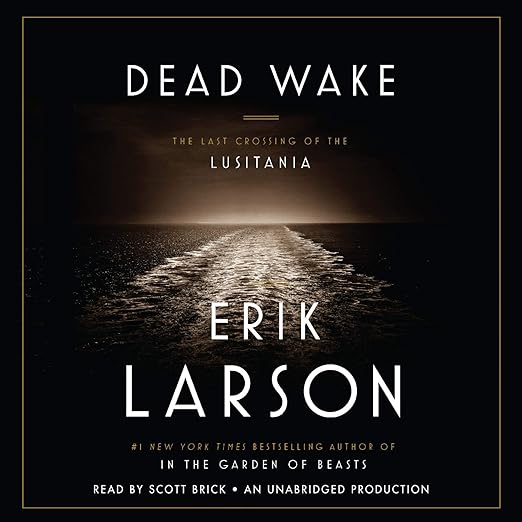
- Performance: Scott Brick has thirteen hours of alternating strands to keep apart, with a liner, a submarine and a grieving president running in parallel.
- What it covers: Hubris and chance, submarine warfare, intelligence withheld, America drifting toward the war.
- Feel: Elegant, dread-soaked and unhurried.
- Our call: Narrative history at the top of its form, provided you want texture rather than a fresh argument about causes.
May 1, 1915 is where this audiobook starts its clock, in New York, with a liner as richly appointed as an English country house pulling out for Liverpool carrying a record number of children and infants. The war was ten months old. Germany had declared the seas around Britain a war zone. The passengers boarded anyway, reassured by speed, by custom and by a century of rules that had kept civilian ships out of the fighting. Erik Larson writes the crossing as a countdown, and every chapter tightens it by another few hours.
Hubris, a Chance Fog, and a Guarded Secret
Hunter and hunted alternate, which is the structural decision the whole book rests on. On one side sits the Lusitania and Captain William Thomas Turner, trusting in speed and in the gentlemanly strictures of warfare. On the other sits Unterseeboot-20 and Walther Schwieger, operating under rules Germany had just decided to change. Between them sits an ultra-secret British intelligence unit that tracked the submarine and told nobody, which is the detail turning a maritime disaster into a moral question. Hubris, a chance fog and a closely guarded secret are the copy's own list of causes, and the book treats all three as equally decisive.
Perspective is what one May 2017 five-star singles out, and it names the method precisely: history assembled from small vantage points rather than from official records, built to bring the event out through the people who were inside it or lost their lives in it. That entry calls the result novel-like nonfiction and contrasts it directly with textbooks and objective documents. It also states the stakes plainly, describing the sinking as one of the major reasons America eventually entered the war. Then the page cuts it short, in the middle of explaining what the author wanted readers to feel.
Scott Brick's Restraint Serves a Structural Suspense
Specialists get the most valuable verdict in this column, and it is a carefully qualified one. A four-star filed in June 2015 comes from a reader who has followed this author since Devil in the White City and has worked through numerous books about the Lusitania, going back to one published in the 1970s. That entry finds Dead Wake entertaining and a joy, and its own title calls it a good book about the Lusitania but not a great one. For a subject with a long bibliography, that is precisely the calibration a new buyer needs: excellent as narrative, familiar as history.
Five people carry the human weight, and the copy names every one of them: the captain, the submarine commander, a Boston bookseller, a pioneering woman architect, and a president dreading the widening war while distracted by the prospect of new love. That last portrait is the one that surprises people. A book about a torpedo spends real time on Woodrow Wilson's grief and courtship, because Larson is writing America at the height of the Progressive Era as much as he is writing a sinking. Audio suits that arrangement, since each strand arrives as a person rather than as a chapter heading.
Scott Brick is the credited reader, and the column has nothing whatever to say about that. Across five written entries, nobody names a voice, a pace or a performance, so the recording itself sits unassessed on this page. What the material asks for is restraint. Narrative nonfiction of this kind fails when a reader pushes the suspense, because the suspense is already structural: the audience knows the ship goes down, and the tension comes from watching people who do not. Thirteen hours of countdown wants a reader willing to trust the countdown.
Praise from Entertainment Weekly, NPR, and a Novelist
Readers outside the United States filed three of the five entries here, and two of those were typed in languages that appear nowhere among this record's fields. The remaining entry from abroad, five stars in August 2016, is also the most vivid in the column: it credits the book with painting 1915 so completely that the horror arrives alongside a better grasp of how the war actually worked, and reports being mesmerized from the first page. That is a strong endorsement of the writing. It is also, like everything else here, an endorsement of a printed book.
Blurbs arrive before the book does, three of them, and one comes from a novelist rather than a historian. Entertainment Weekly calls it terrifying and enthralling, NPR calls it thrilling and dramatic, George R.R. Martin calls it thoroughly engrossing. Those endorsements sell narrative energy, which is fair enough, since narrative energy is exactly what this book has. The tag on the record is less defensible. Americas covers the departure port and the portrait of Wilson's country, and covers nothing about a British liner torpedoed in the seas around Britain by a German submarine, which is where the book spends most of its time.
Getting to Know a Passenger List, Day by Day
History listeners who want the texture of a period rather than an argument about it are the core audience, and anyone who has enjoyed this author's other reconstructions already understands the contract. Newcomers to the First World War are well served too, since the book explains the state of play as it goes and never assumes you already know why the waters around Britain mattered in 1915. The human scale does the teaching, which is a gentler route into the period than a survey history offers.
Skeptics of narrative nonfiction should know exactly what they are buying: a work that sets scenes, assigns motives and paces itself like a thriller, on a foundation of documented material. Anyone wanting a sustained argument about causes, or a historiographical account of what that intelligence unit knew and when it knew it, will find this thinner than hoped. What Dead Wake delivers instead is the thing a textbook cannot: a crossing lived day by day, a fog arriving at the worst possible hour, and a passenger list you have come to know by the time the torpedo does its work.
Does knowing how it ends spoil the audiobook?
The sinking is no secret to anybody, and the book is built on that fact. Suspense comes from proximity rather than outcome: a fog arriving at the wrong hour, an intelligence unit tracking the submarine and warning nobody, a captain trusting rules that had quietly stopped applying. Knowing the ending is the whole point of the structure.
Is this audiobook a reasonable entry point for someone who knows little about the First World War?
Yes. The book opens with the war already ten months old and explains the situation as it unfolds: why Germany declared the waters around Britain a war zone, why civilian liners had felt untouchable until then, and what changed. No prior reading is assumed, and the human scale keeps the politics legible throughout.
How does the audiobook compare with other accounts of the Lusitania?
The subject carries a long bibliography, and this one competes on narrative rather than on new evidence. What it offers is the day-by-day texture of a crossing and a cast you come to know, from a Boston bookseller to the commander of the submarine. Anyone already well read on the sinking should expect familiar events, freshly told.