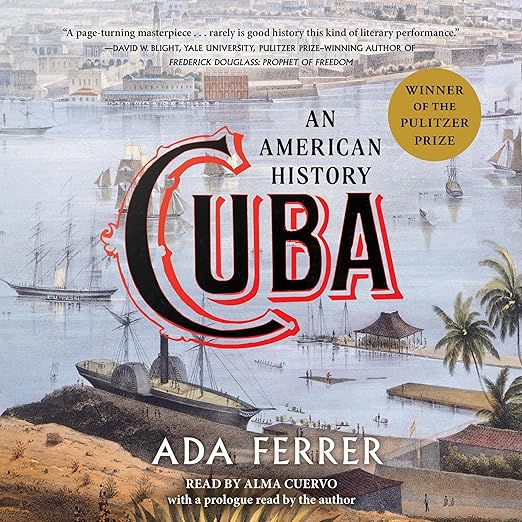
The listing calls this audiobook Cuba (Winner of the Pulitzer Prize), which is not what the book is called. Open the description and the real title appears in the third paragraph: Cuba: An American History. Somewhere in the pipeline the subtitle got evicted and the award moved into its slot, and the swap costs a browsing listener the single most useful piece of information on the page. An American History is an argument. It says the book treats Cuba and the United States as one entangled story rather than two neighboring ones. Winner of the Pulitzer Prize tells you a committee approved. Only one of those helps you decide whether twenty-three hours is a good use of your autumn.
Our Take on Cuba (Winner of the Pulitzer Prize)
Ada Ferrer covers more than five centuries, from before Columbus to a present day the book locates in 2021, drawing on thirty-odd years of research in Cuba, Spain and the United States. The spine of it is the relationship: 1961 and the severed diplomatic ties, the revolution three years earlier, ten American presidents facing fifty years of Fidel Castro, his death in 2016, the retirement of his brother and successor in 2021, and the swings in Washington from an opening to a reversal and back into question. The Pulitzer and the Los Angeles Times Book Prize both went to it, which the title will not let you forget.
Twenty-three hours and thirteen minutes is the commitment, and it deserves saying plainly rather than in a parenthesis. That is a full working week of listening for a survey history, and the responses are honest about what that costs. One reader, who rates it five stars and calls it by far the best book on Cuba and the United States they have read, opens by warning that this is not an easy read and that you would have to be seriously interested in the subject to find it worthwhile.
Alma Cuervo holds that entire credit alone, and across five written responses nobody says a word about the reading. That silence matters more here than it would on a shorter book. At this length the narrator is not a delivery mechanism, it is the experience: one voice, twenty-three hours, five centuries of names and dates and shifting governments. A listener has no way to sample the pacing from this page, and the people best placed to describe it were all reading print.
Why Listen to Cuba (Winner of the Pulitzer Prize)
Interconnection is the thesis, and it is what lifts the book above a chronology. The description promises the story of how the island kept turning up in American affairs and how American power kept reshaping the island, and readers confirm the emphasis lands. One calls the approach a deliberate focus on the interconnections between the two countries, deeper than most people assume. That framing is the reason a listener with no family connection to the island has a stake in this material rather than merely an interest in it. The prize citations sit at the top of the description; the argument sits quietly underneath them.
Tampa is where the argument stops being abstract, and a reader supplies the example rather than the publisher. The cigar industry there traces to Cuban exiles arriving in the 1880s and 1890s, and Cuban coffee and the Cuban sandwich still turn up on ordinary menus in the area. That is a small, checkable, slightly domestic fact, and it does more to explain what the book is arguing than any of the prize citations stacked at the top of the description.
Readers coming in cold are well served, according to the people who came in cold. One recommends it specifically for anyone who likes survey histories and knows little about Cuba, praising the on-the-ground anecdotes and quotes that make events feel inhabited rather than catalogued. Another, writing from the United Kingdom, describes learning a great deal that schools never taught. Between them they describe a book that assumes no prior knowledge while refusing to condescend, which is the hardest register in popular history to sustain for this long.
What to Watch For in Cuba (Winner of the Pulitzer Prize)
Gene Killian, the one dissenting voice, files a four-star response worth reading before you commit. It grants that Ferrer is an excellent and engaging writer and that the recounting of five hundred years is impressive, then argues the treatment of the Cuban government's more troubling chapters suffers from tunnel vision, and wonders aloud whether the author's own politics have edited the record. That objection is stated carefully and without heat, and any listener planning to use this as their single account of Cuba should hear it before hour one rather than after hour twenty.
A single rating props up the 4.6 badge on this page while five separate readers have filed full responses under it. A single whole-star rating cannot average to 4.6 under any convention, so the score and the counter are not describing the same thing, and neither of them is describing this recording. The written column is the only usable evidence here, and it is unanimous on the writing, split on the politics, and completely blank on the audio.
Politics in the description also stop moving in 2021. Biden's election is the last event named, and the questions the copy raises about the country's future are the questions of that moment. The history is not perishable, but the final stretch is, and a listener arriving years later should treat the closing chapters as a snapshot with a date on it rather than as current reporting. Nothing on the page flags that, and nothing has to, but a buyer is entitled to know which decade the last chapter is standing in.
Who Should Listen to Cuba (Winner of the Pulitzer Prize)
Serious readers of narrative history are the audience, and specifically the ones who want a single authoritative volume rather than a skim. It rewards listeners with a personal stake, whether Cuban, Cuban-American, or simply American and curious about a relationship most school curricula skip. Anyone who enjoys history that argues a case while telling a story will find the case argued clearly and the story told well, and twenty-three hours starts to feel like a feature rather than a toll.
Casual listeners should be honest with themselves about the runtime and the density, both of which the most enthusiastic reader on the page flags as real barriers. Anyone wanting a critical account of the revolutionary government from the inside should read the four-star objection first. Twenty-three hours asks for a decision, not a whim, and this listing gives you the prize, the praise and nothing whatsoever about the voice you would be spending them with.
Quick Take
- Narration: Alma Cuervo carries twenty-three hours and thirteen minutes of five-century history as the only credited voice, and not one of the five written responses mentions the reading.
- Themes: five hundred years of Cuban history, entanglement with the United States, revolution and its long aftermath, who controls a national story
- Mood: Dense, narrative and unhurried
- Verdict: The single-volume account its readers rate above every rival, at a length that demands you genuinely want it.