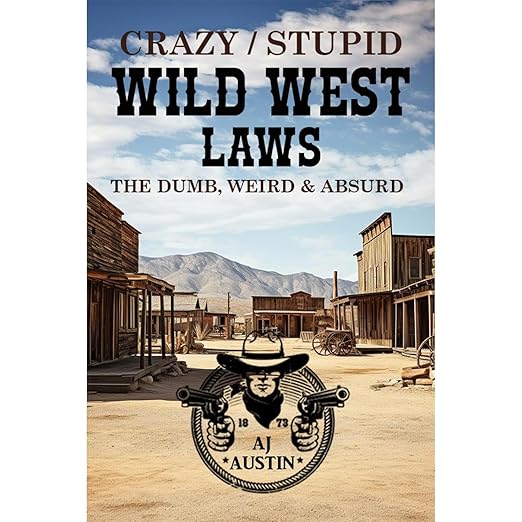
Tombstone's Ordinances Outshine the Earp Mythology
What did Tombstone's city council actually prohibit, and why? Most people know the Earp mythology and the gunfight at the OK Corral, but the municipal ordinances that governed life in that city are less famous and, as AJ Austin's audiobook argues, considerably more revealing about how communities actually function under pressure. 'Crazy/Stupid Wild West Laws' approaches the Wild West through its legal record rather than its legend, and the result is a listen that is funnier and more historically illuminating than the title might suggest at first glance.
At 1 hour and 13 minutes, this is a short-form audiobook, and it works best understood as exactly that: a curated collection of legal oddities from frontier settlements between the early 1800s and the turn of the century, organized into episodes with enough context to make the absurdity legible. Austin does not pad the material or stretch it past its natural length, which is a discipline that short-form history writers sometimes lack. The episodic chapter structure suits audio listening particularly well, since each segment is self-contained enough that a listener who tunes back in after a distraction can re-engage without losing the thread.
AI Narration Misses the Comic Weight
The Virtual Voice AI narration is a genuine limitation here and worth stating plainly. AI narration delivers the words without the tonal intelligence to know which moments deserve a pause, which oddities should be allowed to sit before moving on, and which turns of phrase carry comic weight that requires rhythmic handling. For comedic popular history, where the punchline often arrives in the juxtaposition of dry legal language with the reality it was attempting to govern, that tonal absence costs something real. Listeners who are particularly sensitive to AI narration should be aware that this is not a human narrator.
The material itself compensates substantially. Austin covers Deadwood's gambling licenses, Tombstone's discharge ordinances, and a range of frontier regulations that reveal how communities improvised governance in the absence of established law. The stories behind the laws are what make this entertaining, and Austin's research into those stories gives the audiobook more historical texture than its casual register might imply. Deadwood's strict gambling licensing, for instance, reflects a genuine attempt to control revenue and regulate violence simultaneously: a more interesting civic story than the saloon-brawl mythology suggests.
Gambling Licenses Reveal Pragmatism Over Chaos
The humor is consistent and grounded in genuine historical detail rather than invented comic exaggeration. Frontier communities really did produce laws that sound absurd to contemporary ears because they were solving problems that contemporary legal systems had never encountered: what to do about aggressive cattle in city limits, how to regulate a profession like saloon-keeping that existed in legal ambiguity, what constituted a legitimate claim in territory where land law was still being written. Austin understands that the absurdity comes from the specificity of the situation, not from the lawmakers being foolish.
The relationship between law and order in the Wild West was genuinely complicated in ways the mythology obscures. The famous lawlessness of frontier towns was often short-lived; communities moved quickly to establish legal structures because economic activity requires predictability, and predictability requires enforceable rules. The gambling licenses of Deadwood were not evidence of a town comfortable with lawlessness; they were evidence of a town trying to regulate an industry that was going to exist whether licensed or not, and choosing taxation and accountability over prohibition and chaos. Austin's audiobook surfaces that pragmatism, which is more interesting than the outlaw romanticism that usually gets the attention.
The book's framing of 'pioneer, prospector and settler creativity in legal form' is the right lens. These laws are not primarily evidence of stupidity, despite the title's comedic framing. They are evidence of improvisation under pressure, which is historically more interesting than mere absurdity. Austin mostly honors that distinction, treating the lawmakers as people doing their best in extraordinary circumstances rather than as figures of mockery, which keeps the historical integrity of the material intact.
For listeners looking to understand the Wild West through something other than biography or military history, this audiobook offers a usefully different perspective. Legal codes are some of the most revealing documents a community produces, because they reflect what people were actually afraid of and what they were actually fighting over. That dimension of the material is what makes it more than entertainment, even in its short-form package. The history of frontier legal improvisation is also the history of a society deciding what values it actually wanted to enforce when enforcement had real costs, which is a question with obvious contemporary resonance.
Short Commute Listening, with One AI Trade-off
Casual history listeners who enjoy popular nonfiction with an accessible tone, fans of the Old West who want a different entry point than the standard biography or battle history, and anyone looking for a short-form audiobook that covers ground efficiently without demanding sustained attention will find this worthwhile. The runtime makes it a natural companion for a commute, a short drive, or a lunchtime session. The episodic structure means you can stop anywhere without losing a larger narrative thread.
Listeners who prefer human narration for comedic material should be aware of the Virtual Voice limitation. The content is solid; the delivery is the variable. Academic historians or listeners seeking primary source analysis will find the popular format too light for their purposes. But for curious listeners who want a fresh angle on frontier history and can tolerate AI narration, Austin's research is worth the hour.
Does this audiobook use Virtual Voice AI narration, and how does that affect the listening experience?
Yes, the narrator listed is Virtual Voice, which is AI-generated narration. For comedic popular history where timing and tonal awareness matter, this is a noticeable limitation. The content is well-researched, but listeners sensitive to AI narration may prefer the print edition.
Is this audiobook historically accurate, or is the legal content exaggerated for comic effect?
Based on the synopsis, Austin's approach grounds the comedy in actual historical legal codes from Wild West towns including Tombstone and Deadwood. The absurdity comes from the laws themselves, not from invented embellishment, which makes it more interesting as history.
How long is this audiobook, and is it a good choice for a short commute?
It runs 1 hour and 13 minutes. The episodic structure makes it well-suited to commute listening, since each segment is self-contained and does not require sustained linear attention to follow.
Does the audiobook cover specific towns like Tombstone and Deadwood, or is it a general survey of frontier law?
Both specific and general material appear based on the synopsis. Tombstone's shooting ordinances and Deadwood's gambling licensing are named examples, with additional chapters covering frontier law more broadly across the period from the early 1800s to the turn of the century.