Quick Take
- Performance: Virtual Voice provides AI-generated narration; the performance is functional but lacks the comic timing the material needs to land as intended.
- What it covers: State-by-state American legal oddities, the accumulation of specific regulations over time, and the gap between legislation and common sense.
- Feel: Lighthearted in intention, uneven in execution, best approached as rapid-fire trivia rather than historical exploration.
- Our call: A short, accessible collection of genuine American legal oddities that works as trivia fuel but falls short of its comedy and insight ambitions.
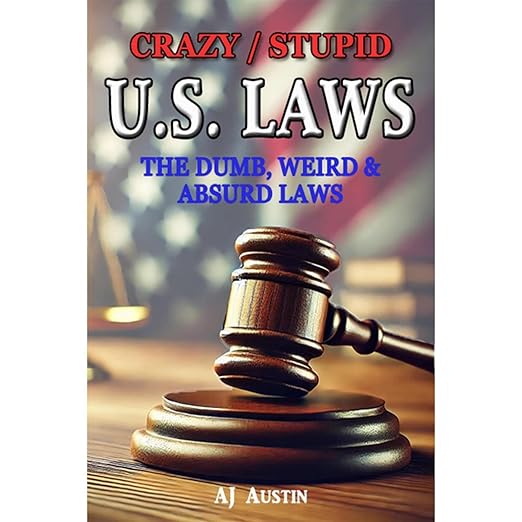
What happens when a state legislature bans something so specific it implies a genuine incident? That question is, in essence, the entertainment premise behind Crazy/Stupid U.S. Laws, an audiobook that tours the more peculiar corners of American legal codes across all fifty states in just over an hour. The narration is handled by Virtual Voice, meaning this is an AI-generated audio performance, which is worth knowing before you begin and which the listening experience makes evident quickly.
Fifty States Squeezed Past Any Real Depth
A J Austin's project is primarily a trivia collection dressed as legal history. The premise has genuine legs: American state law is a remarkably varied patchwork, and the specific regulations that accumulate over centuries of local legislation do produce examples that are both genuinely absurd and genuinely illuminating about the social concerns of their moment. Laws banning specific actions in specific public spaces, regulations governing the treatment of particular animals in particular contexts, and licensing requirements for activities so obscure as to puzzle contemporary readers all exist in the real American legal corpus.
The challenge for this kind of book is depth. The most interesting thing about any strange law is the story behind it: what happened, who complained, what emergency was being addressed. At just over an hour, this audiobook cannot provide that context for all fifty states. The result is a rapid-fire survey that lands closer to a listicle in audio form than to the historical narrative the framing suggests. For listeners expecting genuine exploration of American legal history, the execution falls short of that promise.
Corny, Says the Only Review on File
The book's single available review is candid: "Corny, not informative nor is it funny." That response reflects what happens when trivia content promises insight it cannot deliver within its runtime. The laws themselves are real, but the framing of them as endlessly hilarious misunderstands how comedy works: absurdity requires context to land, and the book provides very little context.
That said, the stated goal of the project, lighthearted entertainment and trivia ammunition for social situations, is achievable within these constraints if a listener sets appropriate expectations. Not every audiobook needs to be a serious historical investigation, and a collection of state-by-state legal oddities has a clear audience among people who enjoy unusual facts and want an efficient delivery system for them.
AI Narration Undercuts the Comic Delivery
The audiobook format, even with AI-generated narration, makes the material accessible in situations where reading is impractical: commutes, household tasks, short listening sessions that do not require sustained attention. At just over an hour, the entire book fits in a single sitting without asking much of a listener's schedule.
For trivia enthusiasts who want unusual American legal facts they can share in conversation, the content does deliver a collection of genuine oddities from the legal codes of all fifty states. The research, whatever its depth, has produced a sufficient supply of strange examples to generate conversational material. Listeners who use audiobooks as a source for social trivia rather than substantive knowledge will get what they came for.
The AI narration via Virtual Voice is worth noting as a format consideration. The performance lacks the nuance and comic timing that a skilled human narrator would bring to material of this kind, which matters particularly for content that aims to be funny. The irony and emphasis that make absurdist legal examples land as jokes in spoken form depend on delivery, and AI narration does not reliably manage those cues.
Honest About Operating at the Trivia Level
The rating for this title sits at 3.0 out of 5, which reflects mixed reception rather than consistent enthusiasm. Listeners who discovered the book through an interest in American legal history or genuine legal scholarship should be aware that the book operates at the popular trivia level, not the research level. The laws listed are real; the analysis of why they exist or what they reveal about American legal culture is minimal.
The AI narration, while functional, will be noticeable to listeners accustomed to human narrators. Timing, emphasis, and the natural rhythm of spoken comedy are all areas where the Virtual Voice performance shows its limitations. This is a practical consideration rather than a fatal flaw, but it affects the overall listening experience for content that depends on delivery for much of its effect.
At just over an hour, the audiobook does not overstay its welcome even if the content falls short of expectations. The investment is minimal, and listeners who go in knowing what they are getting will not feel misled.
Trivia Ammunition, Best Enjoyed with Modest Hopes
This audiobook suits trivia enthusiasts who want an efficient collection of American legal oddities without the investment of a full-length legal history. Listeners looking for light entertainment for a short commute or a simple background listen will find the runtime appropriate. People who enjoy sharing unusual facts in conversation will find the content serves that purpose even if it does not explain the facts particularly well. The all-fifty-states structure gives the book a satisfying sense of comprehensiveness, even if each state's coverage amounts to only a handful of examples.
Listeners who want substantive engagement with American legal history, cultural analysis of why specific laws exist, or genuinely sharp comedy about legal absurdity will find this audiobook does not reach those goals. For that audience, a longer and more carefully researched treatment of the same subject matter would be more satisfying. The book is best understood as a starting point for curiosity rather than a destination for it.