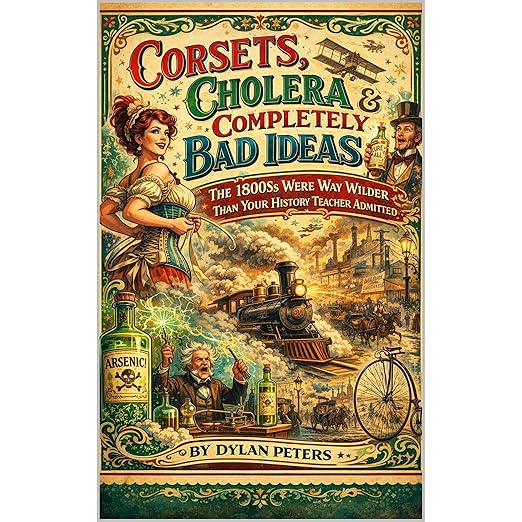
Poisonous wallpaper, radioactive cosmetics, coffins fitted with safety bells: this audiobook is a list, and its four-hour-forty-four-minute runtime never once indicates where the list came from. Dylan Peters promises the strange truths of the 19th century that textbooks usually skip, delivered fast and without ceremony. The pitch lands because every item on offer is the kind of thing you repeat to somebody within a day of hearing it, which is precisely why provenance matters more here than on a book you finish and shelve.
Missing Provenance, yet a Defensible Spine Underneath
Think about what happens to a book like this after the last chapter. Medicine mixed from cocaine, arsenic and opium. Children sent down chimneys to work. Public executions attended as entertainment. Electricity applied to corpses. Ketchup sold as medicine. A panic around early trains that the copy calls railway madness. Nobody remembers a fact book as a book. People keep six items from it and repeat them for years, usually without whatever qualifier was attached at the time. A title whose whole value is portable claims owes the listener some indication of where each claim came from, and this description offers none.
Filing is the second puzzle. The record files it twice, under History and again under politics and social sciences, with a tag reading Americas. The copy, meanwhile, opens on Victorian society and its preaching about manners and morality, and keeps returning to that vocabulary throughout. Whether the material covers one side of the ocean, both, or some mix of the two is not something the page settles, so a shopper hunting for a specific national history should read the tag and the description side by side and treat the gap between them as unresolved.
Virtual Voice does the reading, and the copy it has been handed was written for the eye. Think the 1800s were polite, quiet, and proper? Think again. Short lines, a bulleted inventory, a closing three-beat about a century that was absolutely chaotic. That rhythm belongs to a page somebody skims quickly. A hired reader is normally the person who varies pace so item forty does not arrive sounding exactly like item three, and a generated voice is not performing that job. On a book assembled out of separate items, the cost shows up as sameness rather than as bad acting.
Underneath the freak show sits something more respectable, and the copy names it: the weird, dangerous and surprisingly relatable world of everyday people living through the 1800s. That is social history in a fast package. Hygiene, work, transport, medicine and what people put on their faces are the real subjects, and the shocking framing is a delivery mechanism rather than the point. Judged that way, the book has a defensible spine, and the best entries are likely to be the ordinary ones rather than the ghoulish ones.
Self-Contained Items Survive Interrupted Listening Well
Shape is the format's quiet advantage. Self-contained items make an unusually forgiving listen: lose four minutes to a phone call and you lose four minutes, not the thread of an argument built across three chapters. Very few nonfiction titles survive interrupted listening that well, and at two hundred and eighty-four minutes the whole thing fits into the gaps of an ordinary week without ever needing a bookmark you can trust.
Curiosity gets served properly, too. Why early trains produced a medical panic. Why some people were buried with bells attached. Why wallpaper could poison a family slowly. Why ketchup once sat on a shelf as medicine. Every one of those is a question with an answer waiting behind it, which is a sturdier structure than a theme illustrated by examples, and it gives the listener a reason to stay for the next item rather than merely permission to.
Self-description is honest as well. The copy names its audience outright: people who love strange history, unbelievable true stories, and the hidden side of everyday life. Nobody is being sold scholarship. The register is a wink rather than a lecture, right down to Think again as the second sentence, and a listener who wants exactly that will not feel misled by anything on the page.
Marketing Baked into the Title Itself
No historian is named anywhere. No archive, no museum, no primary document, no date more precise than the 1800s. Popular history often works this way and popular history usually gets a bibliography regardless. Since the entire appeal of these items is that they sound too strange to be true, the fair working assumption is that a few of them have drifted somewhere between the record and the retelling. Check anything you intend to repeat, especially anything arriving with a memorable name already attached.
Nobody has scored it and nobody has written about it. The file is dated March 10, 2026, and the series field reads Centuries with no position number, so whether companion volumes exist, how many, and where this one falls among them all stay unknown. Every impression available today comes from a description written to sell, which is worth holding in mind while reading the confident parts of it.
Marketing work is happening in the title, occupying the space where a subtitle usually does something descriptive. Way Wilder Than Your History Teacher Admitted establishes a register, invents an opponent and promises a correction before a single chapter begins. Built well for a search result. It also sets an expectation the material has to keep meeting for four and three-quarter hours, and a sequence of shocks is the hardest possible structure for sustaining shock.
Verify Before You Repeat It at Dinner
Collectors of strange historical detail will get their money's worth here, as will listeners who want nonfiction that survives being interrupted. It suits curious teenagers, long tasks that need company, and readers whose interest in the 19th century starts with how people lived rather than with who governed them. Treated as a doorway into a period, it opens onto plenty.
Look elsewhere if you want dates, citations, or one national history handled properly rather than gestured at. Verify anything you plan to pass along at a dinner table, and hold the whole thing as a list of leads worth following rather than a set of facts already established.