
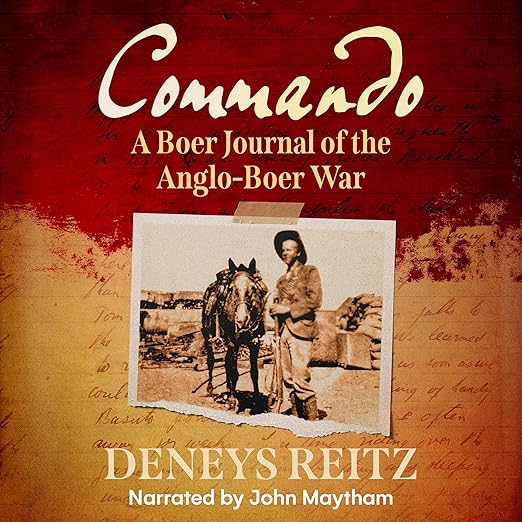
Seventeen years old, mounted and armed, Deneys Reitz begins the account this audiobook carries, riding out in 1899 with the Boer army against the British. He could already ride, shoot and swim, the description says, almost from the time he could walk, and across eleven hours and thirty-five minutes those skills and the endurance he built during the campaign are what keep him alive. A boy's competence on horseback, turned into a war record. That is the book, and it explains why it outlived almost everything else written about the conflict from the losing side.
Missing a Year, Called a Classic Anyway
The value here is proximity. Reitz served with several commandos and was present at major actions including the Battle of Spion Kop, and he moved among the era's decisive figures rather than reading about them afterward: President Paul Kruger, the Boer generals Piet Joubert, Louis Botha, Koos de la Rey, Christiaan Beyers and Jan Smuts, and on the other side the British commander Lord Kitchener. Very little first-person writing from any war puts a teenaged private that close to the men making the decisions, and the perspective shift between those two altitudes is what gives the book its texture.
Nowhere on the listing does the book's own age appear. The copy says the account is as relevant today as when it was first penned and calls it a South African classic, both of which imply distance, yet no publication year for the original appears anywhere. The only date the record carries belongs to this recording, issued by Jonathan Ball Publishers in July 2024. A buyer therefore cannot tell whether they are getting a memoir written in the immediate aftermath of the fighting or a reconstruction assembled decades later, and for a first-person war narrative that gap changes how you read every page.
Maytham Must Keep Joubert Distinct From Botha
John Maytham is credited with the reading, and the assignment is unusually specific. This text runs on proper nouns: Boer surnames, South African place names and river crossings, unit designations and the rank structures of two armies, arriving at the pace of a campaign diary rather than a lecture. A listener who cannot see the spelling depends entirely on the reading to keep Joubert distinct from Botha and one river crossing distinct from the next. The second half of the job is restraint, since a teenager's flat reporting of terrible things loses its force the moment it is performed. Try a battle passage before buying.
Eyewitness testimony of this quality is rare because the conditions that produce it usually kill the witness. Reitz was inside a mobile guerrilla force for the duration, which means the book records the parts of war that official histories compress into a sentence: distances covered, weather endured, the plain physical cost the description sums up in one word as endurance. The description promises prose that carries both the brutality and the beauty of the fighting, and that combination is exactly what makes soldier memoirs endure while campaign histories date.
The aftermath adds a second, quieter arc. Reitz built a lasting personal and political friendship with Jan Smuts after the war, founded on mutual respect between men who had fought together. Knowing that the young rider in these pages ends up bound politically to one of the figures the description calls prominent puts a different weight on the early chapters, and it is the sort of context a listener carries through the whole recording.
Testimony From One Side, Typos and All
This is a partisan memoir and should be listened to as one. Reitz enlisted at seventeen to fight for his own side and wrote from inside it, so the book is testimony rather than history, and the figures the description lists are almost entirely commanders and politicians, with one British general standing in for an entire opposing army. The civilian experience of the war, the politics that started it and the society Reitz was fighting to preserve are not what a combatant's journal is built to examine. Bring a history alongside it.
The record itself needs a light warning too. Forty-two ratings have produced a 4.6 average, which is perfectly consistent arithmetic, and not one written response sits beneath them, so a buyer gets a number with no reasoning attached. The publisher copy has also gone out unproofed: one sentence describes fighting as a member several Boer commandos, and another describes a friendship built one reciprocal respect. Small errors, but they are the visible ones, and they suggest nobody read the page closely before it went live.
Seventeen and Riding Through a War Diary
Military history listeners are the obvious audience, particularly anyone who prefers testimony to analysis and wants the guerrilla phase of a colonial war described by somebody who rode through it. Readers of South African history get a foundational text with the country's later leadership walking through it. It also belongs on the shelf beside the great young-soldier memoirs, because the central fact of the book, that a seventeen-year-old is doing all of this, never stops being the thing that makes it extraordinary.
Approach it as a general account of the Boer War and you will finish underinformed. It is one rider's field of view over several years, not a survey, and it assumes you already know why the two sides were fighting and what the republics were. Listeners who need content warnings should note that the brutality the copy advertises is not figurative. Students starting an essay would be better served by reading a modern history first and coming here for the texture that no history can supply.
Good to Know
Is this audiobook a history of the Boer War or a personal memoir?
A memoir, firmly. Reitz enlisted at seventeen and wrote from inside the Boer commandos, so the book records what one rider saw across several years of campaigning. Major events such as the Battle of Spion Kop appear because he was present, not because the narrative is surveying the war.
Does the audiobook need prior knowledge of the conflict?
Some background helps a great deal. The narrative assumes you know who the Boers were, why they were fighting the British and how the republics were organized, and it moves between engagements without pausing to summarize. Pairing it with a general history makes the eyewitness detail far more legible.







