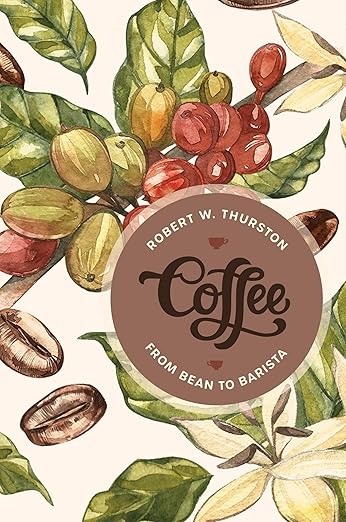
Coffee by Robert W. Thurston is the most comprehensive single-volume treatment of its subject I have encountered in audiobook form, and that comprehensiveness is both its greatest strength and the quality that makes it most demanding of sustained attention. Dan Kassis narrates eighteen-plus hours of content spanning coffee's journey from Ethiopian highlands through colonial trade routes, global markets, climate crises, and specialty roasting culture, and the result is a genuinely authoritative listen that rewards patience with an unusually complete picture of one of the world's most culturally significant commodities.
Kassis Prioritizes Comprehension Over Vocal Performance
Thurston's approach is that of a careful academic who has also spent considerable time in the field, and that combination gives the book a credibility that more enthusiast-focused coffee books sometimes lack. He does not romanticize the industry. The sections on climate change and its effects on arabica cultivation are sobering, and Thurston presents the data on shifting growing regions, hybridization research, and agricultural adaptation without either catastrophizing or minimizing. The picture that emerges is of an industry under genuine structural pressure, which makes the cultural celebration of coffee that runs through other sections feel complicated rather than uncritical.
The historical portions are particularly strong. Thurston traces coffee's path from its origins in Yemen and the Ethiopian highlands through the coffeehouses of the Ottoman Empire, the Dutch colonial trade system, and the European bourgeois public sphere with the authority of someone who has spent years with primary sources. Carl Pletsch described this book as 'indispensable' for anyone interested in coffee beyond the surface level, and the historical depth is a significant part of why that assessment holds up.
Kassis's narration is clear and consistent without being particularly characterful. For a book of this length and this density, a narration style that prioritizes comprehension over performance is probably the right call, and Kassis delivers precisely that throughout the long runtime. The audiobook format requires slightly more attentiveness from the listener than the print version would for content this information-dense, but the pacing is measured enough to make that manageable for engaged listeners.
Modular Chapters Let You Skip Around Freely
The audio format works for this book primarily because of how well-organized Thurston's arguments are. Each chapter functions as a self-contained unit of inquiry, which means the audiobook is genuinely modular: you can return to specific sections without needing to re-establish extensive context, and the overall arc from cultivation through culture through contemporary challenges is clear enough to follow even if you dip in and out across multiple listening sessions.
The sections on brewing culture and the contemporary specialty coffee industry are where Thurston is most accessible and most engaging for general listeners. His examination of the third wave coffee movement, the revival of traditional brewing methods, and the contested meaning of 'quality' in coffee culture brings the book's historical and agricultural analysis into immediate relevance. These sections reward attention even from listeners who came primarily for the history or the global trade dimensions.
For listeners interested in the intersections of globalization, climate change, and social justice, Thurston provides substantial material on the labor conditions of coffee production, the economics of fair trade certification, and the structural inequities between producing and consuming countries. These sections make this considerably more than a coffee appreciation guide and give it genuine relevance to readers interested in commodity economics.
Broad by Design, Thin in a Few Spots
The limited reviewer base for this audiobook makes the reception harder to triangulate than a title with broader coverage. Carl Pletsch's scholarly appreciation gives a clear sense of what the book offers for engaged, informed listeners, but readers looking for a more conversational or anecdotal approach to the subject may find Thurston's academic register demanding across eighteen-plus hours of listening time.
Some sections, particularly those covering the technical chemistry of roasting and the scientific research on hybridization, will be more accessible to listeners with some scientific background. Thurston explains these areas clearly, but they require closer attention in audio form than they might in print, where you can re-read a difficult passage immediately rather than rewinding and relying on memory.
The book's ambition is its scale, and that scale occasionally means that specific topics receive less depth than specialists might want. The coffee cultures of Japan and Scandinavia, for example, are interesting but brief given how significant those markets are to contemporary specialty coffee. Thurston has made editorial choices about what receives extended treatment, and not every listener will agree with where the emphasis lands. Listeners with particular expertise in any single dimension of coffee, whether history, agronomy, or the economics of trade, will likely find those sections illuminating but ultimately less detailed than dedicated monographs on those specific topics. The book's value lies in its breadth rather than its depth in any single area.
Understanding Coffee Completely Takes Eighteen-Plus Hours
This audiobook is best suited for listeners who already have genuine interest in coffee as a subject and want to understand it comprehensively rather than cursorily. Specialty coffee professionals, food and beverage writers, students of agricultural economics, and global history enthusiasts will find the depth and rigor consistently rewarding. Casual listeners looking for a quick appreciation primer may want something lighter as an entry point before committing to eighteen-plus hours.
The book is also a strong choice for anyone working on or thinking through questions of climate adaptation in agriculture, fair trade economics, or the global commodity trade. Thurston's treatment of these issues is substantive and current enough to be genuinely useful for research and policy contexts, not just personal enrichment. For the listener who wants to understand coffee completely rather than just appreciate it, this audiobook is the most thorough resource available in audio form.