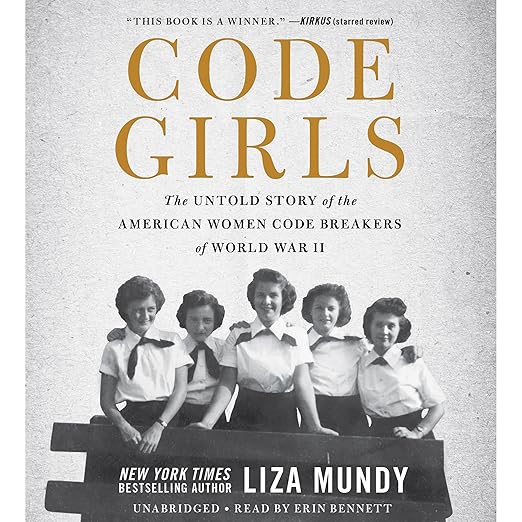
Secrecy is the reason this book had to be written at all, and it is also why the audiobook runs fourteen hours and four minutes. More than ten thousand American women were recruited by the Army and the Navy, out of small towns and elite colleges alike, to break codes during World War II, and a strict vow afterward nearly erased every trace of what they had done. Liza Mundy rebuilt the record from research and from interviews with the surviving code girls, and Legacy Lit released the recording in October 2017.
Bennett Alone Carries Ten Thousand Women's Testimony
Ten thousand women is a number rather than a story, and the copy names that structural problem without meaning to. Any history at this scale has to keep alternating between the individual and the aggregate. The description promises both: the meticulous work of code-breaking, and the careers it opened to people who had been shut out of them, with the claim that the effort shortened the war and saved countless lives. The runtime gives the book room to move between those registers instead of choosing, which is precisely why it works better as a long listen than as a skim.
Direct testimony gives this page its most striking account. That reader heard about the book several months ahead of publication and was determined to get to it immediately, because their own mother had been among the code breakers at Arlington Hall, a largely civilian group of women working under the auspices of the US Army. Then comes the detail no publisher's paragraph would supply: a teacher who left a girls' boarding school in Virginia not only to serve her country, but to do more exciting and challenging work than peacetime made available to most women. One sentence, and the book's entire argument about what the war opened is inside it.
Erin Bennett carries the entire file alone, which on this particular book is a consequential piece of casting. A history assembled from interviews contains a great many voices that are not the author's, women recalling their own work decades after the fact, and one reader has to mark every shift from narration into testimony without a second performer to lean on. That makes the transitions matter more than the character work, and the preview is where a listener finds out whether the seams hold.
Cribs and Additives Explained Without Getting Technical
Specifics are what the four-star entry brings, and they earn its place here. That reader is taken back to the early 1940s, before, during and after the war, for a story of talented American women working to break the communication codes used by the Germans and the Japanese, and singles out the brief tutorial on decoding technique: cribs, overlaps, additives. The verdict on that tutorial is the useful part. Not too technical, and sufficient to give a reader real appreciation of how difficult and tedious the job could be. Popular history that explains its own method without curdling into a manual is much harder to write than it looks.
Difficulty and tedium are exactly why a recording suits this material. Codebreaking was repetitive by design, and a listener experiences repetition differently from a reader, who can skim a paragraph of process and move along. A long spell inside that grind sits closer to the texture of the actual job than a fast read ever could. Set that beside the fact that the secrecy oath kept most of these women from describing their work even to their own families, and the sheer duration of the file starts to read as a form of restitution.
A Five-Star Rating That Is Really About Shipping
Part of one response here is not about the book at all. It calls the thing superb and informative, then flags what a buyer should genuinely weigh, lots of names, dates and detail to absorb, before closing with thanks to a retailer for sorting out a mis-order quickly and efficiently. That final sentence is grading a delivery rather than a recording, which is a useful reminder of what star lines actually aggregate. The observation before it stands entirely: this is a dense book, and audio gives you no way to glance back at a name from three chapters ago.
Density is the practical caveat, and it deserves specifics. Mundy moves between named individuals, service branches, Washington offices and technical procedure, and any of those threads can slip away from a listener who looks up for a minute. A reader flips back to check which woman was posted where. A listener holds it or loses some of it, which for most people is an acceptable trade on a book whose emotional weight survives the loss of a surname or two.
SugarCamp Dayton Gives One Reader a Family Link
Readers who know the codebreaking story as it usually gets told, with men at the center of it, are the intended audience, and this is built to correct a record rather than decorate one. It also rewards anyone drawn to institutional history: how a recruitment pipeline gets built from nothing, what the Army and the Navy each wanted, and how ten thousand people were moved to Washington and taught a skill almost all of them arrived without. The war is the occasion here. The machinery is the subject.
Family readers are an audience this book has already found, and one of them left something that reads like an addendum. The reader behind it had a mother posted to SugarCamp in Dayton Ohio, who told stories at home about her days helping the war effort, and the entry credits the book with highlighting a few intelligent, brave women who led the code-breaking while also giving an overview of the thousands working around the clock behind them. That is a precise description of the method, offered by somebody in a position to check it.
Pass on it when what you want is the cryptography rather than the people. The technical side arrives as context rather than as subject, and anyone hoping for a full account of how the ciphers actually fell will find the explanation deliberately short. Listeners who dislike group history, where no single figure ever occupies the whole book, should also weigh that, since the cast is enormous by design. Fourteen hours is a genuine commitment for a subject a shorter treatment could sketch, though the sketch would miss what this one exists to do.
In Brief
- Voice: A single credited reader across fourteen hours, which makes stamina as relevant a casting question here as characterization.
- Big ideas: Wartime codebreaking, a secrecy oath that erased a record, careers opened by war, institutional history.
- Atmosphere: Absorbing and detailed, with the tedium left honestly in.
- Worth it?: The best kind of long history listen, provided you accept a cast of thousands and few cipher specifics.
Common Questions
How long is the Code Girls audiobook and who narrates it?
Fourteen hours and four minutes, with Erin Bennett as the sole credited reader, put out by Legacy Lit in October 2017. That length is substantial for popular history and reflects the scope, since the book covers recruitment, training, two service branches and the postwar silence rather than one operation.
Did the women in the Code Girls audiobook ever get to discuss their work?
The description says a strict vow of secrecy nearly erased their efforts from history, which is why the book had to be rebuilt long after the fact, out of research and out of testimony from the women still able to give it. Many held that silence for decades, and the reconstruction is the real subject.