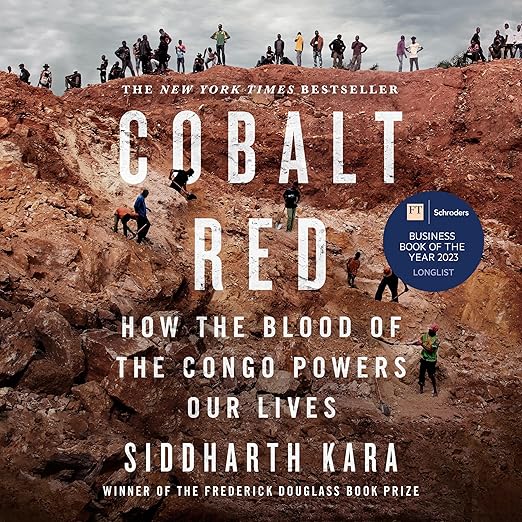
Siddharth Kara traveled to militia-controlled mining areas in the Democratic Republic of the Congo to gather the testimonies collected in Cobalt Red, narrated by Peter Ganim in this audiobook, and the method matters as much as the conclusions. This is not an investigative work that aggregates secondary sources into a policy argument. Kara went to the places where cobalt is extracted from the ground and talked to the people doing the extracting, children among them, in conditions that international labor law prohibits and supply chain audits consistently fail to detect. The result is a first-ever exposé of what the global cobalt supply chain actually rests on, and the audiobook's author's note, read by Kara himself, adds a dimension of direct testimonial authority that no hired narrator can replicate.
The stakes are structural rather than exceptional. Approximately 75 percent of the world's cobalt supply comes from the DRC. Cobalt is an essential component of every lithium-ion battery currently manufactured. Every smartphone, laptop, tablet, and electric vehicle in global circulation depends on a supply chain that passes through these mines. This is not a story about a rogue operator or a correctable anomaly in an otherwise sound system. It is an account of the system's foundations, and Kara's argument is that the system cannot be audited into compliance because the problem is the system itself.
What Siddharth Kara Delivers
Ganim's narration carries a significant burden in this audiobook. The testimonial passages, in which Congolese miners, including children, describe their working conditions, their injuries, and the structures that prevent them from leaving the mines, require a narrator who can render voices from circumstances radically different from the listener's without the performance becoming mediation that softens what is being said. Ganim largely succeeds at this. He does not editorialize through delivery. He renders the testimonies with the gravity they require and trusts the content to do its work.
The supply chain investigation is the book's second major contribution alongside the testimonies. Kara traces the path of child-mined cobalt from a toxic pit to the logistics chains of consumer-facing technology companies, and the precision of this tracing is what distinguishes the book from more generalized criticism of mining practices in developing countries. He is naming specific companies and specific practices, and the implications for every technology user in the developed world are not abstract. Reviewers describe the book as changing how they view particular subjects permanently, which is the specific response to a work that has not allowed the reader a comfortable distance from its conclusions.
What Siddharth Kara Gets Right
The audiobook format makes a particular kind of argument for this material. Kara writes that we must all care about what is happening in the Congo because we are all implicated, and the format of an audiobook playing through the same kind of lithium-ion-battery-powered device whose supply chain the book is describing creates an uncomfortable loop that print does not. This is not a metaphor Kara makes explicit, but it is one the audiobook format makes available to every listener who encounters the material through a phone or tablet. The medium is evidence.
At 11 hours and 18 minutes, the audiobook covers the full scope of Kara's investigation: the history of cobalt extraction in the Congo, the current mechanics of artisanal and small-scale mining, the international supply chain, the specific involvement of technology companies, and the policy implications. The New York Times Book Review placed it among Notable Books of the Year in 2023, as did The New Yorker, which provides useful calibration for the book's quality and ambition relative to the investigative nonfiction field.
Where Siddharth Kara Loses Some Ground
The sections where Kara describes his physical movement through the mining territories are not incidental detail. They are evidence. He is demonstrating that these areas are accessible to a researcher willing to go there, which is a structural argument against the supply chain audits that technology companies point to as evidence of due diligence. If Kara can get in and speak to miners, so can auditors. The implication of those scenes, that the audits do not find what they do not look for, is one of the book's most politically charged arguments.
The child labor testimony is the material listeners may be most tempted to pass through quickly, and it is the material that most requires sustained attention. Kara is careful to present these testimonies without sensationalizing them. They are accounts of economic desperation and structural coercion rather than dramatic horror, and their very ordinariness, the fact that these are routine working conditions rather than aberrant incidents, is the quality that makes them most difficult to absorb and most important to hear.
Who Should Pick Up Cobalt Red
Listeners with any interest in global supply chains, the human rights implications of the green energy transition, or the political economy of technology production will find this audiobook essential context. Those who own smartphones or electric vehicles and want to understand what their participation in those markets actually funds should treat this as required listening rather than optional background.
Listeners who want actionable conclusions alongside difficult information should know that Kara's book is primarily investigative and testimonial. The policy recommendations exist but are not the book's primary contribution. If you are looking for a solutions-focused account, this is not that. It is a documentation of a problem that the world has not yet decided to solve.
In Brief
- Narrator: Peter Ganim delivers the testimonial passages with the gravity they require, and the author's note read by Siddharth Kara himself adds a layer of direct accountability that few investigative audiobooks achieve.
- Subjects: Supply chain complicity in human rights abuses, the Congo's cobalt economy, the cost of the green energy transition
- Tone: Urgent, unflinching, and deliberately uncomfortable
- Bottom line: Kara's ground-level investigation into cobalt mining in the DRC is the kind of audiobook that makes continued ignorance harder to justify, and Ganim's narration gives the testimonies the weight they deserve.