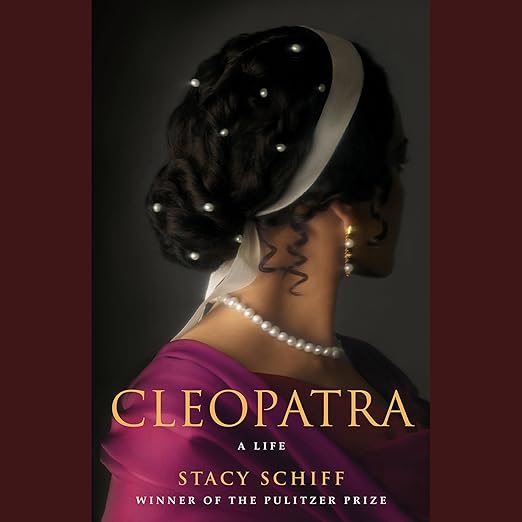
How much of what we think we know about Cleopatra was invented by people who wanted her diminished? Stacy Schiff spends fourteen hours and sixteen minutes answering that, and her answer is: most of it. The audiobook is a biography, but it is also a sustained argument about evidence, which makes it a stranger and more demanding listen than the palace-intrigue framing suggests. Onyx, garnets, and gold are in here. So is a running quarrel with the Roman writers who supplied nearly everything later ages believed.
No Response Mentions Robin Miles's Pacing
Plutarch and Dio are the problem the book is built around. T. Graczewski, who wrote the most substantial response on the page, lays it out cleanly: the Cleopatra most of us know is a fictional creation assembled by early Roman writers, and taking them at face value is, in Schiff's own comparison, like reading a history of twentieth-century America written by Chairman Mao. Schiff's thesis follows from that. If the name is indelible, the image is blurry, and the biography's real subject is the gap between the two.
Robin Miles is the credited reader, and the credit does something specific for this material. A book whose argument is that a woman's voice was overwritten by her enemies gains a small extra charge when it arrives in a voice rather than on a page. Whether that charge lands is unknown, because no response among the five on this listing mentions the narration, the pacing, or the handling of the many ancient names the text requires. Fourteen hours of classical nomenclature is a real performance problem, and the column has left it entirely unexamined.
Fame and Power Obscured the Real Cleopatra
Fourteen hours suits this book better than its length might imply, because Schiff writes in scenes. The marriages to two brothers, the civil war fought against the first while both were teenagers, the poisoning of the second, the disposal of an ambitious sister: the biography moves through them as episodes rather than as an argument with footnotes attached. Liesl credits it with taking a critical look at what the authors of Antiquity wrote and at the role modern media played in keeping those myths alive. Both halves of that description are accurate.
Schiff's own reputation is part of the sales pitch, and JuliaC makes the case at length: winning the Pulitzer Prize twice for nonfiction on unrelated subjects, plus a third shortlisting, which is an unusual record by any measure. What that buys the listener is confidence in the handling of sources, and the book needs it. Cleopatra had one child with Julius Caesar and, after his murder, three more with his protégé, and both alliances read very differently depending on which surviving Roman account you privilege. Schiff shows her work on those choices rather than smoothing them into a single narrative line.
Dinogirl7 supplies the only grade below five and also the most useful framing for a prospective listener. That response calls it a solid introduction to the period, well researched enough for an armchair historian and lively enough for anyone with a passing interest, then identifies the book's real preoccupation: that Cleopatra's myth obscured her reality even during her own lifetime. Fame and power, not romance, are what the biography keeps circling. Shermin Shakiri, posting in March 2026, puts the same thing more briefly, praising a portrait of intelligence, leadership, and political skill that goes past the usual myths.
Every Blurb on This Page Predates the Recording
Little, Brown and Company is listed as the publisher, which is a book house rather than an audio imprint, and the rest of the page is consistent with that. The description opens by quoting a Kirkus Reviews citation naming it one of the best books of the twenty-first century, a designation awarded long after a title released in November 2010, and closes with a Wall Street Journal blurb. Every piece of framing here belongs to the printed edition. None of it addresses a recording, which is worth noticing before you treat the surrounding praise as praise for what you are about to hear.
Readers arriving for the Elizabeth Taylor version will find the book actively hostile to it. Shakespeare and Shaw put words in her mouth, the description says; Michelangelo, Tiepolo, and Taylor put a face to the name; and Schiff's project is to strip all of that away. What remains is a shrewd strategist and an ingenious negotiator operating in a world of assassination and incest, which the description calls family specialties without flinching. That is a colder book than the packaging implies, and listeners who want the love story will spend fourteen hours being told the love story is largely Roman invention.
Two is what the vote counter says, and 4.2 is what the badge says, and those cannot both describe the same set of whole-star ratings. Five people have written full responses underneath, which is more than the counter admits exist. I would not read anything into the 4.2 at all. The written column is worth reading in full instead: it runs five, four, five, five, five, and the substantial entries argue about method rather than about drama, which is the most reliable signal of a serious history that a comments section can give you.
Sample Robin Miles Before You Trust the Badge
Anyone who reads popular history for the argument rather than the anecdote should start here. The book rewards attention to how a claim is sourced, and Schiff makes that visible without turning the prose academic. Listeners with a general interest in the ancient Mediterranean get a well-paced entry point, since the period is reconstructed rather than assumed. And anyone who has absorbed Cleopatra mainly through film will get the most out of it, because the whole book is organized around dismantling exactly that inheritance, piece by piece, with the sources named as it goes.
Casual listeners who want a romance with a queen in it should pass, and so should anyone hoping for a straightforward chronology, since the structure keeps doubling back to ask who told us this and why. Fourteen hours of source criticism is a genuine commitment even when the prose is this good. Robin Miles remains an unknown quantity on this page, so a sample matters more than the rating badge, which in this case describes nothing verifiable. Let Schiff argue with Plutarch for an afternoon and the queen who emerges will be less familiar and considerably more interesting than the one you brought with you.
Questions Listeners Ask
Is the Cleopatra audiobook a straight biography or something more argumentative?
Both, and the argument is the point. Schiff reconstructs a life while continuously interrogating where each detail came from, since the surviving accounts were written by Romans with reasons to distort. Expect chronology interrupted by source criticism. One respondent identifies the central claim as myth having overwhelmed reality within her own lifetime.
Who narrates the Cleopatra audiobook, and what do listeners say about it?
Robin Miles holds the credit for the entire recording. Nobody on this listing has commented on the reading at all, which leaves a fourteen-hour performance full of ancient names completely unassessed in public. Given how much this text depends on tone and irony, sampling before purchase is more useful here than usual.