Key Details
- Narrator: George K. Wilson is a sturdy, professional narrator whose clarity serves Ambrose's first-person accounts well, he does not perform the material so much as transmit it, which is the right call for oral history built from real voices.
- Subjects: Ordinary courage under extraordinary pressure, the institutional character of the American military, the personal cost of collective victory
- Tone: Immersive and heavy, with the specific weight of history told through individual faces rather than commanding officers, close enough to feel it, wide enough to comprehend it
- Bottom line: Ambrose at his most characteristic, accessible, humanizing, and willing to let the soldiers' own words do the work that more literary historians would do through analysis.
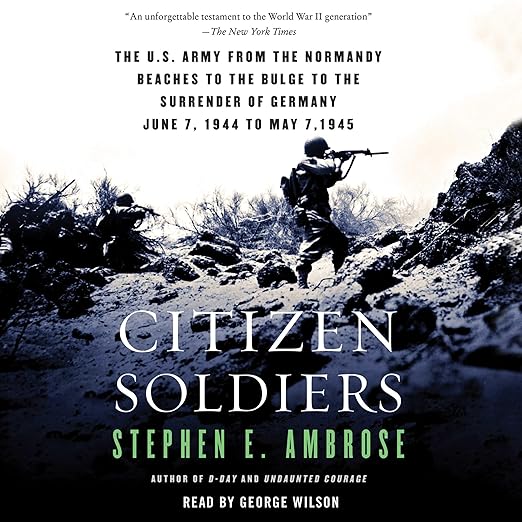
I spent a significant part of a summer some years ago working through Stephen Ambrose's Second World War books in sequence, and Citizen Soldiers was the one I kept returning to after Band of Brothers had given me the emotional template. Band of Brothers has a company with a beginning, middle, and end; it has a knowable cast of characters and the narrative logic of a unit story. Citizen Soldiers does something less tidy and in some ways more ambitious: it tries to render the experience of an entire army across an entire theater of war, from the beach at Normandy to the German surrender, by moving between hundreds of individual voices without losing the shape of the whole.
Ambrose opens at 0001 hours on June 7, 1944, the day after D-Day, when the particular exhaustion and relief of having survived the landing gave way to the understanding that what lay ahead was long. He closes at 0245 hours, May 7, 1945. Between those coordinates, he follows infantrymen, tankers, medics, nurses, prisoners of war, and the men on the other side of the line, drawing on hundreds of interviews to reconstruct a war experience that was largely finished being told by living witnesses by the time the book appeared.
First, the Big Picture
Ambrose's approach has attracted criticism from some military historians for prioritizing the experiential over the analytical, he is less interested in why commanders made the decisions they made and more interested in what it felt like to execute or suffer those decisions at ground level. That criticism is accurate as description even if it is offered as complaint. Citizen Soldiers is not a strategic history. It is, as one reviewer accurately noted, mainly first-hand accounts, and the absence of sustained strategic analysis is a deliberate choice rather than an oversight.
What Ambrose does with those accounts is build a cumulative portrait of American character under specific conditions of stress, fear, fatigue, and moral complexity. The hedgerows of Normandy, the winter in the Ardennes, the discovery of concentration camps, the exhausted crossing into Germany, each section carries a different emotional register, and Ambrose is skilled at moving between them without losing the thread of his argument: that these were ordinary people, most of whom had no prior military ambitions, who did what was required and returned to ordinary life without expecting to be understood for what they had done.
Why Listen to Citizen Soldiers
George K. Wilson's narration suits the documentary quality of the material. This is a book built from testimony, and Wilson does not impose a dramatic interpretation over interviews and reconstructed dialogue that already carry their own authority. His even, clear delivery allows the voices of the soldiers, filtered through Ambrose's transcriptions but present in them, to land with their own weight. At over twenty-one hours, this is a substantial listening commitment, and Wilson's consistency across that runtime is a genuine service to the material.
A Few Reservations
Readers expecting the focused emotional arc of Band of Brothers will find Citizen Soldiers more diffuse and harder to hold as a single narrative. The sheer number of individuals Ambrose moves between can make it difficult to track specific figures across the book's breadth, this is a portrait of a collective more than a story of individuals, and the listening experience reflects that. The German perspective is present and treated with seriousness; Ambrose is not writing propaganda, and the humanity he extends to American soldiers is extended to their adversaries as well. The sequences involving concentration camp discovery are present and handled with appropriate gravity.
Should You Listen to Citizen Soldiers?
Listeners who completed Band of Brothers and D-Day and want to continue with Ambrose's WWII work will find this the natural continuation, it picks up precisely where D-Day ends and extends the timeline to the German surrender. Those interested in the lived experience of ordinary combatants as distinct from command decisions or strategic analysis will find this exactly what they need. Listeners who want a single focused story with a coherent cast of characters will find the breadth of Citizen Soldiers less satisfying than Ambrose's more narratively concentrated titles. The combination of accessibility, moral seriousness, and primary-source density makes this one of the better audiobook options in its genre.
Common Questions
Should I listen to D-Day before Citizen Soldiers, or can it stand alone?
Ambrose designed Citizen Soldiers to pick up directly where D-Day ends, it opens on the morning of June 7, 1944, the day after the landing. D-Day provides context that enriches the early sections of Citizen Soldiers, but the later book introduces its own characters and can be followed independently. Having both gives the most complete experience.
Is the strategic and tactical context clear enough for listeners without prior WWII knowledge?
Ambrose is genuinely accessible, this was part of his strength as a popular historian and a source of some friction with academic critics. The strategic context is present but light; the emphasis is on what soldiers experienced rather than why commanders decided what they decided. Listeners wanting operational analysis will need to supplement with other sources.