Before You Press Play
- Narration: Tom Parks carries the entire twenty-three hours solo, and the reviews are silent on how that reading actually sounds.
- Themes: two thousand years of church history, denominational schism, Christianity's global spread
- Mood: Measured and expansive, closer to textbook than drama
- Verdict: A solid single-narrator overview for listeners who want breadth over thrills, best sampled before committing to the full runtime.
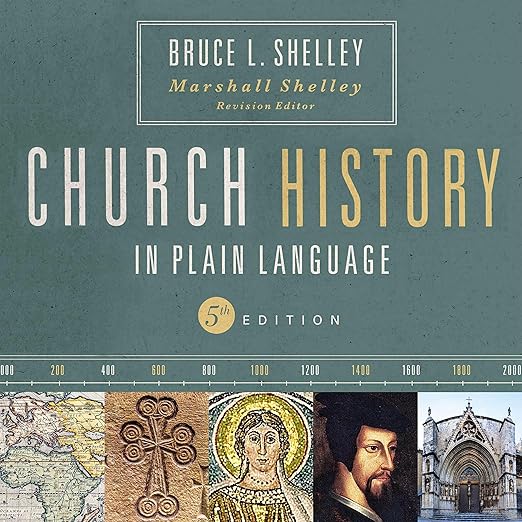
I queued up this audiobook expecting a dry seminary textbook and got something closer to a string of character studies instead. Bruce Shelley's Church History in Plain Language has reportedly sold over 330,000 copies since it first appeared, and this fifth edition, read by Tom Parks across a little over twenty-three hours, is built around a structural trick worth knowing before you press play: each chapter opens with characters, setting, and plot, the way a screenwriter might block a scene, before it settles into the actual history.
Each Chapter Opens Like a Movie Scene
Shelley's approach carries you from the earliest centuries of the church through the modern era without stopping to footnote every council or creed. The book treats each period as a story about actual people caught in a particular moment, acting or being acted upon, and that narrative bent is what keeps twenty-three hours from feeling like a lecture series. For this fifth edition, Marshall Shelley assembled a team of historians, historical theologians, and editors to revise and expand what the synopsis calls "this father's classic text," adding material on the growth of Christianity in Asia, India, and Africa across both the early church and the twentieth and twenty-first centuries. The synopsis also promises more attention to women and non-Europeans whose roles in church history were underrepresented in earlier editions, plus new sections tracking the rapid growth of evangelical and Pentecostal Christianity in the southern hemisphere, the decline of traditional mainline denominations, and how technology has reshaped the spread of the gospel. A companion PDF with maps, timelines, suggested reading, and end notes ships alongside the audio, though obviously none of that reaches you through your headphones, so listeners who want the visual scaffolding will need to track down the download separately rather than expect it to surface mid-chapter. The chapter-by-chapter formula does mean momentum resets often. Just as one era's characters and stakes come into focus, Shelley moves the story forward a generation or two, and that rhythm rewards listeners who treat each chapter as a self-contained unit rather than expecting one continuous narrative arc across twenty-three hours.
Catholic Scholar and General Reader Reach Agreement
Mike, whose review is the first of five on this listing, describes the book as a fast-moving sweep through the complexity of the Christian church across the ages, useful precisely because it avoids the density of a seminary textbook. Redque calls it easy to follow and credits it with clarifying how modern churches grew out of earlier events, while being careful to note the book is not a devotional and does not aim to affect anyone's spiritual life directly. What struck me most is Raymond J. Colombo's account, which identifies a lifelong, practicing Catholic background and still found the book's telling of Christianity's fractures into competing factions absolutely fascinating, which suggests Shelley's version of events lands regardless of which pew you sit in. Kindle Customer goes further, writing that early chapters left an impression of a religion that had merely survived persecution, but that the book's momentum built a new respect for the Roman Catholic church, evident mistakes and all, as it moved into the messier middle stretches of the story. That range of reaction, from a scholar of Catholicism to a general reader looking for an overview, is the strongest evidence the book does what its title promises.
Tom Parks Alone Carries Twenty-Three Hours
D. Osterloo's four-star review is worth reading closely because it names the book's one real limitation: the title is accurate down to the word, which also means anyone hoping for a page-turner should recalibrate. Osterloo calls it concise, accurate, and thorough enough for practical use, but not thrilling, and that trade-off is baked into the format rather than the narration. The listing itself carries a wrinkle worth flagging. Mike's review credits the text as "updated by R. L. Hatchett for the Fourth Edition," while the synopsis attached to this page describes a fifth-edition revision led by Marshall Shelley, continuing the work the synopsis calls "this father's classic text." Both credits may be accurate at different points in the book's publishing history, but the page does not reconcile which team touched the version you are about to hear, so I would not assume the two describe the same pass at the manuscript. One more thing worth flagging: this page displays 4.7 stars from what it says is a single vote, yet five complete write-ups sit right there for anyone to read, a mismatch between the counter and what is actually visible on the page. What the credit itself establishes is that a single narrator, Tom Parks, carries the full twenty-three hours, chapter after chapter, without a cast or a change of voice to break up the historical sweep. Whether that steady, single-voice approach suits your ear over such a long runtime is something you will have to sample for yourself, since the review column has plenty to say about the content and nothing at all about the reading.
Sample a Chapter Before the Twenty-Three-Hour Commitment
This is a fit for listeners who want one coherent, chapter-by-chapter path through two thousand years of church history without committing to a multi-volume academic series, and especially for anyone curious about the fifth edition's expanded coverage of Christianity's growth in Asia, India, and Africa. It is a poor fit for anyone seeking devotional content, spiritual guidance, or a story with narrative tension in the thriller sense of the word, since Osterloo's caveat about pacing is the most useful data point in the whole review column. Twenty-three hours is a real commitment, so I would sample the first chapter or two before deciding whether Shelley's screenwriter-style structure works for your ear across the long haul. If you already own a print or ebook copy for the maps and timelines, pairing it with the audio for your commute or your daily walk is probably the most efficient way to get through a book this size, since the two formats were clearly built to work together rather than stand entirely apart. Readers drawn to the fifth edition's promise of expanded coverage on Asia, India, and Africa specifically should know that promise lives in the synopsis rather than in anything the review column confirms, since none of the five listed reviews mention those additions by name.
A Few Questions About Church History in Plain Language, Fifth Edition
Does this audiobook include the fifth edition's new material on Christianity in Asia, Africa, and India?
The synopsis says the fifth edition adds coverage of Christianity's growth in Asia, India, and Africa along with more attention to women and non-Europeans, but none of the five written reviews on this listing mention those additions specifically, so treat the promise as unconfirmed by listener feedback.
Is the companion PDF included when you buy this audiobook?
Yes, the listing states that maps, timelines, suggested reading, and end notes are available as a companion PDF download alongside the audio. That material exists outside the narration itself, so it will not play through your headphones and has to be downloaded and read on its own, separate from the listening experience.
Why does one review describe a Fourth Edition update by R. L. Hatchett when this listing says Fifth Edition?
Reviewer Mike credits a Fourth Edition revision by R. L. Hatchett, while this listing's synopsis describes a Fifth Edition update led by Marshall Shelley. Both may be accurate at different points in the book's history, but the listing does not clarify which team's work is in this specific audiobook.
Is this audiobook meant to work as a devotional or spiritual guide?
No. Reviewer Redque specifically notes it is not a Bible, not a devotional, and not intended to focus on personal spiritual life or affect it directly. It is a history of the church as an institution and a movement, told chronologically, rather than a book meant for reflection, prayer, or worship.