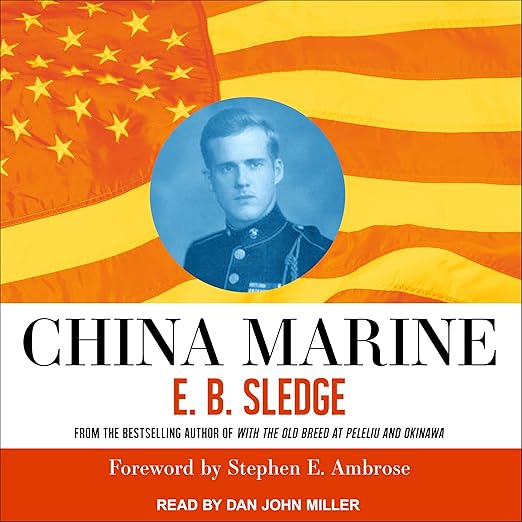
- Narrator: Dan John Miller brings quiet authority to Sledge's understated, observational prose; this is not a performance that calls attention to itself.
- Subjects: The aftermath of combat, reentry into civilian life, post-traumatic identity before it had a name
- Tone: Reflective and melancholy, with the specific exhaustion of a man trying to become ordinary again
- Bottom line: Essential for anyone who has read With the Old Breed; a rare and honest document of what it felt like to come home from the Pacific.
I came to China Marine having already spent considerable time with E. B. Sledge's first memoir, With the Old Breed, which is among the finest firsthand accounts of combat ever written by an American soldier. The HBO series The Pacific brought Sledge to a wider audience, and his prose, plain and precise and devastated, has stayed with me in the years since. Coming to China Marine felt less like reading a sequel than returning to a voice I had been listening for without knowing it.
The book picks up where With the Old Breed ends, with the surrender of Japan and the First Marine Division redeployed not home but to the ancient city of Peiping, as Beijing was then called, to help stabilize the transition from Japanese occupation. What it means to bring a man like Sledge, who has been crawling through the coral at Peleliu and the mud at Okinawa, to a city of temples and ceremony, is one of the book's central preoccupations. And then what it means to bring him home to Mobile, Alabama, after all of that.
Sledge's prose in this second memoir is less harrowing than in the first, and that is part of its meaning. The violence has mostly stopped; what remains is the problem of the self. He writes about watching people eat dinner at a restaurant and feeling like he is watching a pantomime of normalcy from behind glass. He writes about nightmares and flinching at sounds. He does not pathologize these responses or explain them through any framework that would not have been available to him at the time. He simply describes them, with the same methodical honesty that characterized his combat writing.
Dan John Miller's narration is a good match for this material. He does not dramatize what Sledge has already made vivid, which is the right instinct. Reviewers who have praised the book consistently mention Sledge's unique perspective on what was happening within him as well as around him, and Miller's restrained delivery allows that interior dimension to surface without underscoring it unnecessarily.
What Stands Out
The Peiping sections are fascinating in a way that is almost geopolitically accidental. Sledge arrives in China at a moment when the Nationalist and Communist forces are already in conflict, when the Japanese are still armed and present, and when the city is caught between several possible futures simultaneously. He is not a political analyst; he is a twenty-year-old from Alabama with a rifle and a set of experiences that have permanently changed his capacity for surprise. His observations of Chinese civilian life, of the ancient streets and markets and the strange peace of temples, carry a weight that a more sophisticated observer might have diluted with interpretation.
A reviewer who read the first book noted that China Marine gave him even more to reflect on regarding not just what was happening around Sledge, but what was happening within him as a result of the horrors of war. That is precisely right, and it is what distinguishes this book from most military memoirs. The internal accounting is as honest as the external one.
Before You Commit to China Marine
This is a short book at just over five hours, and its brevity has been noted by readers who wanted more. The Peiping section is rich enough that one reviewer wanted it expanded considerably. The homecoming section, by contrast, may feel compressed for readers expecting a fuller reckoning with post-war civilian life. Sledge suggests more than he resolves, which is true to his temperament and his prose style but may leave some listeners wanting the kind of catharsis he never quite offers.
This book should not be listened to before With the Old Breed. Multiple reviewers and the book's own structure assume familiarity with the first memoir, and listeners who begin here will miss the accumulated weight of what Peleliu and Okinawa cost Sledge, which is the entire context for his behavior in China and at home.
Best Suited For
Listeners who have already experienced With the Old Breed, whether in print or audio, owe it to themselves to complete the account with this book. Students of World War II memoir writing, and anyone interested in the history of what we now call PTSD before it had a name, will find it invaluable. It is not a book for listeners who want action-driven military narrative; it is a book about what happens to a person after the action ends, and it requires patience and attention proportional to its quiet ambition.
Frequently Asked Questions
Can China Marine be listened to without having read With the Old Breed first?
Technically yes, but practically no. The book is a direct sequel that assumes knowledge of Sledge's experiences at Peleliu and Okinawa. Without that context, the emotional weight of the homecoming and the depth of Sledge's internal conflict are significantly diminished. Start with With the Old Breed.
Is China Marine as intense or graphic as With the Old Breed?
No. The combat in this book is largely over by the time it begins. The intensity here is psychological rather than physical, as Sledge processes his wartime experiences while stationed in China and then returning to civilian life. It is a quieter, more inward book.
How does Dan John Miller's narration suit Sledge's prose style?
Miller's narration is restrained and appropriate to Sledge's plain prose. He does not editorialize or dramatize, which suits the material. His approach allows the interior dimension of Sledge's self-examination to surface naturally.
What does the China section of the book cover, and how much of the runtime does it occupy?
The China section covers Sledge's time in Peiping in the immediate aftermath of Japan's surrender, including observations of civilian life, the presence of competing Chinese political forces, and the gradual demobilization of the First Division. It takes up a significant portion of the book's five-hour runtime before the homecoming section in Mobile, Alabama.