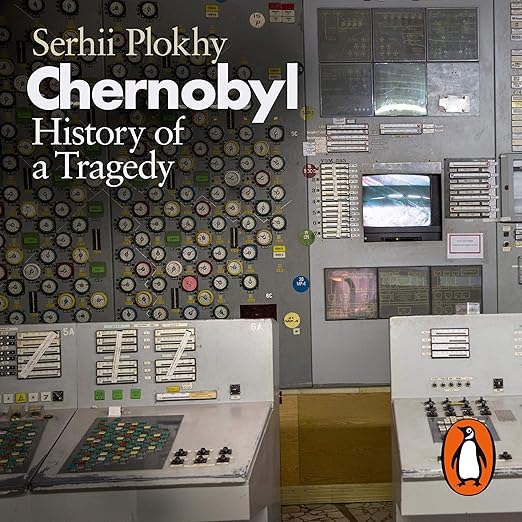
How does less than five percent of a reactor's fuel escaping end up contaminating over half of Europe? Serhii Plokhy's Chernobyl, shortlisted for the Baillie Gifford Prize, spends this audiobook's 13 hours and 35 minutes answering exactly that.
A Closer Look at Chernobyl
Serhii Plokhy structures the book around the morning of April 26, 1986, when a turbine test at the Chernobyl plant in Soviet Ukraine went wrong and set off what the synopsis calls the worst nuclear disaster in history. Less than five percent of the reactor's fuel actually escaped, and that fraction alone was enough to contaminate over half of Europe with radioactive fallout, a ratio that does more to convey the stakes than any body count could.
Plokhy's account moves through firefighters, scientists, engineers, workers, soldiers, and policemen, following the people who did the actual work of, in the synopsis's words, extinguishing the nuclear inferno and putting the reactor to sleep. That ensemble approach is also where the political argument sits: the immediate cause was a mechanical failure, a turbine test gone wrong, but Plokhy traces the deeper roots to the Soviet political system itself and the structural flaws in its nuclear industry. The synopsis pushes the argument further still, tying the disaster to the Soviet Union's collapse a little more than five years later, destroyed from within by the same unsustainable ideology and dysfunctional systems the meltdown exposed.
Two well-known blurbs travel with this book and both hold up against what the reviews describe. Yuval Noah Harari calls it a book that reads like a good thriller while exposing the danger of mixing powerful technology with irresponsible politics, and Viv Groskop's Observer review calls it a cracking read that is as painstakingly researched as it is moving. Steven Schlossstein's review echoes that thriller comparison almost exactly, independent of either blurb. The synopsis sums up its own ambition in similar terms, calling this a poignant, fast paced account of the drama of heroes, perpetrators, and victims, and describing it outright as the definitive history of the world's worst nuclear disaster. Harari's blurb is credited specifically to the author of Sapiens, a detail that signals Penguin is pitching this at readers of big-idea nonfiction generally, not only at disaster-history specialists.
What Makes Chernobyl Worth Hearing
This Chernobyl account was shortlisted for the Baillie Gifford Prize, a nonfiction credential that lines up with how reviewers describe the actual reading experience. Steven Schlossstein's review calls Serhii Plokhy a brilliant historian and specifically praises the detail on the former Soviet Union, Ukraine, and the design flaws of the Russian RBMK reactor, a design the review notes was rejected in the West.
Wolfhound Dennis's review adds a more measured, still positive angle, calling this a historical fact filled book about a tragic incident whose consequences, in the reviewer's words, are still being told, and praising it as a comprehensive account of that period. That word, comprehensive, comes up again and again across the five reviews in different forms, which suggests the book's scope, political, scientific, and human all at once, comes through clearly regardless of which angle a given reader cares most about. The listing's own tags, Engineering and Russia, reflect that same split focus, one technical and one geopolitical, without favoring either over the human cost Plokhy keeps returning to.
Great Timing's review adds a research-driven angle: a ton of independent investigation into the disaster already done, and still finding new insight in Plokhy's account, plus a direct recommendation to buy it. Amazon Customer's review points to a different strength, the personal stories woven through the history, calling the result well written and easy to read while still bringing listeners into the moment rather than just reciting a timeline of the accident.
At 13 hours and 35 minutes, Leighton Pugh has a genuinely long, detail-heavy account to carry, the kind of runtime that only works if the pacing holds up across a full workday's listen. The thriller comparison two separate reviewers reach for independently is a good sign that the writing itself supplies enough momentum to carry a runtime this long.
The Caveats
Two counted votes are doing a lot of work here. Five people wrote full reviews for Chernobyl, but only two ratings actually appear in the total behind the 4.6 average shown on the page, Steven Schlossstein's detailed history-fan account among them alongside dlbest23's much shorter note. Trusting a precise average built from just two votes, when five different people clearly took the time to write something, is a leap worth thinking twice about.
One of those five reviews is not actually about the audiobook, or arguably not even about this edition at all. dlbest23's review, titled "arrived in great condition, well packaged," describes a book that was well packaged and protected, exactly as described, signed, and a first edition, details that only make sense for a physical print copy. It is a clean example of a print-edition review landing on an audio product's page, most likely because Penguin's print and audio editions share the same listing history. Listeners relying on the star rating and review count to gauge the audiobook specifically should treat this one entry as noise rather than signal.
Steven Schlossstein's review also spells the author's name Ploky rather than Plokhy throughout, a small slip that, like the packaging review, is a reminder that Amazon's review pool for a book with multiple editions rarely sorts itself perfectly by format. None of that undermines the substance of what the five reviewers describe, only the assumption that every word on the page is reacting to Leighton Pugh's specific recording.
Who Serhii Plokhy Is Writing For
History listeners drawn to narrative nonfiction that reads like a thriller, per both Yuval Noah Harari's blurb and Steven Schlossstein's review independently, are the clear audience, especially anyone curious about the RBMK reactor's specific design flaws and the Soviet political system that let them stand uncorrected. The Baillie Gifford Prize shortlisting is a reasonable proxy for quality if you need one more signal beyond the reviews themselves, and the Sapiens connection in Harari's blurb suggests it also works for readers who liked that book's big-picture approach to history.
History listeners who want the human cost of Chernobyl explained with thriller-level momentum, per Harari's blurb and multiple reviewers independently, get exactly that promise delivered. Anyone hoping for a purely technical engineering breakdown instead should look elsewhere, since the synopsis and every review agree the focus stays on people, firefighters, scientists, soldiers, policemen, rather than reactor mechanics alone.
Questions Listeners Ask
How long is the Chernobyl audiobook?
Chernobyl runs 13 hours and 35 minutes, narrated by Leighton Pugh. Serhii Plokhy's book was shortlisted for the Baillie Gifford Prize, and reviewers including Steven Schlossstein describe the writing itself as reading like a thriller despite covering real nuclear engineering and Soviet political history.
Is one of the Chernobyl audiobook's reviews actually about a print edition?
It looks that way. One review, titled about the book arriving in great condition and well packaged, describes a signed first edition copy, details that only apply to a physical book. It almost certainly belongs to a print listing that shares this product page.
Does the Chernobyl audiobook's rating add up given how few ratings are counted?
Not cleanly. The page shows only two counted ratings behind a 4.6 average, yet five full written reviews appear beneath it. That gap between how many people voted and how many actually wrote something is worth knowing before treating the displayed average as a reliable, trustworthy summary.
Is this audiobook more about the science or the human stories of Chernobyl?
Both, but the human and political angle leads. The synopsis follows firefighters, scientists, engineers, and soldiers rather than staying purely technical, and traces the disaster's roots to Soviet political failures as much as to the reactor's own mechanical design flaws.