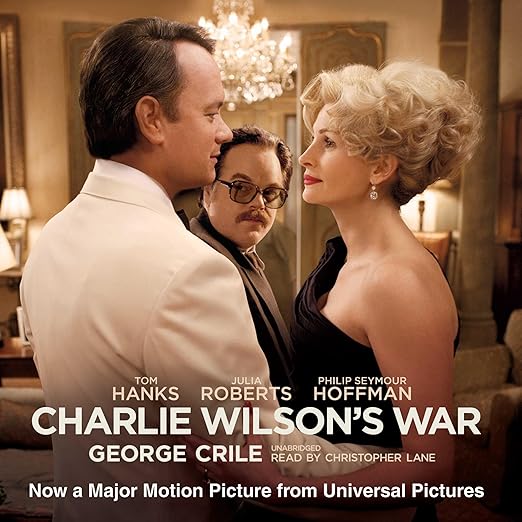
Writing about the Cold War's final chapter requires navigating a strange tonal register: the operations were genuinely comic at times, the consequences were catastrophic, and the people involved were frequently both principled and absurd within the same sentence. George Crile found that register and held it for over 500 pages, which is why Charlie Wilson's War remains one of the most remarkable works of investigative nonfiction published in recent decades. Christopher Lane's narration of this audiobook sustains the book's double-edged tone with real skill: the twenty hours rarely feel like documentation; they move like a novel, complete with the sense that every time the situation could not possibly get stranger, it does.
The story is genuinely improbable. Charlie Wilson, a Texas congressman famous for his Houston socialite connections and his particular approach to congressional leadership, conspired with Gust Avrakotos, a rogue CIA operative who could not get a hearing in Langley, to fund and supply the Afghan mujahideen against the Soviet army in what became the largest and most successful covert operation in CIA history. Crile was one of the few journalists with access to the actual participants, and the level of on-record sourcing distinguishes this book from the many Cold War histories that rely on inference and declassified documents.
What Stands Out
The biographical portraits are what make this audiobook worth twenty hours of your attention. Charlie Wilson himself is drawn with extraordinary specificity: the hot tub conversations with congresswomen, the particular way his staff learned to manage his enthusiasms, the genuinely impressive legislative maneuvering that kept funding flowing through budget cycles that should have killed the operation. Gust Avrakotos is, if anything, an even more compelling figure: a working-class Greek-American CIA officer perpetually at war with the Ivy League culture of his own agency, whose operational instincts consistently outperformed the official line. One reviewer described the book as 'a story that reads better than fiction,' and that is accurate: the real people are stranger and more interesting than anything a novelist would have invented.
Christopher Lane handles the tonal challenge admirably. The book moves between comedy and policy analysis and genuine tragedy without giving any strand priority, and Lane follows Crile's lead rather than trying to unify the register artificially. His Wilson is appropriately larger than life without becoming a caricature, and his Avrakotos has enough edge that the CIA bureaucracy scenes carry real frustration alongside their absurdity.
The operational mechanics Crile describes are also fascinating as technical history. How Wilson shepherded funding through committees, how Avrakotos identified and sourced the specific weapons systems that would actually work against Soviet helicopter gunships, how Pakistani intelligence was brought into the operation and what they extracted in return: this level of procedural specificity is what separates Crile's account from the many more general histories of the period. Lane renders those detailed sections with clarity rather than flattening them, which is a genuine feat across twenty hours of dense material.
Things to Know Before Starting Charlie Wilson's War
Crile is honest about the consequences. The covert operation that helped end the Soviet presence in Afghanistan was followed by a complete American withdrawal from the region, leaving behind the fractured power structures and radicalized factions that the CIA funding had created and sustained. The book does not dwell on this as its primary subject, but Crile does not allow the reader to finish without confronting the full arc. This is a book that begins in victory and ends in something considerably more complicated, and listeners who come for the comic Cold War adventure will find themselves sitting with more ambivalence than they might have anticipated.
At twenty hours and twenty-four minutes, the audiobook is a genuine commitment. The pace is sustained well through the first two-thirds; the operational sections where Wilson and Avrakotos are most active move quickly. The later sections, as the US policy response following Soviet withdrawal becomes the subject, are less propulsive. This is structurally honest, the story genuinely does slow down as the triumph gives way to the aftermath, but listeners should know the back third of the audiobook operates in a different register than the front.
Crile's reporting extends to dimensions of the operation that most popular histories of the period ignore entirely. The specific logistics of how American-funded weapons reached the mujahideen without a direct CIA fingerprint, the role of Egyptian and Saudi intermediaries in the supply chain, and the particular bureaucratic maneuvering that kept the operation funded across multiple presidential administrations: this level of operational granularity is where the book genuinely expands what the general reader can understand about how covert operations actually function. Christopher Lane renders the more technically specific passages with the same authority he brings to the biographical narrative sections, which prevents the policy and logistics material from feeling like interruptions to the story of Wilson and Avrakotos. The operational detail is the story, and Lane treats it as such.
Best Suited For
Listeners with a serious interest in Cold War history, US foreign policy, or the mechanics of covert operations will find this one of the most absorbing works in the genre available in audio form. Fans of investigative journalism that refuses to simplify its subjects will appreciate Crile's refusal to resolve Wilson and Avrakotos into either heroes or cautionary tales. Christopher Lane's narration is a strong match for this material and makes the twenty-hour investment feel worthwhile.
Listeners who prefer their history with cleaner moral frameworks may find the book's willingness to present the operation's architects as simultaneously admirable and catastrophic in their consequences more unsettling than satisfying. That unsettledness is precisely what makes this one of the essential works of Cold War nonfiction, and Lane's performance honors that complexity by never pushing the listener toward a simpler reading than the material supports.
Frequently Asked Questions
Is this audiobook appropriate for listeners without prior knowledge of Cold War or Afghan history?
Largely yes. Crile builds enough context into the narrative that prior specialist knowledge is not required to follow the story. General adult listeners who want to understand what the CIA operation actually looked like at the operational level, rather than the strategic summary, will get full value from the audiobook.
How does Charlie Wilson's War compare to other Cold War nonfiction audiobooks in terms of narrative approach?
Crile's approach is distinctly biographical and novelistic. He is less interested in geopolitical framework than in the specific people who made the operation happen, which sets it apart from policy-focused Cold War histories. The closest comparisons in terms of style and readability are Steve Coll's Ghost Wars and Seymour Hersh's investigative reporting, though Crile's tone is considerably warmer than either.