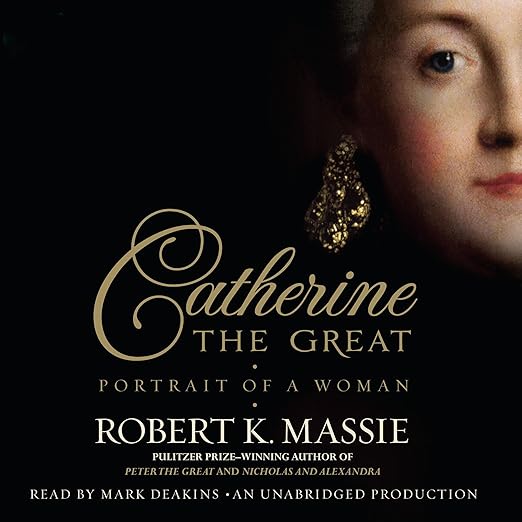
A minor German noble family produced the woman who would spend thirty-four years holding the government, the foreign policy, the cultural development and the welfare of the Russian people in her hands. Robert K. Massie's account of how that happened runs to eight minutes short of twenty-four hours of audiobook, and the length is the least surprising thing about it.
Nine Years Unconsummated, Then Ruling an Empire
The transformation is the story, and the copy states it without decoration: an obscure German princess turned herself into empress of Russia by sheer determination. What followed was three and a half decades in which an empire's government, foreign policy, culture and welfare all ran through one person, alongside domestic rebellion, foreign wars and the tidal wave of political change and violence churned up by the French Revolution.
The private half gets compressed into a single paragraph by one response, better than most summaries manage it. A German-born princess marries the Tsar-elect and waits in the wings while the reigning empress, Peter the Great's daughter, holds the throne. The marriage goes unconsummated for nine years. Catherine, born Sophia, takes numerous lovers, one of whom fathers the next Tsar. That same entry supplies the sharpest line anywhere on the page, which is that the woman makes Mrs Thatcher look like a poodle.
Award Furniture That Actually Tells You Something
Massie has the full apparatus of a major biographer around this book, and the listing displays every piece of it: a Pulitzer for earlier work, a bestseller placing, a spot on one magazine's roll of the best biographies ever written, and a run of best-of-the-year selections from newspapers across the country. Award furniture usually tells a buyer nothing. Here it does tell you one useful thing: this is a trade biography written to be read for pleasure rather than a monograph written to be cited.
Deakins Must Shift Between Two Registers
The sentence that sells this book was written by a buyer, not by a publicist. Reading it, one response says, you swear you can see and feel Catherine's breath upon her mirror. That entry calls the result epic and intimate at once, full of stories, personalities, diplomacy, fate, love and lovers, and singles out the surprise of Catherine's own words. The last item is the one to note. Massie has her writing to work from, and a biography able to hand the floor to its subject holds an advantage no quantity of research can supply.
Eight minutes short of twenty-four hours is a serious sitting, and this is one of the cases where the length is the point rather than the price. Thirty-four years of rule cannot be compressed without collapsing into a list of wars and reforms. What the format adds is company: a long biography taken over two weeks becomes something nearer to living alongside a person than to studying one, and a method built on the accumulation of incident rewards precisely that.
Mark Deakins reads it, and the assignment carries two registers rather than one. Half the book is chronicle: treaties, ministers, rebellions, the working machinery of an autocracy. The other half is a private life reported partly in Catherine's own writing, which needs an entirely different temperature. A reader who delivers the memoir passages the way the diplomatic passages get delivered will flatten the best thing in the book, so those are the minutes to test in a sample.
No Family Tree Amid Ministers and Generals
The four-star entry is also the most frustrating thing on this page. Its headline advertises two separate hesitations, a qualified verdict on the biography and an odd note besides, and the text available here never reaches either one. What it does establish is standing: that reader has worked through this author's books on Peter, on Nicholas and Alexandra, on the Romanovs, on the birth of iron ships and the modernization of the British navy, and on the less successful sequel to that. A dissent from somebody that well read is exactly the dissent a buyer wants, and the page will not hand it over.
The series fields deserve a second look. This gets shelved as volume two of a Romanovs Series, while the copy lists three earlier Massie titles without arranging them into any sequence at all. Those are standalone biographies written across decades, not installments in a set. A number on the page implies an order the publisher's own description does not support, and anyone who assumes something must be read first will go hunting for a volume nobody ever designated book one.
Names are the practical difficulty in audio, and this page offers nothing to soften it. A Russian court biography moves through Peters, Pauls and Elizabeths, and through a subject born Sophia who died Catherine, plus ministers, generals, enemies and lovers in quantity. No family tree travels with the file and no map either, both of which would sit in a printed book's front matter as a matter of course. Expect to go looking for one yourself somewhere around hour four.
Meeting Catherine Sideways, Through a Hermitage Portrait
This is for anyone who has met Catherine sideways and wanted the rest. Somebody who came to the subject through an object describes that route exactly, in a response filed from Australia: an exhibition of works from the Hermitage, a portrait of a woman who looked pleasant and gentle, and the sudden need to know how somebody from very minor German royalty ended up ruling Russia as an autocrat for three decades. Readers of narrative history who want personalities alongside policy are the target audience, and the book supplies both without choosing between them.
Historiography is not on offer here, so look elsewhere for it. Massie writes to absorb a reader rather than to argue with other historians, and the debates simply are not part of the design. Look elsewhere too if twenty-four hours on one reign sounds like more than you ever wanted to know, since the pace is unhurried by intention and the pleasure is cumulative. Anyone hoping for a survey of Russian history should note that this narrows to a single life, and that everything outside it appears only where it touched her.
In Brief
- Performance: Mark Deakins is the only voice credited, on a book that spends thirty-four years inside one head.
- What it covers: Self-invention, absolute power held by a woman, court intrigue and lovers, enlightenment ambition meeting revolution.
- Feel: Sweeping, gossipy, unexpectedly tender.
- Our call: The trade biography of Catherine, worth all twenty-four hours, on a page that invents a series number for a standalone.