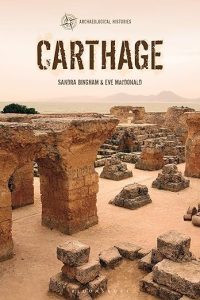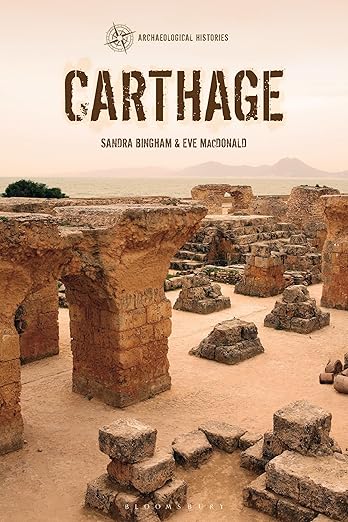
Key Details
- Narration: Eve MacDonald narrates this research personally, one voice carrying both the ancient history and its rediscovery.
- Themes: ancient Mediterranean history, archaeology and historiography, the recovery of a lost city
- Mood: Scholarly and measured, built for sustained attention
- Verdict: A solid pick for readers of academic ancient history; go in aware no listener reviews yet confirm the experience.
No listener has left a single written review of the Carthage audiobook, which is unusual enough on this site that it is worth saying plainly before anything else: this one arrives with a lone five-star rating and nothing else to go on. Eve MacDonald both wrote and narrates this account of the ancient city, tracing its founding in legend by the Tyrian queen Dido through nearly sixteen hundred years on the coast of Africa, its destruction by Rome, its rebirth as a Roman city and center of Christian worship, and its final fall in 698 CE. Bloomsbury Academic published the book in June 2024, and this audio edition runs ten hours and forty-three minutes, covering one of the oldest cities on the Mediterranean from its founding through its slow disappearance from view. The second half of the book turns from antiquity to historiography, following European antiquarians and travelers who rediscovered the site in the 17th and 18th centuries and the archaeologists who eventually organized real excavations there.
MacDonald Narrates Her Own Scholarly Account
With no reviews to draw from, the clearest signal here comes from the publisher and the format itself. Bloomsbury Academic put this out as a scholarly title, and MacDonald's own background as the author of the material being narrated suggests a specialist speaking directly to the listener rather than a general-audience popular history read by an outside performer. The synopsis is unusually candid about how little of ancient Carthage survives to look at directly: European explorers who arrived searching for the site in the 17th and 18th centuries were reportedly startled that almost nothing of its former glory remained, a detail that reframes this less as a story about ruins and more as a story about absence and reconstruction. Founded, per the synopsis, in legend by the Tyrian queen Dido, the city dominated the central Mediterranean for almost sixteen centuries before its fall, a span of time that makes the near-total disappearance of its physical remains, described in the synopsis as startling even to the earliest European searchers, genuinely strange.
A single rating sits attached to this listing, a five, with no written explanation behind it, meaning no listener testimony exists here to weigh against the publisher's own framing, unlike almost anything else reviewed on this site. That makes this a case where a prospective listener is trusting the synopsis and the author's credentials more directly than usual.
Sixteen Centuries, Then the Archaeologists Take Over
Real weight comes built into the subject itself: a city founded in legend, destroyed after wars with Rome, rebuilt as a Roman city, and transformed into a center of Christian worship before its final fall in 698 CE, one of the longest continuous storylines an ancient Mediterranean city can offer. What distinguishes this account from a straightforward ancient-history narrative is its second half, which follows the specific antiquarians and travelers who searched for Carthage centuries after its fall and the archaeologists whose sometimes controversial excavation work, per the synopsis, eventually restored the city to public imagination. Punic artifacts, the plunder of the site for European museums, and the establishment of proper scientific excavation all get billing in the synopsis as part of that recovery story. The synopsis also describes the exploration of the site as gradual and, at points, controversial, a phrase that hints at real disagreement among the historical figures involved without spelling out the specifics, leaving that detail for the book itself to unpack.
At ten hours and forty-three minutes, this sits at a reasonable length for a book covering both ancient Carthage and roughly three centuries of its rediscovery, and MacDonald narrating this same research means the listener gets one consistent voice for both the ancient history and the historiography built on top of it, rather than a switch in register between subject and source commentary.
Leftover Print Metadata Clutters the Listing
Several fields on this listing carry the kind of leftover print formatting that suggests this data was copied from a physical book listing rather than built fresh for audio: the ISBN, publisher, and language fields all open with an invisible directional mark typical of print metadata, and the listing also carries a page count of 149, a print-book measurement with no real meaning for a ten-hour, forty-three-minute audio recording. The price shown, $1999, is also almost certainly a formatting error rather than a real price point, since it is missing a decimal point somewhere in that figure.
None of that print-metadata clutter reflects on the audio content itself, but it is worth knowing that this listing shows more signs of being adapted from a print or ebook record than most audiobooks reviewed on this site, right down to the single five-star rating standing in for what would normally be a handful of written reviews.
Trust MacDonald's Credentials Over a Single Rating
Listeners specifically interested in ancient Mediterranean history, and who also want the historiography, meaning the story of how modern scholars and antiquarians rebuilt knowledge of Carthage from near-total physical absence, will get the most from this one, more than a book that simply stops at the city's fall in 698 CE. Bloomsbury Academic's involvement signals a scholarly register throughout, so casual history listeners looking for something breezier may want a preview sample first. Given the complete absence of listener reviews, anyone on the fence should weigh the publisher's academic reputation and MacDonald's authorship more heavily than usual, since no crowd of prior listeners exists here to confirm or complicate that impression.
Good to Know
Are there any listener reviews for the Carthage audiobook?
No. This listing shows a single five-star rating with no written review attached to it, an unusually thin base of listener feedback. Anyone deciding whether to commit to this one is relying almost entirely on the publisher's synopsis and Eve MacDonald's credentials as both author and narrator.
Does the Carthage audiobook cover the city's modern rediscovery, or just its ancient history?
Both. Roughly half the book, per the synopsis, follows the city's ancient history from its legendary founding through its fall in 698 CE, while the other half tracks European antiquarians and archaeologists who rediscovered and excavated the site starting in the 17th and 18th centuries.
Is this audiobook narrated by its author?
Yes, Eve MacDonald narrates this same material as its author, so the listener gets one consistent voice across both the ancient history sections and the later historiography covering the site's rediscovery and excavation. No separate professional narrator is credited on this listing.
Why do some of the details on this audiobook's listing look like they belong to a print edition?
Several fields, including the ISBN, publisher, and language entries, carry leftover print-formatting characters, and the listing also shows a 149-page count, a print measurement that does not map onto the ten-hour, forty-three-minute audio runtime, a strong sign this record was carried over from a physical book edition rather than assembled fresh for audio.