The Short Version
- Narrator: The reader credit names Fajer Al-Kaisi, while everything else on the record describes a live bilingual talk, and nothing reconciles the two.
- Subjects: An introduction to Tibetan Buddhism, a lecture given at a university, translation as part of the meaning.
- Tone: Warm, digressive, unhurried.
- Bottom line: Worth seventy-nine minutes for a first encounter, provided you accept that the page will not tell you whose voice you are buying.
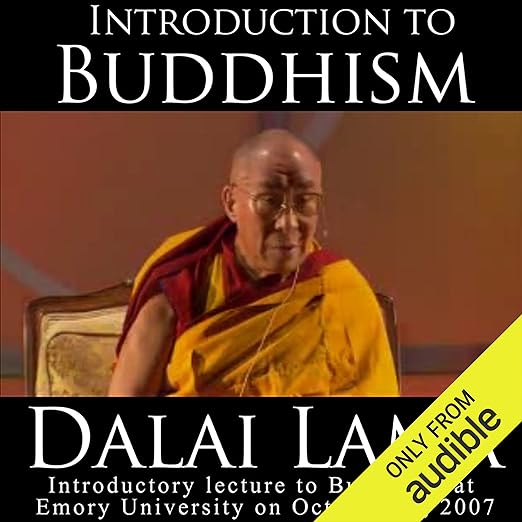
Two voices are documented on this audiobook record and they do not belong to the same person. The narrator credit reads Fajer Al-Kaisi. The description tells you about somebody else entirely: the Dalai Lama, speaking partly in English and then in his native tongue with an interpreter's help, at a lecture given during a visit to Emory University. Nothing on the page reconciles those two accounts, and a buyer who came here for a particular voice has no way to find out which one is on the file.
Al-Kaisi Is Credited, the Dalai Lama Is Described
Start with the credit, because it decides what this purchase actually is. One name sits under the reader heading and it is not the author's. Meanwhile the copy describes an event: a visit, a talk, a shift from one language into another partway through, an interpreter working alongside the speaker. A studio reading of a transcript and a captured lecture are two different products with two different reasons to exist, and this listing sells them under a single credit line without acknowledging the gap.
Language compounds the problem rather than resolving it. It says English. The copy says the speaker moves out of English partway through and finishes with a translator. Both statements sit on the same record, one of them has to be incomplete, and it happens to be the field a careful buyer checks precisely when the copy starts mentioning interpreters. On a title sold at this length, that single word is doing more work than any other field, and it is the one contradicted by the paragraph beneath it.
Hearing the Song of a Tibetan Voice
Hearing this rather than reading it has an unusually strong case, and the page makes it almost by accident. The one note underneath is headed with an instruction to take the time to hear the song of the speaker's voice, and it explains what it means: the Dalai Lama "sings his words with his Tibetan tongue, which is translated for us to better understand," and much of the emotional intent arrives through "the rhythm, tones, and laughter you will hear throughout." No transcript carries laughter. If the file is what that note describes, the format is not a convenience, it is the point.
Brevity works in the book's favor. What you buy here is short enough to take in one sitting, which suits the material. The copy is candid that the talk wanders, and wandering is a property of lectures rather than a flaw in them. An introductory account of Tibetan Buddhism delivered by someone the copy credits with an authority few authors can claim is worth an hour of anyone's attention, whatever their beliefs, and the brevity removes the usual objection to spiritual titles, which is that they take four hours to say what fits in one.
Casting demands split along the same fault line. If the file is the lecture, no casting decision was made at all and the interpreter is effectively the second performer. If it is a reading, then a hired voice is being asked to deliver material whose meaning the only listener on record locates in cadence and laughter, which is close to the hardest assignment in the studio. The credit line is not a footnote here. It is the whole question.
Twenty-Three of Seventy-Nine Minutes Are Warm-Up
Publisher copy here is not a description. It is a review, and a hedged one. It cautions that the lecture is not what a university classroom would normally deliver, concedes that "The talk is not entirely linear.", grants that audiences turn out in numbers anyway, and then closes with a sentence no seller writes on purpose: "Things really get going about 23 minutes in."
Take that literally, because it is arithmetic. Twenty-three of the file's seventy-nine minutes are being written off by the party selling it, which is close to thirty percent of the running time flagged as warm-up before you press play. Honest, and genuinely useful if you plan to skip. Less useful as the only account of the contents on offer, since it leaves you with no outline of what the talk covers and no sense of how the English and translated stretches divide up.
Identification is thin everywhere else too. The title is a single word. The publisher field is three letters with no expansion anywhere on the record. No date is given for the talk itself, only a 2012 release for the file, and nothing states whether the recording is complete or excerpted. For a lecture with a specific occasion and a specific venue, this page documents remarkably little of either.
Note also how little the listing has accumulated. A single written note, filed nearly seven years after the record was published, is the entire body of testimony available. Nine words of metadata and one paragraph of enthusiasm is what a decade and a half of availability has produced, and none of it addresses clarity, editing or sound. None of that disqualifies the title. It does mean the crowd will not be doing your checking for you, and on a record with an unresolved credit line that matters more than it usually would.
Fine for Skeptics and Practitioners, Thin on Structure
A single sitting is a low price to pay for hearing the man think rather than reading what he thought. Curiosity is the right reason to buy this: a first encounter with Tibetan Buddhism, an introduction rather than a syllabus, delivered by the person best placed to give one. It works for a commute, for a walk, or for anyone who has meant to read something on the subject for years and never started. It suits a skeptic as readily as a practitioner, since the copy promises no doctrine and only a label in the metadata frames this as devotion rather than as a lecture.
Keep your money if you want structure. No outline, no reading list, no chapter titles and no study apparatus appear anywhere, and the copy admits the talk moves sideways. Keep it too if the voice is the whole reason for the purchase, because that is the one thing this record cannot promise you: a listener who specifically wants the speaker's own delivery and a listener who specifically wants a clean studio reading are both buying on faith here, and just one of them can turn out to be right.
Is this audiobook a recording of the actual lecture or a studio reading of it?
Unresolved, and the page shows no sign of noticing. One field points at a hired performer while the surrounding prose points at an event with two languages in it, and nothing arbitrates between them. Anyone buying specifically for a particular voice is taking a gamble that the runtime, at least, keeps cheap.
Does the interpreter's translation form part of what you hear?
By the copy's own account, yes. It states that the speaker begins in English and then moves into his native tongue with an interpreter's help, so translated passages belong to the event itself. What proportion of the running time each language occupies is stated nowhere, so expect at least some stretch of consecutive interpretation.
Why is this audiobook filed under history?
Hard to justify. The record carries two genre labels, history alongside religion and spirituality, plus a religious tag. A short introductory talk about a living tradition fits the second comfortably and the first barely. Anyone browsing a history shelf should know they are getting a lecture rather than a chronology of anything.