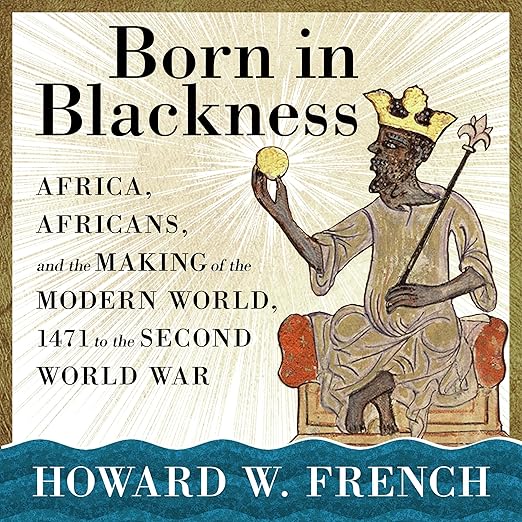
French Roots the Discovery Era in Gold
Howard W. French's central argument in Born in Blackness is the kind of historical revision that, once properly understood, makes the standard account look not merely incomplete but fundamentally inverted. French proposes that the Age of Discovery was not primarily driven by Europe's desire to reach Asia, which is what most Western history curricula still teach, but by centuries-old European hunger for trade with legendarily wealthy Black societies in West Africa. The audiobook, spanning six centuries and narrated by James Fouhey, covers the implications of that reframing across the entire arc of modernity, from early European maritime expansion through the Second World War. This is one of the more genuinely revisionist histories published in recent years, and the audiobook format over sixteen hours and forty-nine minutes gives French the space to build the argument at the pace it requires.
I came to this audiobook already familiar with some of the revisionist historiography in this space, the New Historians of Africa, the scholarship around Atlantic history, and the project of decentering European primacy in global origin stories. What French does that distinguishes Born in Blackness from adjacent work is ground the argument not in cultural theory but in material economics. The gold that drove early European maritime ambition came from West Africa. That is the starting point, and French follows it with the rigor of a historian who has spent years researching on the continent.
Fouhey Sustains a Sixteen-Hour Chain of Logic
James Fouhey brings the scholarly authority this text demands. French is writing about centuries of material that requires the narrator to sustain intellectual gravity across complex arguments without allowing the delivery to become either dry or artificially dramatic. Fouhey navigates that balance well. He does not perform the historical injustices French documents; he delivers them with the kind of measured intensity that lets the facts carry their own weight. For a sixteen-hour audiobook covering material this dense, sustained clarity of delivery is more valuable than expressiveness, and Fouhey provides it.
The structural achievement of Born in Blackness is the sequencing of its argument across centuries without losing the thread. French shows how the economic logic of early West African gold trade connects to the development of the Atlantic slave trade, which connects to the intellectual infrastructure of Enlightenment thought, which connects to the institutional development of Western democracy. That chain is built carefully, and Fouhey's ability to maintain narrative momentum across those conceptual transitions is a significant contribution to why the audiobook works.
Active Listening Rewards French's Compounding Argument
This is a book that rewards sustained attention. It is not structured for passive listening. French's argument builds across chapters in ways that compound; arriving at the later sections without having tracked the earlier ones means missing the foundation of the claims French is making. At nearly seventeen hours, this is an investment, and listeners who approach it as background audio will not get what the book is offering. This is active listening material for people who genuinely want to understand the argument.
One reviewer described the book as challenging 'the way history has been taught and told by whites,' which is an accurate description of French's project. Born in Blackness is explicitly a work of counter-history, an argument that the conventional account has been shaped by the interests of the people who dominated the record-keeping. Listeners who approach history as a settled matter may find the framing confrontational. Listeners who understand historical interpretation as a field in genuine ongoing debate will recognize French's methodology as rigorous and well-documented.
The coverage of the period leading to World War II, where French shows how the ideological infrastructure of colonialism and the Atlantic slave trade contributed to twentieth-century atrocities, is the section where the historical argument reaches its most ambitious scope. Fouhey handles those passages without editorializing, which allows French's argument to land on its own terms.
French's treatment of what he calls the 'dehumanizing engagement' between Europe and Africa is where the audiobook's moral weight is most fully felt. He is not making simply an economic argument; he is arguing that the ideological infrastructure required to justify that economic engagement, the ideas that allowed European powers to treat African people as property and African societies as resources rather than civilizations - built the intellectual framework that enabled subsequent atrocities. That connection between economic exploitation and ideological dehumanization is not new to the historiography, but French traces it with specificity and chronological precision that gives it force beyond the theoretical. Fouhey handles those arguments with the same composure he brings to the economic history sections, which is the right choice. The argument does not need emotional amplification. The documented facts carry sufficient weight when delivered clearly.
Casual Narrative Fans Should Look Elsewhere
Listeners who want a serious, well-researched historical argument for why the standard account of the making of the modern world is inadequate will find Born in Blackness a rewarding seventeen hours. Reviewers who called it exceptional, erudite, and a book that challenges received history were not overstating its ambition. If you came out of standard Western history education with a sense that something was missing from the story of how modernity was built, French provides a specific, materially grounded answer.
This audiobook is not for listeners seeking a light engagement with African history or a narrative-first approach to the period. French is a journalist and historian who writes with density and precision, and Fouhey respects that by not smoothing the texture. Listeners who want the full argument, fully made, will find this audiobook one of the more substantive history releases of recent years.
- Narration: James Fouhey sustains intellectual gravity across seventeen complex hours without flattening the argument or dramatizing the material; his measured intensity lets French's historical evidence carry its own weight.
- Themes: African centrality in modernity's origins, Atlantic trade and slavery, counter-history methodology
- Mood: Dense and deliberate, intellectually demanding, rewards sustained attention
- Verdict: A genuinely revisionist history audiobook that reframes the Age of Discovery through Africa's centrality; essential listening for history readers prepared to engage with a serious argument.
Frequently Asked Questions
What is the central argument of the Born in Blackness audiobook?
French argues that the Age of Discovery was driven primarily by Europe's centuries-old desire for trade with wealthy West African societies, not by a desire to reach Asia as standard historiography claims. The audiobook follows that reframing across six centuries to show how African economic history shaped the entire development of Western modernity.
Is Born in Blackness suitable as background listening or does it require active attention?
Active attention. French's argument compounds across chapters, and the later sections depend on having tracked the earlier foundation. Passive listeners will miss the structural logic of the argument. This is a seventeen-hour audiobook built for engaged listening sessions, not background audio.
How does James Fouhey's narration handle the emotional weight of the slavery and colonialism sections?
Fouhey maintains measured intensity rather than performing the historical injustices dramatically. He delivers those sections with the same scholarly control he applies to the economic and political argument, which allows French's documented evidence to carry its own weight without the narrator editorializing through tone.
Is prior knowledge of African history required to understand this audiobook?
No, but familiarity with the standard Western history curriculum helps because French's argument is structured as a revision of that curriculum. The audiobook builds its own foundation, but knowing what the conventional account says makes it easier to track where French is departing from it and why.