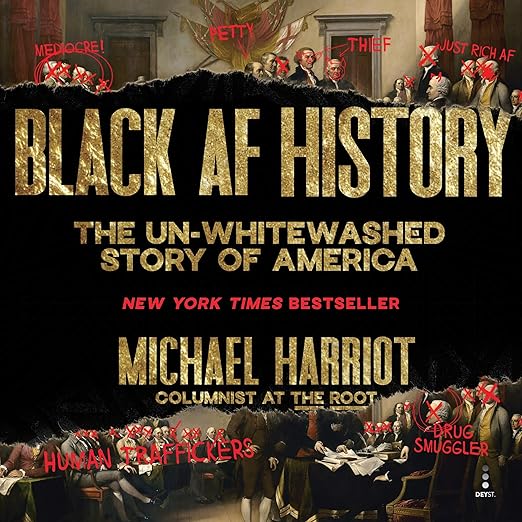
Sarcasm does not survive a neutral reading, which is the first thing worth knowing about this audiobook: the columnist who wrote it also reads it. Michael Harriot's retelling of American history runs fifteen hours and forty-two minutes, and its whole method depends on tone. Take the deadpan out of a sentence about slaves who supposedly teleported themselves across an ocean with nothing but strong backs and spirituals, and the sentence stops working entirely. Dey Street Books published it in September 2023, with a supplemental document included alongside the audio.
Cherry Tree Mythology Meets the Primary Sources
Premise first, because it is stated bluntly and the book never softens it. America's backstory, the description argues, is a whitewashed mythology installed in collective memory: pilgrims on the Mayflower, George Washington's cherry tree, Abraham Lincoln's log cabin, a sugarcoated legend based on an almost true story. Harriot's answer is not to complain about the omissions but to rebuild the account from primary sources and from the work of Black historians, scholars and journalists who were doing this long before it became publishable at this scale.
Reactions in the response column are unanimous in kind if not in wording. Writing in January 2026 at five stars, one reader calls it a phenomenal and wildly entertaining reckoning, credits Harriot with combining deep historical research and a genuinely funny voice, and reports being educated, enraged, inspired and made to laugh out loud in roughly that order. That entry closes by calling the book an instant classic. Its sequence of verbs is the most accurate account of the reading experience anyone here manages, because the book really does move between those states inside a single chapter.
Structurally it works by specificity. Rather than argue in the abstract that the record is distorted, the book goes after individual episodes: African Americans present on the continent before 1619, and the unenslavable bandit whose existence prompted what became America's first police force. Both of those are stories with names in them, which is why the material holds across a long runtime.
Why the Book Needed Harriot's Own Narration
Authorship and performance collapsing into one person is not a gimmick on a book like this. Comic timing in prose is a set of instructions the reader has to reconstruct: where the pause falls, which word carries the weight, when a sentence is being said straight and when it is being said with an eyebrow raised. A hired narrator makes those calls by interpretation. Harriot makes them as the person who put them there. Whatever you think of the result, it is not a translation of the text into speech, it is the text arriving in its intended register for the first time.
Evidence that the prose wants a voice comes from an unexpected direction. One reader, at five stars, describes finishing the book in a week and then immediately starting it over, out loud, to a fourteen-year-old. That is not a normal thing to do with a history book. It happens when the sentences have a rhythm that improves when spoken, and it makes the most persuasive case for the recording anywhere here, coming from somebody who was not thinking about recordings at all.
Fifteen hours and forty-two minutes gives the argument room to accumulate, which matters more than usual here. A corrective history has to establish a pattern before any single correction lands as more than a quibble. By the second half, the reader has been shown enough individual distortions that the general claim about who wrote the textbooks stops feeling like rhetoric. The included document is worth opening as well, since a book built this heavily on primary sources leaves a trail a listener will otherwise lose.
Praise That Keeps Reaching for a Bookshelf
Confrontation is the register, and it is deliberate rather than incidental. The appraisal that credits a gifted, in-your-face writer with an easy-going style puts it best, noting how much work that combination does on a topic that could have collapsed into grievance. That same entry misspells the byline twice, adding a letter to Harriot's surname, which is a small thing except for where it turns up. Readers who want their history delivered evenhandedly, with the tone held flat, will find the voice here consistently uncomfortable, and that discomfort is the point rather than a side effect.
Written responses also describe a physical object with striking consistency. One of them arrived on a friend's recommendation and files the book among the best reads on a bookshelf. Shelves, margins and reading aloud: three of the five reach for the vocabulary of a printed edition rather than of a recording, which is worth knowing before you weigh a star average against fifteen hours of audio.
Length is the last practical caution, and sampling will not settle it either way. The comic voice is established early and sustained, and listeners who find it grating in the first hour will find it grating in the fourteenth, since Harriot never modulates into a conventional textbook register to give anyone a rest.
Argued History for Readers Ready to Be Provoked
Anyone who wants American history argued rather than summarized should start here, particularly if being provoked appeals more than being reassured. Readers who already suspect the version they were taught was edited will find specific evidence rather than a general complaint. Nonfiction that is funny without being frivolous is the third draw, and the jokes are load-bearing: they carry material that would be close to unbearable delivered straight.
Neutral survey is the wrong expectation here, as is a chronological reference you can consult by chapter. Profanity, ridicule of national figures and a sustained tone of contempt for the received account run through the whole of it, and anyone who would be blocked by those will miss research that is genuinely substantial and worth having. Sharing it with a younger listener needs care as well, because the language has not been adjusted for anybody.
Before You Listen
Does the audiobook include the supplemental PDF?
Yes. The listing states that a supplemental enhancement document accompanies the audio. On a book built from primary sources and the work of earlier Black historians, that file is where the citations live, so download it before starting rather than trying to reconstruct references from memory.
How long is the Black AF History audiobook and does it work in short sessions?
Fifteen hours and forty-two minutes, arranged as discrete episodes rather than one continuous narrative. That structure suits a commute or a chore session well, since individual stories resolve within a sitting. The cumulative argument does build, so complete skipping around is less rewarding.