
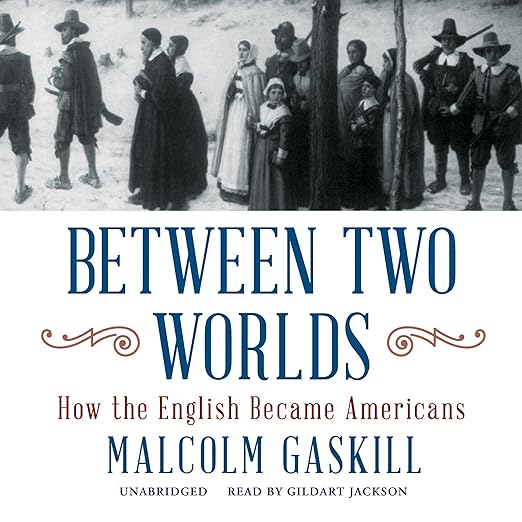
In Brief
- Read by: Gildart Jackson takes a university-press history solo for Blackstone, with no cast and no supporting production to lean on.
- At its heart: The unmaking of Englishness, settlement from Barbados to Canada, identity reshaped by conditions nobody chose
- Vibe: Patient, granular, argument-first
- Short version: A serious transatlantic history that repays the hours, provided you already know the outline it has come to complicate.
A decade of buyer responses sits under this audiobook, and one of the five on display grades the condition of a used library copy rather than a word Malcolm Gaskill wrote. That is the first thing worth knowing about the 4.2 attached to Between Two Worlds. The written record runs from February 2015 to July 2025, most of it was compiled by people holding a physical book, and it is arguing about a work of history that deserves a better summary than an average.
350,000 English Migrants Who Became Something New
Malcolm Gaskill's subject is a transformation rather than an event. More than 350,000 English men, women and children crossed to America across the seventeenth century, to Jamestown, to Salem, to Barbados, and nearly all of them went intending to rebuild the country they had just left. The book is about why that project failed and about what the failure made of them instead. Three generations later their descendants had become something the language did not yet have a word for.
Gaskill tracks the shift through pressure rather than through personalities. Harsh ground, sickness, infighting, and the frontier warfare the 2014 publisher copy still describes as bloody battles with Indians all work on the settlers until the thing they were trying to preserve simply stops being available to them. It is a slow argument built from accumulation, and it needs every hour it takes to become convincing rather than merely asserted.
Readers arriving for a colonial American story will notice fast that the center of gravity sits east of the Atlantic. Ronald J Denham's March 2015 verdict, graded four stars, gives the sharpest short account of what this actually is: not dates, not facts, not names, but people of varying station coping with a changed physical environment, with a cultural and political sense emerging after three generations that explains the road to revolution as directly as any reference to John Locke.
Jackson Alone for Twenty Hours of Accumulating Evidence
Twenty hours and thirty-five minutes is an unusual scale for a history with no protagonist, and the scale is doing argumentative work. Gaskill is describing a change too gradual for any single life to demonstrate, so the evidence has to pile up: patents and the men who bought them, sea crossings, property disputes, religious quarrels carried across the water intact. Compressed into a third of the running time this would be a thesis. At this length it becomes a demonstration.
Jackson carries all of it in one voice, which is the production reality of a 2014 Blackstone recording of a university-press history. No cast, no music, no dramatization, nothing to break a long paragraph into parts. That puts the whole burden of clause management on a single reader, and it makes sampling before buying more useful here than on almost any other kind of title, because tolerance for sustained historical argument gets decided inside the first chapter.
Geographic reach is the second argument for taking it on. Teri T. Zandi's May 2016 response, filed at the top grade, points out that most books on the period settle into New England or the Massachusetts Bay Colony alone, while this one moves through the Caribbean, Virginia, the Carolinas and up into Canada, and gives real space to the propaganda wars running alongside the settlement. That breadth is genuinely uncommon on the early America shelf.
An England-Heavy Method Behind a Misleading Average
Three stars is the lowest grade on the listing and easily the most useful. That response identifies Gaskill as a specialist in English history who writes more about events in England than about the English colonies in North America, warns that anybody wanting detail on the earliest colonists will be a little disappointed, and reports getting only as far as the first hundred before giving up. For the interested layman, it concludes, this is a difficult read.
None of that is wrong, and it is worth separating from a complaint about quality. The method requires England in the frame at all times, because you cannot show somebody ceasing to be English without showing what they kept measuring themselves against. A listener who wants Salem and Jamestown in the foreground will nonetheless spend a great many hours in seventeenth-century England, and no amount of goodwill toward the thesis makes those stretches shorter.
Averages conceal their ingredients, and this one conceals a great deal. A 4.2 across eighty-three ratings covers eleven years of buyers, most of them reading rather than listening, and the visible sample includes a five-star verdict from Carrie in July 2025 that praises a secondhand library copy for arriving in excellent condition and says nothing whatever about the contents. Grades like that count toward the number and describe none of the experience.
Atlantic World Readers Are the Right Audience
Atlantic world readers who already own the standard colonial narratives are the right buyers for this. The February 2015 verdict from J. House, graded five stars, calls it full of astonishing information about the settlement of the colonies in the West Indies as well as the northern and southern coasts, and picks out the men who bought the patents, the men who ruled them, the sea journeys, the religious conflicts and the battles over property. That inventory is a fair preview of the texture.
Newcomers to the period should start somewhere narrower and come back. The book assumes you roughly know what happened and want to understand what it did to the people it happened to, so the reward for twenty hours is conceptual rather than narrative. Anybody who needs momentum, named protagonists and a clear forward line will find the accumulation punishing instead of persuasive, and will blame the recording for something the design chose deliberately.
This recording dates from 2014, and the description still carries the vocabulary of that moment, which explains some of the friction a buyer will feel and none of the value underneath it. What Gaskill is doing, showing an identity dissolving under conditions nobody chose and a new one assembling in its place without permission, remains the most interesting question anybody asks about early America. The length is simply what an honest answer to it costs.
Before You Listen
Is the audiobook a sensible format for a history this long and this argumentative?
It depends entirely on how you listen. The organization is thematic rather than chronological, so a distracted session loses the thread in a way a printed page forgives. Listeners who replay a chapter without resentment will do well here. Anybody who treats audio as background will find the argument sliding past unnoticed.
Is the audiobook worth starting with only a casual interest in the colonial period?
Probably not as a first purchase. The reward is conceptual, the pacing is deliberate, and the payoff comes from watching a slow change register across generations. Casual curiosity is better served by something narrower and more character-driven, with this kept in reserve for when the outline starts feeling too tidy.







