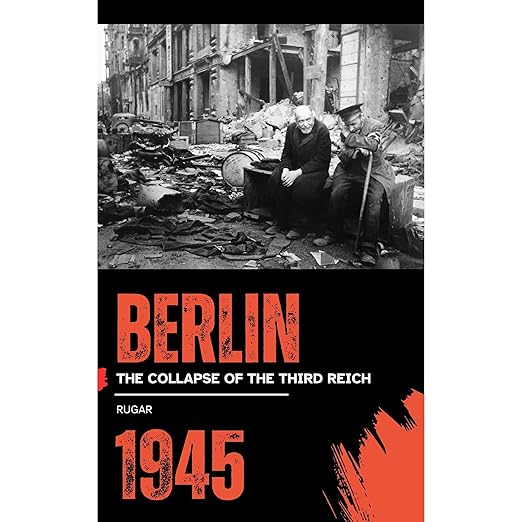
Red Army columns advancing through frozen mud along the Oder, Nazi officers delivering confident briefings to a leadership that had already severed itself from operational reality: Ruben Garcia's audiobook places you inside the final collapse of the Third Reich with the clarity and weight that only narrative history written at close range can achieve. I listened to a significant portion of this thirty-hour production over several sessions, and what stayed with me most was the book's insistence on giving texture to the people caught in the machinery of defeat, not just the commanders making decisions in the bunker, but the women of Berlin, the refugee columns, the Soviet soldiers who had marched from Stalingrad, the political prisoners who survived by luck of timing.
Garcia structures the narrative to move between the Eastern Front's winter collapse and Berlin itself, threading strategic analysis through civilian and soldier testimony. The result is a book that reads as both operational history and human document. The military details are handled with precision: the Oder bridgeheads, the Soviet artillery concentrations, the Wehrmacht's increasingly fictional order of battle, and the grotesque gap between Hitler's map-table orders and the actual state of his armies. But Garcia is equally attentive to what collapse looked like at street level.
The Nazi leadership's psychology in the final months receives extended treatment. The delusional quality of the bunker's final weeks, with Hitler expecting relief armies that no longer existed and Goebbels writing diary entries calibrated for a posterity that would vindicate the regime, is rendered with the dispassion that serious history requires and the implicit moral weight that serious history also demands. Garcia does not editorialize heavily. He does not need to. The documents and decisions speak clearly enough.
A Dutch-language reviewer provided a notably critical note, observing that the book covers the Reich's final weeks more than Berlin itself, and that the title slightly overpromises on city-specific focus. That is a fair calibration. Listeners coming for a street-level history of Berlin's physical destruction and civilian experience will find that material present but not dominant. What dominates is the political and military implosion, the decisions made and not made, the chain of command dissolving under the weight of an ideology eating itself from inside.
Virtual Voice Struggles With Human Testimony
The audiobook is a Virtual Voice production, which for a thirty-hour historical narrative is a meaningful consideration. The synthetic delivery handles expository military history competently. Dense passages of troop movements, command decisions, and strategic analysis are rendered clearly and at a consistent pace. Where the narration is most noticeably limited is in the human testimony sections, where survivor accounts or reconstructed dialogue appear. A human narrator would shift register, adjust pacing, mark the emotional difference between a staff briefing and a refugee's memory. The Virtual Voice does not make those distinctions automatically.
Garcia's research is evidently thorough. The range of sources he synthesizes, German military records, Soviet operational accounts, civilian diaries, postwar testimony from survivors across multiple nationalities, gives the book a multi-perspective depth that distinguishes it from older Western-centric accounts of the battle. The Soviet experience is given genuine attention rather than being reduced to a background force. The scale of what the Red Army had already endured by the time it reached Berlin, and what that accumulated weight meant for behavior during the final assault, is handled with historical honesty.
An American reviewer noted having a personal connection to the material through a father who was a prisoner of war force-marched from Poland, and found the book so affecting that he had to stop partway through. That kind of reader response is its own testimony to the book's capacity to make historical suffering feel real. Garcia writes the human material with enough specificity that the suffering it describes does not become statistical abstraction.
Comprehensive Rather Than Repetitive Across Thirty Hours
The thirty-hour runtime is the most significant practical consideration for this audiobook. At that length, it demands sustained engagement across many sessions. For listeners who approach long-form narrative history as a long-term companion rather than a quick listen, that is not a problem. For listeners who prefer their nonfiction audio in sharper, more concentrated doses, the scope may feel sprawling. Garcia's narrative is not repetitive, but it is comprehensive in a way that reflects the complexity of the subject.
The book's moral register is worth noting as well. Garcia takes seriously the ideological dimension of the Nazi regime's final weeks: the way fanaticism served institutional inertia, the way propaganda made rational decision-making impossible at exactly the moment when rational decisions might have reduced the scale of the catastrophe. The book does not moralize in a reductive way, but it does not pretend that what it is describing was politically or morally ambiguous. For listeners who want history that engages with why events mattered as well as what happened, this is a strength.
The Dutch reviewer's calibration about the title's focus is worth repeating. The book is a history of the Third Reich's collapse that culminates in Berlin rather than a street-level history of the city itself. Listeners who want specific coverage of particular Berlin neighborhoods, buildings, or civilian communities may find the urban detail less granular than the title implies.
Best for Listeners Serious About the Eastern Front
Listeners with a serious interest in World War II's European theater, particularly the Eastern Front's final phase, will find this audiobook substantive and extensively researched. The combination of military analysis and human testimony suits readers who want both the strategy and the experience. The thirty-hour commitment is appropriate for the subject's scope.
Approach cautiously if you are sensitive to accounts of extreme violence, displacement, and atrocity. Garcia does not sensationalize, but the material is genuinely harrowing in places. The Dutch-language reviewer found it well-written but deeply depressing, which is an accurate characterization. This is not casual listening. It is serious history about one of the most catastrophic events of the twentieth century.
Key Details
- Big ideas: Military collapse and ideology, civilian survival under bombardment, the psychology of fanaticism in defeat
- Atmosphere: Weighty and unflinching, comprehensive rather than sensationalized
- Worth it?: A rigorous narrative history of Berlin's fall with genuine multi-perspective depth; Virtual Voice narration is adequate but limits the emotional range of the human testimony sections.
Questions Listeners Ask
How does this audiobook handle the Soviet perspective on the battle?
Garcia gives genuine attention to the Red Army's experience, including the accumulated weight of the Eastern Front that Soviet soldiers brought to the final assault. This multi-perspective approach distinguishes the book from older Western-centric accounts and gives the Soviet advance historical grounding rather than treating it as a background force.
How does the Virtual Voice narration affect the experience of a thirty-hour history audiobook?
For expository military history and strategic analysis, the synthetic narration is functional and clear. The limitation shows most in the human testimony passages, where a human narrator would modulate pacing and register to mark emotional significance. Listeners who prioritize voice performance should factor this in; listeners who primarily want access to Garcia's research and narrative will find the delivery adequate.