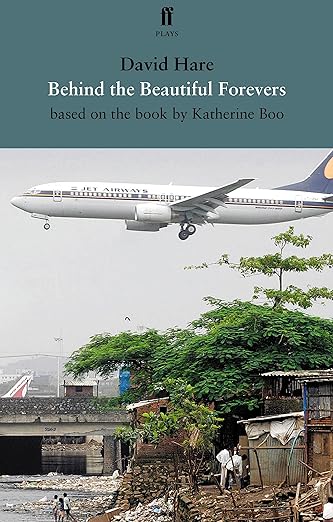
Annawadi is the makeshift settlement under the Mumbai airport flight path where Katherine Boo spent three years, and it is the subject of two different books. This audiobook record cannot decide which one it is selling. The byline says Katherine Boo. The description gives its last two paragraphs to David Hare's stage adaptation, which premiered at the National Theatre in London in November 2014, and the fields carry a 162-page count, a thirteen-digit ISBN and Faber & Faber as publisher, which is the shape of a published playscript. Against all of that sit a runtime of eight hours and sixteen minutes and a reader credit for Sunil Malhotra. All four written responses are about the play.
Malhotra Alone Against Two Very Different Texts
Hare's name appears nowhere in the author field, and that is the first practical consequence. Anyone searching for the adaptation under its adapter will never reach this page, and anyone arriving for Boo's reported nonfiction may be handed a script written for actors. The description does not conceal the difference, it simply presents both in sequence, opening with the settlement's cast of characters and closing on a theatrical premiere. The National Book Award for Non-Fiction in 2012, mentioned in that same paragraph, belongs to Boo's original rather than to the adaptation. Nothing on this page states which text the eight hours contain, and guessing on your behalf would be worse than saying so plainly.
Malhotra is the only performer this record names, and the two candidate texts would make entirely different demands. Boo's book is reported nonfiction held together by an authorial voice, moving between Abdul sorting garbage, Manju teaching, Asha working every angle available, and the police and courts around them. A stage adaptation is dialogue: many speaking parts, cues, scene changes, all of it to be distinguished by one reader with no cast to help. The first is a standard single-voice assignment. The second is among the hardest in the medium. A listener who cares about that distinction has to settle which text is on the file before paying, and the page will not settle it.
Six Annawadi Lives, Three Years of Reporting
Zehrunisa, Abdul, Sunil, Manju, Asha and Fatima are the people the description introduces, and they are why either version deserves your time. A garbage-sorting teenager and a mother running a household as a business; a twelve-year-old picking plastic; a schoolteacher aiming to become the settlement's first woman graduate; a fixer exploiting every scam available in order to become, in the copy's phrase, a first-class person; and a neighbor whose accusation is about to destroy her and shatter the place she lives in. That is a novel's worth of structure, and it came out of three years of reporting rather than invention.
Mumbai's boom is the frame, and the description's first line states the thesis in miniature: it is not just that rich people do not know what they have got, they do not even know what they throw away. Everything in Annawadi is built from what the luxury hotels discard, the local economy included. The three usable responses reach for similar words, mesmerizing from one five-star, excellent and very accessible from the other, and even the three-star surprised by the format calls it a vivid portrayal of the slum areas near the airport. Whichever text this file carries, the material is doing the heavy work, and it survived being cut down for a stage.
One Page, Two Products, and a Shared Rating
Faber and Faber sits in the publisher field, and every neighboring field agrees with it: 162 pages, an ISBN-13, and invisible formatting marks clinging to three fields no audio edition needs, the residue of a row copied out of a print catalog. The January 1, 2015 release date falls six weeks after the London premiere, which is when a script normally reaches print. All of those details point at one object. The runtime and the reader credit point somewhere else entirely. Two products are sharing a single page, and the average of 3.8 across 13 grades is being applied to both at once.
Format surprise is the specific risk here, and one three-star already lived through it: I had not expected it to be written in play format. That response still found the story vivid, but the disappointment is what it opens with, and it came from somebody holding a printed book with the format visible on the cover. A listener gets less warning, not more. Both five-stars are explicitly about the play, one from a reader who says outright that the original book remains unread. The fourth response, the shortest on the page, records a purchase made for a spouse and nothing more, so the column holds three opinions rather than four.
Verify Which Text These Eight Hours Hold
Theatergoers who missed the National Theatre run, students working on either text, and readers who want Boo's reporting in a portable form are the three audiences here, and they want three different files. The material rewards all of them. The account is unsparing without being hopeless, and the copy's summary of how the poor and disadvantaged negotiate with corruption to seek a handhold on capitalism's lowest rungs is an honest description of what you are in for. Anyone wanting a comfortable evening should look at something else, because this is a story that turns on an accusation destroying the person who makes it.
Verify before buying, in the most literal sense. Ask the seller, or listen to the sample, and establish which text these eight hours contain, because a play and the reported nonfiction behind it are not interchangeable purchases and this page presents both without choosing. If the play is what you want, the description confirms it exists and names who made it. If Boo's book is what you want, the byline agrees with you and nothing else on the record does. And if the story of Annawadi is the whole of it, either version delivers, which is the one comfortable thing to be said about a listing in this state.
Key Details
- Read by: Sunil Malhotra is the single credited reader, on a record that never settles whether the text is reportage or a stage script full of speaking parts.
- At its heart: Poverty as an economy, corruption negotiated daily, an accusation that shatters a settlement.
- Vibe: Unsparing and vivid, with no comfort offered.
- Short version: Extraordinary material on a record that cannot tell you which text you are buying.
Good to Know
How is this audiobook shelved, and does that help a buyer?
Its two category entries are history and politics and social sciences, with an Asia tag. Nothing marks it as drama or as an adaptation, so a browser looking for stage writing will miss it entirely, while one expecting narrative nonfiction gets no warning at all.
Do I need any background on Mumbai to follow this audiobook?
None. The description establishes the geography in two sentences, luxury hotels ringing the airport and a makeshift slum behind them, and introduces each person by their trade: garbage sorter, plastic picker, schoolteacher, fixer. The economics explain themselves as the story moves.