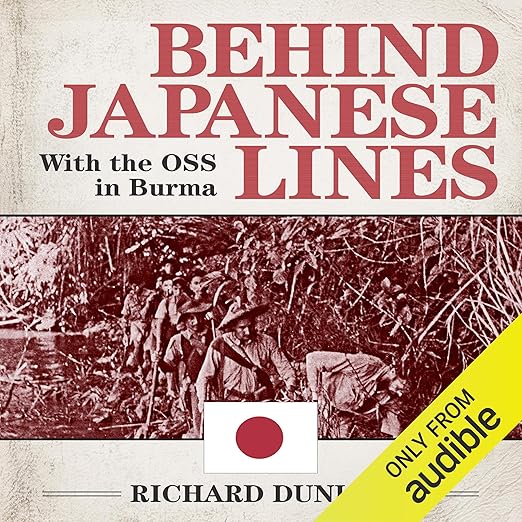
One review of this audiobook builds toward a specific, vivid anecdote, two OSS officers shooting cigarettes off each other's heads with a Model 1911 .45 pistol, and then cuts off mid-sentence right as it is about to say whether the story holds up.
Baker Narrates While Five Reviews Focus Elsewhere
Richard Dunlop served as a member of OSS Detachment 101, and Behind Japanese Lines, originally published in 1979, tells the story from the inside: General William "Wild Bill" Donovan, described in the synopsis as the Father of Central Intelligence, forming the unit in early 1942 to prepare for reopening the Burma Road by running guerrilla operations behind Japanese lines. The men of Detachment 101 fought alongside the Kachin headhunters for close to three years, against, per the synopsis, both a determined enemy and the jungle itself, tropical disease, leeches, cobras, tigers. Dunlop draws on personal experience in the unit along with interviews with surviving members and classified documents, and the synopsis promises cinematic intensity in how the danger and secrecy of the campaign get rendered.
Baker narrates, the sole credited voice, and as with several history titles in this catalog, none of the five reviews discusses the reading itself.
Audible Studios released this recording in February 2014, thirty-five years after the book's original 1979 publication, which puts real distance between when Dunlop first wrote the account and when it reached this audio format. That gap has not dulled the enthusiasm on the review page, three of the five reviews land at five stars, and even the most critical one, James Kreinhop's three-star write-up, still calls the firsthand sections excellent.
Built From Many Voices, Not One Memoir
Sonia's five-star review is unqualified: fantastic, enthralling, could not put it down, riveting dialogue and an incredible display of courage. Dabo's review, from a reader who has covered WWII widely but mostly in Europe, the Pacific, and Africa, describes the Burma campaign as largely a blank spot going in, and comes away most surprised by how much the OSS actually accomplished there, praising the book's detail on both military strategy and its grounding in documents and interviews. Sandy's review carries a personal weight the others do not: a father served with OSS Detachment 101 as a radio communications specialist, spoke fluent Burmese, and trained with the OSS before deploying, connecting Dunlop's account directly to family history rather than abstract interest in the period.
Toe Tag's four-star review adds useful framing: this is not one person's memoir so much as a first-person account built from the collected experiences of the whole OSS operation in the region, covering China, Burma, and India together rather than treating them as separate theaters. That same review calls out specific details that stuck with it, unfamiliar terrain, unusual geologic features, local headhunters, indigenous tribes, tigers, the kind of texture that turns a strategic overview into something closer to a felt experience of the jungle itself.
Kreinhop Trusts the Firsthand Sections, Not the Anecdotes
The one real reservation among these five reviews comes from James Kreinhop, whose three-star write-up is specific: it states the author went overboard with some of the stories from Detachment 101's early days, particularly ones involving a figure named Eifler, including the cigarette-shooting anecdote the review builds toward before cutting off mid-sentence. The review is careful to separate that skepticism from the sections describing what Dunlop personally witnessed and took part in, called excellent there, so the critique is narrower than it might first appear, aimed at secondhand war stories rather than the author's own firsthand material.
A single rated vote sits behind the 4.4 shown on the badge, a figure that math simply will not produce from one whole star, while five full reviews remain visible just beneath it, so lean on the reviews rather than the number.
At thirteen hours and thirty-five minutes, this covers a genuinely obscure corner of WWII history in real depth, useful to know if the goal is a shorter overview rather than a sustained, interview-driven account. Sandy's review adds one more layer of context worth flagging: the account includes a detail about training with OSS radio equipment specifically before deployment, a level of procedural specificity that matches the book's own emphasis on how the operation was actually run day to day, not just what it accomplished strategically.
Family Ties to the OSS Make This Personal
Readers of WWII history looking specifically for the Burma-China-India theater, an area Dabo's review and others here note gets far less attention than Europe or the Pacific, and anyone drawn to firsthand accounts built from a participant's own experience and interviews will find what this set of reviews describes. Sandy's review makes it a natural pick too for anyone with family history tied to the OSS or the Burma campaign specifically, since that kind of personal connection is exactly what pulled at least one reviewer here into the book in the first place, and it colors how that particular review reads compared to the others.
Pass on it if secondhand anecdotes about figures like Eifler need to be airtight; Kreinhop's review suggests at least some of them ask for a degree of trust the book does not fully earn on its own. It is also not the pick for a tight, single-battle account over a sustained campaign history spanning close to three years of jungle warfare, since Dunlop's account moves at the pace of a long guerrilla campaign rather than building toward one decisive engagement.
Common Questions
Is this Behind Japanese Lines audiobook written by someone who was actually there?
Yes. Richard Dunlop served as a member of OSS Detachment 101, and the synopsis notes the book draws on personal experience in the unit alongside interviews with surviving members and classified documents, which several reviewers cite as the source of its authenticity.
Why does one review of this audiobook cut off mid-sentence?
James Kreinhop's review builds toward a specific anecdote, two officers shooting cigarettes off each other's heads with a pistol, and breaks off before finishing the thought. It reads as a display issue with the listing rather than a deliberate choice by the reviewer.
Are all the anecdotes in this audiobook considered reliable by reviewers?
Not entirely, no. James Kreinhop's three-star review specifically flags some secondhand stories involving a figure named Eifler as hard to believe, while still praising the sections describing what Dunlop personally witnessed firsthand. Other reviewers do not raise the same concern anywhere.