Quick Take
- Voice: Rosemary Benson's precise and steady delivery suits the legal-historical material, maintaining clarity across twelve-plus hours without the account becoming dry or losing its human texture.
- Big ideas: Workplace gender discrimination, legal precedent, the incremental expansion of civil rights through individual litigation, and the personal costs borne by women who challenged systemic exclusion.
- Atmosphere: Measured and intellectually rigorous, with enough personal narrative threaded through to prevent the legal history from feeling abstract.
- Worth it?: A substantive legal history that earns its place alongside the best popular accounts of civil rights litigation in the American workplace.
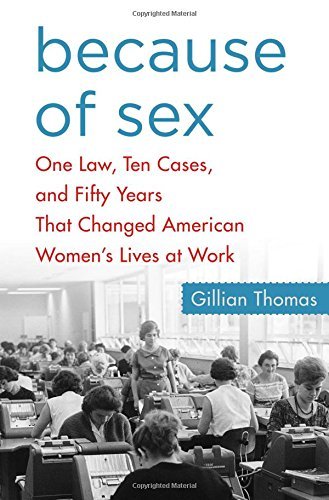
Who decides which jobs a woman is permitted to hold, and what legal mechanism finally forced that question into federal court? Because of Sex by Gillian Thomas answers through individual lives rather than legal abstractions, and Rosemary Benson's narration gives each woman's story the weight it deserves in this audiobook covering some of the most consequential workplace discrimination cases in American legal history.
Ida Phillips and the Clause That Mattered
The organizing principle here is the phrase 'because of sex' as it appears in Title VII of the 1964 Civil Rights Act. Thomas's argument is both historical and cumulative: that two-word clause carried enormous potential that went unrealized until ordinary women decided to test it in court, often at personal and professional cost that the law offered them no guarantee of recouping. The book profiles several of these women in sustained detail, and that choice to anchor the legal history in individual experience is what separates this from a standard administrative law survey.
Ida Phillips was denied an assembly line job because she had a preschool-age child. The hiring manager's logic was that the job required reliability, and mothers of young children were assumed not to provide it. Phillips challenged that assumption and her case eventually reached the Supreme Court, establishing a precedent that protected women from sex-specific employment criteria that had no grounding in genuine occupational necessity. Thomas traces Phillips's decision to fight with enough personal context to make you understand why she kept going when the institutional odds were explicitly stacked against her.
Kim Rawlinson fought to become a prison guard at a time when correctional institutions classified that position as inherently male. Mechelle Vinson brought a sexual harassment lawsuit before 'sexual harassment' existed as a legal category, before the phrase appeared in court documents or legal briefs. These are not abstract figures in a legal timeline. Thomas gives them biographical depth, and the effect is to make the legal developments feel like what they were: the product of specific decisions by specific people rather than the inevitable unfolding of a neutral jurisprudential process.
The chapter on Peggy Young is particularly relevant to readers engaging with the book in the present. Young was a UPS truck driver who asked for temporary reassignment from heavy lifting while pregnant. The company refused and forced her onto unpaid leave. Her case ultimately returned to the Supreme Court decades after Ida Phillips's, and the legal reasoning involved intersects with ongoing debates about pregnancy accommodation in ways that Thomas makes explicit without overreaching into commentary beyond the historical record.
Benson Narrates With Precision Across Twelve Hours
Rosemary Benson narrates with precision and appropriate gravity. The legal arguments require clarity without becoming arid, and Benson navigates the transitions between courtroom description and personal narrative with steady professionalism. At just over twelve hours, the audiobook rewards sustained listening over several sessions. The cases build on each other historically and legally, and the cumulative argument is clearer when you carry the earlier chapters forward rather than returning to the material in isolated fragments.
Thomas's background as a civil rights attorney informs the legal analysis without rendering it inaccessible to listeners without legal training. She explains procedural context where it matters and trusts her audience to follow the reasoning. The first-person accounts woven through the legal history are particularly effective. Hearing the women in their own words, even briefly, anchors the narrative in lived experience rather than pure documentation.
The book's strength is its specificity. Thomas does not try to tell the entire history of women's rights in the American workplace. She tells the story of Title VII and the cases that shaped it, which means the focus stays tight enough to give each case the depth it deserves rather than reducing everything to a footnote in a larger survey.
Clinical Precision Anchors a Narrowly Focused Title
The book is strongest as legal and social history and is deliberately focused on workplace discrimination specifically. Listeners looking for a broader feminist history of the same period will find Thomas stays close to the courthouse. The cases she covers are significant but selective; this is not a comprehensive account of every gender discrimination precedent, and Thomas is upfront about that framing. The emotional register is controlled throughout, which serves the material well but means the book does not deliver the narrative momentum of more dramatically inflected histories.
The title, borrowed directly from the statutory language, may catch some listeners off guard in its clinical precision. That precision is the point. Thomas is interested in how two words in a single clause of a massive piece of legislation became the lever that changed working conditions for millions of women. The legal focus never wavers, even when the personal stories are at their most compelling.
Echoes of Robert Caro's Legislative Histories
Readers interested in legal history, labor history, or the history of feminism in the American workplace will find this one of the more thorough nonfiction audiobooks in the field. It works well for book clubs with a policy or history focus, for listeners who enjoyed Robert Caro's legislative histories or Linda Hirshman's work on the Supreme Court, and for anyone who has wondered how workplace harassment law came to exist as a distinct legal category with its own procedural requirements and evidentiary standards.
This is not a casual listen. The legal content requires sustained attention, and Benson's narration, while clear, does not smooth over the complexity. Listeners who come ready to follow the argument will find the audiobook rewards that engagement with the kind of substantive legal history that rarely receives this level of popular treatment outside of academic publishing.
Frequently Asked Questions
Do I need a legal background to follow this audiobook?
No. Thomas explains procedural context where it matters and writes for a general audience throughout. The legal reasoning is accessible to attentive listeners without law school training, though the material rewards sustained attention rather than casual background listening.
Is Because of Sex audiobook relevant to current workplace law or is it purely historical?
Both. The cases Thomas covers established precedents that remain active in current employment law. The chapter on Peggy Young's pregnancy accommodation dispute is particularly connected to ongoing debates. Thomas makes the contemporary relevance explicit without overstating it or drifting into advocacy.
How does this audiobook compare to other books about gender and the Supreme Court?
Thomas stays close to Title VII workplace discrimination specifically rather than covering the full range of gender-related Supreme Court litigation. Listeners who want a broader view might pair this with Linda Hirshman's work on the Court. As a focused account of employment discrimination precedent, it is among the most thorough available for a general listening audience.