Harrison's Formula Stays Intact for Volume Five
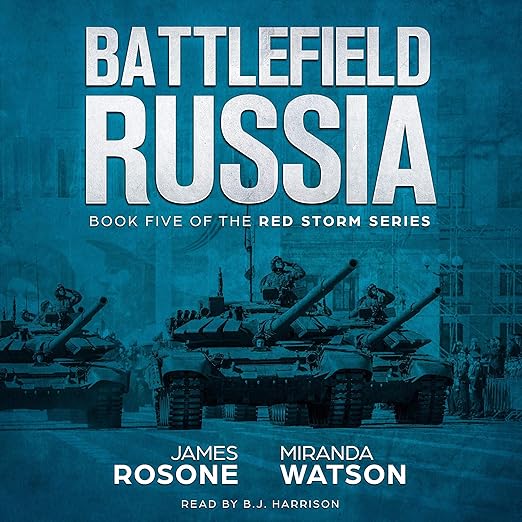
Military thriller audiobooks live and die by their pacing, and the Red Storm series has maintained enough forward momentum across five volumes to keep loyal readers committed. Battlefield Russia, the fifth installment by James Rosone and Miranda Watson, moves the geopolitical action to the Russian Far East as the Eastern Alliance regroups after Pacific losses. B.J. Harrison narrates, as he has throughout the series, and his facility with the combination of tactical ground-level combat and high-altitude geopolitical strategy has become a genuine production asset. Listeners who've followed the series from Battlefield Ukraine through Battlefield Pacific will find the formula intact and the execution solid across twelve-plus hours.
The series has always operated on dual registers: the tactical, involving specific units, weapons systems, and engagements with named characters on both sides; and the strategic, concerning political will, economic mobilization, and alliance formation. What makes this fifth volume slightly different from its predecessors is the domestic American dimension. After a series of 'tragic events in America,' the question of national cohesion under wartime conditions becomes a more prominent subplot. Whether the country comes together or fractures under the pressure of a fully mobilized war economy is a genuine dramatic question, and it gives Battlefield Russia a domestic political texture the earlier volumes spent less time developing.
Tom Clancy's Procedural Realism at Sea and Land
The series has built its audience on a specific kind of military realism: not the psychologically interior realism of novels like The Yellow Birds or Matterhorn, but the systems-and-strategy realism of Tom Clancy at his procedural best. Rosone and Watson have done their research, and that diligence shows in how they handle multi-front operations, logistics chains, and the interaction between land, sea, and air components across geographies. Reviewer B.G. Willis notes that 'the battle scene descriptions are realistic and hold your attention,' while reviewer Robert Lawhead praises the way the books 'combine both tactical and strategic narratives in a realistic manner.' Both assessments reflect what the series consistently delivers.
With India and Indonesia joining the Eastern Alliance in this volume, the geopolitical map expands again, which is both an opportunity and a risk. New alliance members mean new strategic dynamics and new potential flashpoints, which keeps the conflict from feeling static after five books. The democracies-versus-dictatorships framing that structures the series continues to operate, and the economic dimension, the US war economy being fully retooled but potentially outmatched by alliance scale, gives the tension some genuine strategic substance beyond individual battlefield outcomes. The question of whether industrial capacity alone can decide a modern great-power conflict is the kind of question that keeps the series interesting between its action sequences.
B.J. Harrison's narration has become effectively inseparable from the series at this point. His ability to move between the perspective of ground-level soldiers and high-command strategic briefings without losing register coherence is a specific and valuable skill, and it makes the dual narrative structure easier to follow across twelve hours of audio than it might be on the page. Reviewer Gramps, who has read all five books, describes the series as 'entertaining enough to keep my interest and read for extended periods of time, about a book a week,' which is a reliable measure of Harrison's contribution to that pace.
Series Fatigue, Grammatical Errors, and Real Momentum
Reviewer Robert Lawhead flags what he calls 'series fatigue' entering this volume, and that's an honest observation worth taking seriously. By book five of a military thriller series with consistent formula and expanding cast, listeners who haven't been fully gripped by the preceding volumes are unlikely to find themselves converted here. The book rewards investment in the established characters and ongoing strategic situation rather than offering a self-contained experience. The recommendation in the synopsis to listen in correct order is not a formality; the series' dramatic weight depends entirely on accumulated context.
The same reviewer acknowledges 'some grammatical errors' and notes that 'if you wish to be nit picky, some historical inaccuracies can be found,' which reflects the series' general positioning as entertainment-first military fiction rather than rigorous alternate history scholarship. Listeners who can tolerate occasional precision lapses in the name of sustained narrative energy will find these less disruptive than those for whom factual accuracy is a primary criterion. Reviewer B.G. Willis notes having 'already started book 6' immediately upon finishing, which is the clearest possible measure of series momentum.
The series' decision to include a domestic American dimension in this volume is worth more attention than it might initially seem. Military thrillers in the Clancy tradition have traditionally treated the home front as backdrop rather than subject, but Rosone and Watson's interest in whether American society holds together under sustained wartime pressure reflects a concern that feels more contemporary than their source material might suggest. Whether that concern reads as prescient commentary or as genre convention applied to familiar anxieties will depend on what the listener brings to the material, but B.J. Harrison's narration treats it with the same seriousness as the battlefield sequences.
New Listeners Should Not Start at Book Five
This audiobook belongs to listeners who have followed the Red Storm series from the beginning and want to see how the Eastern Alliance crisis plays out in the Russian theater. Fans of Clancy, Vince Flynn, or Brad Thor who enjoy broad geopolitical scope combined with ground-level combat detail will find the series formula satisfying. Harrison's narration makes the twelve-plus hour runtime feel propulsive rather than exhausting, and the domestic American subplot adds a dimension that veteran series readers will find a welcome expansion of the scope.
New listeners should not start here under any circumstances. The series needs to be experienced in order, and a cold entry at book five will leave you contextually adrift in a conflict whose emotional stakes depend on everything the prior four volumes established. This is a series entry, not a standalone, and its pleasures depend almost entirely on prior investment.
Quick Take
- Performance: B.J. Harrison has narrated the entire Red Storm series and his command of the tactical-to-strategic voice shift is now fully calibrated to the material.
- What it covers: Modern great-power warfare and coalition dynamics, national cohesion under wartime pressure, industrial capacity versus alliance scale
- Feel: Propulsive and systems-focused, geopolitically expansive with a new domestic American dimension
- Our call: A competent and satisfying fifth Red Storm entry that adds domestic American political texture to the established military action formula, built entirely for established series listeners.
Can I listen to Battlefield Russia without the earlier Red Storm audiobooks?
Not effectively. Book five assumes detailed knowledge of established characters, the ongoing strategic situation, and prior battlefield outcomes. The series strongly benefits from sequential listening starting with Battlefield Ukraine.
How historically accurate is this audiobook's depiction of Russian Far East military operations?
The series is military thriller fiction that prioritizes narrative plausibility over strict accuracy. Reviewer feedback acknowledges occasional factual looseness. It reads as researched entertainment rather than as alternate history scholarship.
What does the domestic American subplot add to this audiobook compared to earlier volumes?
It introduces questions about national cohesion and economic mobilization that haven't been as central in previous volumes. Whether a fully retooled war economy and a politically fractured domestic population can sustain the Allied war effort gives this entry meaningful new thematic texture.
At twelve-plus hours, is Battlefield Russia paced well enough to sustain attention?
B.J. Harrison's narration keeps the material propulsive across the runtime, and the dual tactical-strategic structure prevents any single mode from overstaying its welcome. Series fans consistently report sustained engagement, though Lawhead's 'series fatigue' note is honest for listeners who weren't already fully invested.